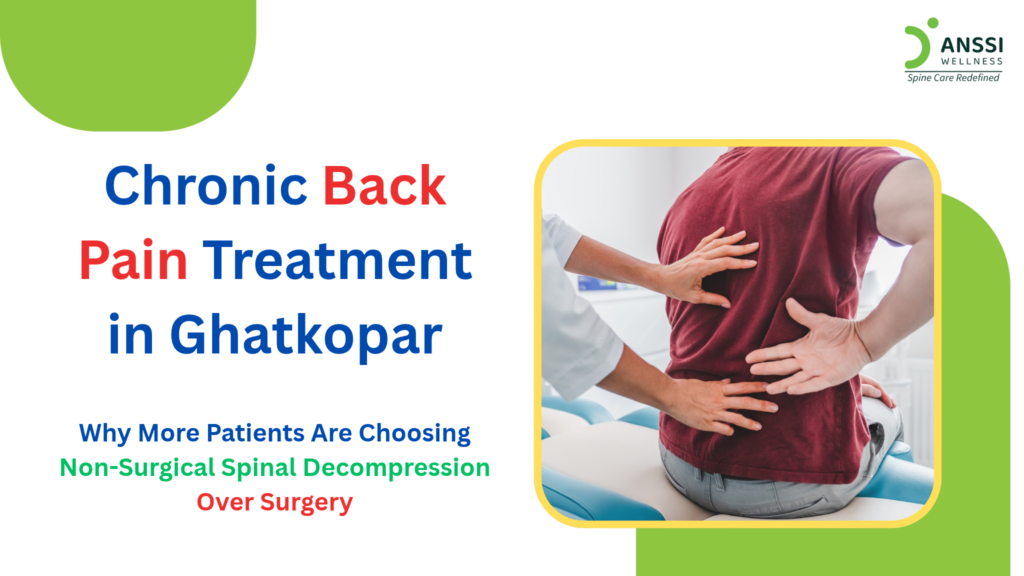
Chronic lower back pain can affect almost every aspect of your daily life, from sitting at work and travelling to performing routine household activities. For residents of Ghatkopar, Mumbai, managing persistent back pain can be particularly challenging because of long working hours, crowded public transport, and demanding daily commutes.
Conditions such as lumbar disc herniation, spinal stenosis, and degenerative disc disease can cause recurring pain, stiffness, and nerve-related symptoms. When medication and other conservative treatments do not provide sufficient relief, some patients may be advised to consider spinal surgery. However, concerns about surgical expenses, recovery time, and disruption to work often encourage patients to explore non-surgical alternatives.
One option that some patients can choose is Non-Surgical Spinal Decompression Treatment (NSSDT).
Why Patients With Chronic Back Pain Consider Surgery
Chronic lower back pain can have several underlying causes. Three common spinal conditions include:
- Lumbar Disc Herniation: When the soft inner material of an intervertebral disc protrudes through its outer layer, it may irritate nearby nerves and cause lower back pain, sciatica, tingling, or numbness.
- Spinal Stenosis: Narrowing of the spinal canal or nerve passageways can place pressure on spinal nerves, sometimes causing pain, numbness, or weakness in the legs, particularly while standing or walking.
- Degenerative Disc Disease: Age-related changes in spinal discs may contribute to reduced disc flexibility, back discomfort, and, in some cases, nerve irritation.
Depending on the diagnosis, severity, neurological findings, and response to conservative care, a doctor may recommend surgery. Procedures such as discectomy, laminectomy, or spinal fusion may be appropriate for specific conditions.
However, not every patient with a disc bulge, degeneration, or spinal stenosis requires an operation. Understanding the available treatment choices is essential before making a decision.
The Financial Challenges of Spinal Surgery
For many middle-income families in Ghatkopar, the financial implications of private hospital surgery are an important consideration.
The total expense may include more than the surgeon’s fees.
- Hospitalisation, diagnostic investigations, anaesthesia, medicines, medical equipment, rehabilitation, and follow-up consultations can add to the overall cost.
- Expenses vary considerably depending on the procedure, hospital, medical complexity, insurance coverage, and length of stay.
You may also need to consider income disruption during recovery. For employees, self-employed professionals, and people whose jobs involve physical activity, taking extended leave can create additional financial pressure.
This is one reason why patients often ask whether their condition can be managed without surgery.
Recovery and Daily Commuting: A Practical Concern for Ghatkopar Residents
Surgical recovery involves more than the procedure itself.
- Depending on the operation and the patient’s health, rehabilitation may take weeks or months.
- Returning to work, driving, lifting objects, and resuming regular activities must be planned according to medical advice.
For Ghatkopar residents who depend on local trains, buses, two-wheelers, or crowded roads for daily travel, post-operative restrictions can create practical difficulties. Long periods of sitting, standing, walking, or travelling may be uncomfortable during recovery.
Non-surgical treatment may offer a more manageable option for suitable patients because it generally does not require hospitalisation or a surgical recovery period. However;
- This does not mean that every patient can continue normal work and commuting without restrictions.
- The treatment schedule, activity recommendations, and expected progress depend on the individual’s condition.
Non-Surgical Spinal Decompression Treatment: Exploring a Non-Surgical Option
Non-Surgical Spinal Decompression Treatment (NSSDT) uses a specialised, computer-regulated decompression technology to apply controlled stretching forces to selected spinal segments.
- The approach is designed to reduce mechanical loading around the targeted spinal region and may help manage symptoms in some carefully selected patients with disc-related conditions.
- It may be combined with physiotherapy and supportive rehabilitation based on the patient’s assessment and treatment requirements.
A structured treatment programme may include:
- Clinical assessment of symptoms and medical history
- Review of relevant MRI or X-ray findings, where available and indicated
- A customised treatment plan based on the patient’s condition
- Computer-controlled spinal decompression sessions when appropriate
- Physiotherapy exercises to support mobility and muscular function
- Guidance on posture, daily activities, and movement habits
Surgery vs. Non-Surgical Treatment: How Should You Decide?
The decision should be based on medical suitability rather than cost or convenience alone.
Surgery may provide important benefits when there is a clear indication, such as significant nerve compression causing progressive neurological problems. It also carries potential risks, including infection, bleeding, anaesthesia-related complications, and recovery-related challenges.
Non-surgical management may be appropriate for patients whose symptoms and clinical findings allow conservative care. Options can include physiotherapy, prescribed medication, activity modification, and selected treatments such as NSSDT.
Before choosing, discuss the following with your doctor:
- What exactly is causing your back pain?
- Is surgery medically necessary at this stage?
- What are the risks of delaying or avoiding surgery?
- What results can realistically be expected from conservative treatment?
- What will the complete cost and recovery requirements be for each option?
Patients with severe or progressive weakness, spinal cord or cauda equina compression, significant instability, or other serious complications may require urgent specialist assessment and potentially surgery. Delaying necessary treatment to try an unsuitable alternative can be harmful.
About ANSSI:
ANSSI Wellness focuses on improving the quality of life for patients suffering from spinal issues, aiming to provide relief where other conventional treatments have failed. Through advanced Non-Surgical Spinal Decompression Treatment, ANSSI is committed to helping patients avoid surgery and recover in a safe, effective, and compassionate environment.
Book Consultation:
Call +91 9004726844 | 9920936844
Visit www.anssiwellness.com
Connect with ANSSI Wellness on LinkedIn, Instagram, and Facebook for expert guidance.