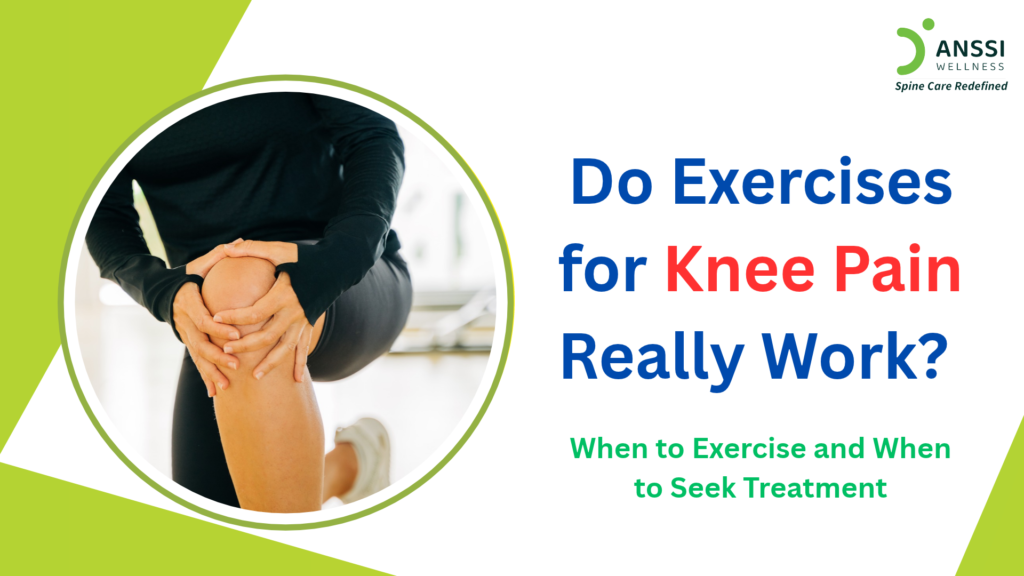
Knee pain is one of the most common musculoskeletal complaints in India. It affects people across all age groups, from young adults and working professionals to older adults managing age-related joint changes. It can interfere with walking, climbing stairs, sitting for extended periods, and a wide range of everyday activities that most people take for granted.
A question many patients ask is whether exercise can genuinely help, or whether it risks making things worse. The honest answer is: it depends on the cause.
For many cases of knee pain, appropriate low-impact exercise can meaningfully improve muscle strength, joint mobility, flexibility, and stability, reducing discomfort and supporting daily function. For others, exercise without professional assessment can delay treatment and worsen the underlying condition.
Understanding which category applies to your knee pain is the most important step before starting any exercise programme.
Exercises That May Help Relieve Knee Pain
For patients with mild to moderate knee pain from muscle weakness, early joint degeneration, or reduced joint mobility, and in the absence of acute swelling, instability, or suspected structural injury, the following gentle, low-impact exercises are commonly recommended as a starting point:
Quadriceps Sets
This activates the quadriceps without placing any compressive load through the knee joint, making it one of the safest initial exercises for most knee pain cases.
- Lie flat with the leg straight.
- Tighten the thigh muscle (quadriceps) by pressing the back of the knee gently downward.
- Hold for five seconds, then release.
Straight-Leg Raises
This strengthens the quadriceps and hip flexors without repeatedly bending the knee under load. It is appropriate for patients who find bending painful.
- With one leg straight and one knee bent, lie flat.
- Tighten the thigh of the straight leg and raise it to the height of the opposite knee.
- Hold briefly, then lower slowly.
Seated Knee Extensions
This exercises the quadriceps through a controlled range and can be adjusted to stay within a comfortable, pain-free range.
- With your feet flat on the ground, sit up straight in a chair.
- One leg should be gradually straightened until it is parallel to the floor.
- After two to three seconds of holding, gradually lower it.
Heel Slides
This ensures knee flexion and extension through a gentle, controlled range without loading the joint. It helps to preserve and enhance range of motion.
- Lie flat on your back.
- Bend the knee and slowly slide one heel toward the buttock.
- Then slowly slide it back to straight.
Stationary Cycling
When comfortable, stationary cycling provides low-impact repetitive knee movement that supports joint mobility. It also improves muscle activation around the knee and promotes synovial fluid circulation within the joint. Remember that the seat height should be adjusted so the knee does not fully flex at the bottom of the pedal stroke.
Safe Exercise Practices
Regardless of which exercise is chosen, several principles apply consistently:
- Start slowly with low repetitions and short duration, and progress gradually over days and weeks.
- Use controlled, deliberate movements; avoid jerking, bouncing, or rushing through any exercise.
- Stay within a pain-free or minimally uncomfortable range. Mild temporary muscle fatigue is acceptable; sharp, stabbing, or worsening joint pain is not.
- Stop immediately if radiating pain, sharp joint pain, increased swelling, or significant discomfort develops during or after exercise.
- Seek professional guidance before beginning any exercise programme if you have a diagnosed joint condition, a history of knee injury, or symptoms that have not been medically assessed.
Technique matters as much as the exercise itself. Poorly performed exercises, particularly those involving knee alignment, can place abnormal stress on the joint and surrounding structures, counteracting any potential benefit. For patients with diagnosed conditions including early osteoarthritis, meniscal pathology, or ligament involvement, a physiotherapist-guided programme tailored to individual findings is significantly more appropriate than a generic exercise list.
Warning Signs: When to Seek Medical Help
Exercise is not appropriate for all causes of knee pain. The following symptoms indicate that medical assessment is needed:
- Persistent or recurring swelling around the knee joint, particularly after activity
- Pain that is worsening over time rather than improving with gentle activity
- Knee locking; the joint feels stuck or cannot be straightened fully
- A sensation of instability or giving way during weight-bearing
- Difficulty bearing weight or significant reduction in walking distance
- Reduced range of motion that is not improving with gentle movement
Seek prompt medical assessment if the knee is hot, red, and severely swollen; particularly when accompanied by fever, rapid-onset severe pain, or inability to bear any weight. These cases require urgent evaluation to exclude joint infection (septic arthritis), significant structural injury, or other conditions that exercise would worsen and that require immediate medical management.
Similarly, knee pain that has persisted for more than four to six weeks without improvement, that is interfering progressively with your sleep or daily activities, or that is accompanied by instability or locking, warrants specialist orthopaedic assessment and imaging; not continued self-management with exercise alone.
Advanced Knee Rehabilitation Programme at ANSSI Wellness
When knee pain does not respond adequately to general exercise, or when a diagnosed condition such as early osteoarthritis requires a more structured approach, ANSSI Wellness’s Advanced Knee Rehabilitation Programme offers a comprehensive, non-surgical management solution for appropriately selected patients.
The programme combines specialist orthopaedic assessment, personalised physiotherapy, targeted strengthening and flexibility exercises, along with advanced knee decompression technology, which is a controlled, non-invasive approach designed to reduce joint loading, support knee function, and improve mobility without surgery.
Treatment suitability is determined only after clinical assessment and imaging review. The programme is not appropriate for all knee conditions. Advanced joint degeneration, significant structural injury, or cases requiring surgical evaluation are assessed individually and referred appropriately.
When to Seek Assessment at ANSSI Wellness
Consult an ANSSI Wellness specialist if:
- Knee pain has persisted beyond four to six weeks without structural diagnosis
- Exercise is not producing improvement or is worsening symptoms
- Swelling, instability, locking, or difficulty with stairs or walking is present
- You have received a diagnosis of early osteoarthritis and are looking for a non-surgical rehabilitation programme
About ANSSI:
ANSSI Wellness focuses on improving the quality of life for patients suffering from spinal issues, aiming to provide relief where other conventional treatments have failed. Through advanced Non-Surgical Spinal Decompression Treatment, ANSSI is committed to helping patients avoid surgery and recover in a safe, effective, and compassionate environment.
Book Consultation:
Call +91 9004726844 | 9920936844
Visit www.anssiwellness.com
Connect with ANSSI Wellness on LinkedIn, Instagram, and Facebook for expert guidance.
Clinical References:
- Fransen M, McConnell S, Harmer AR, Van der Esch M, Simic M, Bennell KL. Exercise for osteoarthritis of the knee: a Cochrane systematic review. British Journal of Sports Medicine. 2015;49(24):1554-1557.
- Skou ST, Roos EM, Laursen MB, et al. A randomised, controlled trial of total knee replacement. New England Journal of Medicine. 2015;373(17):1597-1606.
- Bannuru RR, Osani MC, Vaysbrot EE, et al. OARSI guidelines for the non-surgical management of knee, hip, and polyarticular osteoarthritis. Osteoarthritis and Cartilage. 2019;27(11):1578-1589.
- Carpenter CR, Schuur JD, Everett WW, Pines JM. Evidence-based diagnostics: adult septic arthritis. Academic Emergency Medicine. 2011;18(8):781-796.