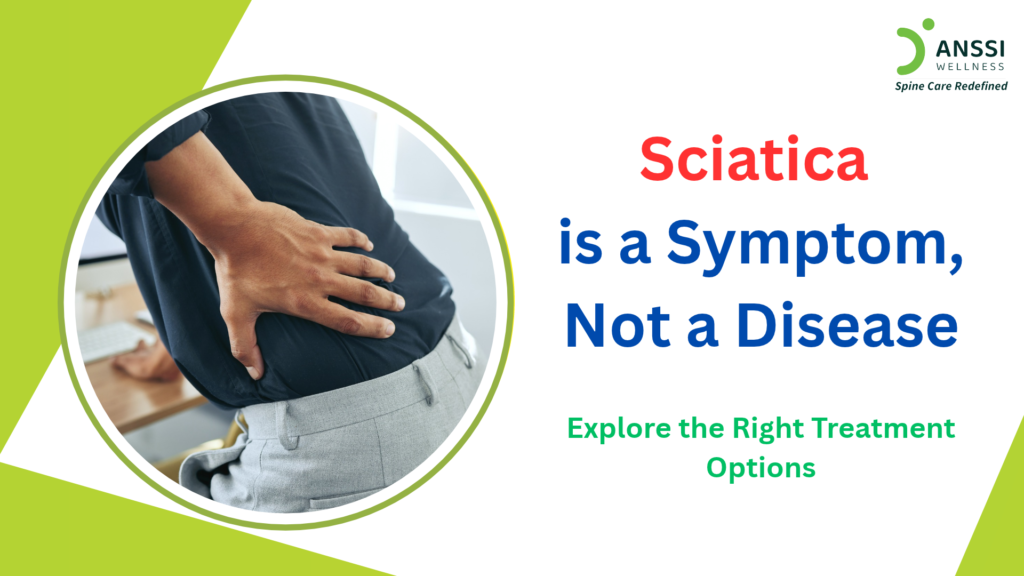
Many people say, “I have sciatica,” as though sciatica itself were a disease. In reality, sciatica describes a pattern of pain and other symptoms associated with irritation or pathology affecting the lumbosacral nerve roots. The underlying problem may be a disc herniation, spinal stenosis, degenerative changes, or another condition affecting the lower spine.
This distinction is important. If sciatica is treated simply as “leg pain,” the underlying spinal problem may remain unidentified. Understanding why the nerve is being irritated or compressed is an important part of determining appropriate treatment.
What Causes Sciatica?
One of the most common causes is a lumbar disc herniation or prolapse. The discs between the vertebrae act as cushions, but a damaged or displaced disc can sometimes irritate or compress a nearby nerve root. This can produce pain that travels from the lower back or buttock into the leg.
Other potential causes include:
- Lumbar spinal stenosis, where narrowing around the spinal nerves can contribute to symptoms.
- Degenerative changes in the spine that affect the spaces through which nerves travel.
- Spondylolisthesis, where one vertebra shifts relative to another.
- Other conditions capable of irritating or compressing lumbar nerve roots.
Importantly, not every disc bulge or degenerative change seen on an MRI causes symptoms. The imaging findings need to be considered alongside the patient’s symptoms and physical examination.
Which Habits and Actions Can Contribute to Sciatica?
Sciatica does not have one single lifestyle cause. However, certain activities and physical factors can place additional mechanical stress on the lower back.
Prolonged sitting can be problematic for people who spend many hours at a desk or behind the wheel, particularly when combined with limited movement. Repeated bending, twisting, awkward lifting techniques, sudden increases in physical activity, and physically demanding work may also place stress on the lumbar spine.
Inadequate physical conditioning can be another contributing factor. Weakness or poor endurance in the muscles supporting the trunk may make certain activities more difficult to tolerate.
However, these factors should not be presented as direct causes in every individual. A person can develop sciatica without having a single identifiable “bad habit,” and changing posture alone cannot eliminate every underlying spinal condition.
How Does Sciatica Feel?
The classic symptom is pain travelling from the lower back or buttock into one leg. Depending on the affected nerve root, the pain may extend into different areas of the thigh, calf, foot, or toes.
Other symptoms can include:
- Tingling or “pins and needles”
- Numbness
- Burning or electric shock-like pain
- Weakness in parts of the leg or foot
- Increased discomfort with certain movements, coughing, or straining
Not every person with leg pain has sciatica. Hip problems, peripheral nerve disorders, muscle conditions, and other medical issues can produce similar symptoms. That is why self-diagnosing every instance of radiating leg pain as sciatica can be misleading.
How is Sciatica Diagnosed?
Diagnosis generally starts with a detailed medical history and physical examination. A doctor may assess the distribution of pain, muscle strength, sensation, reflexes, spinal movement, and other neurological findings.
The objective is to determine whether the symptoms are consistent with nerve-root involvement and, if so, identify the likely source.
MRI is not automatically required for everyone with sciatica. Imaging is generally considered when the result is likely to change management or when there are concerning features. The findings also need to correspond with the patient’s symptoms and clinical examination rather than being interpreted in isolation.
Treating the Cause Instead of Only the Pain
Many cases of sciatica improve with conservative treatment. Depending on the individual’s condition, management may include remaining appropriately active, physiotherapy, targeted exercises, education, and medicines when clinically appropriate.
The aim is not simply to suppress pain but to help the person regain movement and function while addressing factors contributing to the symptoms.
For persistent symptoms, the treatment plan may need to be reassessed. If a specific structural problem is identified, management can be directed toward that condition.
Can Non-Surgical Spinal Decompression Help?
For selected patients, Non-Surgical Spinal Decompression Treatment (NSSDT) may be considered as part of a broader rehabilitation program.
NSSDT uses a computer-controlled treatment table and harness to apply a controlled decompression force to selected areas of the spine. The treatment is intended to reduce mechanical stress around the targeted spinal segments. It may be combined with physiotherapy, strengthening exercises, posture guidance, and activity modification.
However, Non-Surgical Spinal Decompression Treatment is not appropriate for every cause of sciatica and should not be presented as a guaranteed cure. It does not mean that every disc problem can be reversed or that surgery will always be avoided. Suitability should be determined after an appropriate clinical assessment.
When Should Sciatica Be Taken Seriously?
Most people with uncomplicated sciatica do not require emergency treatment, but certain symptoms require urgent medical assessment.
New problems with bladder or bowel control, numbness around the groin or saddle area, or rapidly worsening weakness can indicate serious nerve compression, including cauda equina syndrome. These symptoms require urgent evaluation.
About ANSSI:
ANSSI Wellness focuses on improving the quality of life for patients suffering from spinal issues, aiming to provide relief where other conventional treatments have failed. Through advanced Non-Surgical Spinal Decompression Treatment, ANSSI is committed to helping patients avoid surgery and recover in a safe, effective, and compassionate environment.
Book Consultation:
Call +91 9004726844 | 9920936844
Visit www.anssiwellness.com
Connect with ANSSI Wellness on LinkedIn, Instagram, and Facebook for expert guidance.
Clinical References:
- El Melhat AM, Youssef ASA, Zebdawi MR, Hafez MA, Khalil LH, Harrison DE. Non-Surgical Approaches to the Management of Lumbar Disc Herniation Associated with Radiculopathy: A Narrative Review. J Clin Med. 2024 Feb 8;13(4):974.
- Kreiner DS et al. North American Spine Society. An evidence-based clinical guideline for the diagnosis and treatment of lumbar disc herniation with radiculopathy. Spine J. 2014 Jan;14(1):180-91.
- Koes BW, van Tulder MW, Peul WC. Diagnosis and treatment of sciatica. BMJ. 2007;334(7607):1313-1317.
- Gose E., Ph.D, Naguszewski W., MD, Naguszewski R., MD. Vertebral Axial Decompression Therapy for Pain Associated with Herniated or Degenerated Discs or Facet Syndrome: An Outcome Study. Journal of Neurological Research, Volume 20, No 3, April 1998.
- Tilaro F., MD, Miskovich D. MD. The Effects of Vertebral Axial Decompression On Sensory Nerve Dysfunction In Patients with Low Back Pain and Radiculopathy. Canadian Journal of Clinical Medicine Vol. 6, No 1, January 1999.