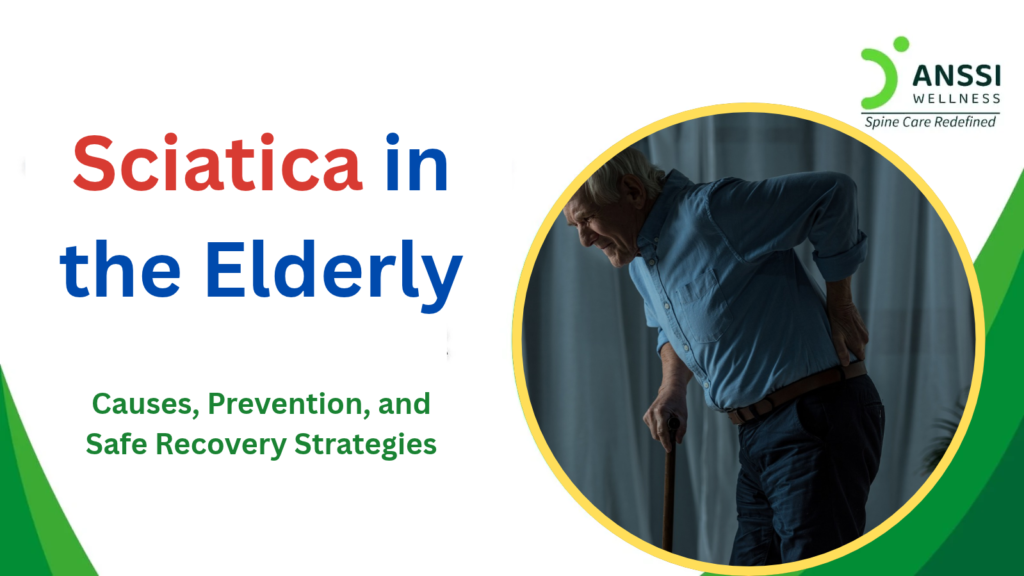
Sciatica can become particularly difficult to manage in older adults. The pain may begin in the lower back or buttock and travel down the leg, sometimes accompanied by tingling, numbness, or weakness. For an elderly person, these symptoms can affect much more than comfort. Difficulty walking, standing, sleeping, or performing everyday activities can gradually reduce independence and confidence.
Sciatica is not a disease by itself. It describes symptoms associated with irritation or compression of one or more of the nerves that form the sciatic nerve, usually because of a problem in the lower spine. Understanding the possible causes and adopting appropriate prevention and recovery strategies can help older adults protect their mobility and quality of life.
Why Are Older Adults More Likely to Experience Sciatica?
Age-related changes in the spine can increase the likelihood of nerve irritation. Over the years, the spinal discs may lose some of their flexibility and height, while joints and other spinal structures can undergo degenerative changes.
- A herniated or bulging disc can irritate a nerve root. Although disc herniation can occur at any age, degenerative changes in the spine may alter the way forces are distributed through the discs as a person gets older.
- One important cause is lumbar spinal stenosis, in which the spaces available for the spinal nerves become narrower. This can produce pain, numbness, or weakness in the buttocks and legs, particularly during standing or walking.
- Other possible contributors include degenerative disc disease, spondylolisthesis, spinal osteoarthritis, previous spinal injuries, and changes in spinal alignment.
- Muscle weakness, prolonged inactivity, poor posture, and physically demanding activities may further influence symptoms.
Importantly, not every leg pain experienced by an older adult is sciatica. Hip problems, peripheral nerve conditions, vascular disorders, and other health conditions can produce similar symptoms. Proper clinical evaluation is therefore important.
How Can Sciatica Affect Elderly Patients?
For an older adult, persistent sciatica can have consequences beyond pain.
- A person may begin avoiding walking because movement aggravates the symptoms. Over time, reduced activity can lead to muscle weakness and poorer physical conditioning.
- Pain, numbness, or weakness can also make stairs, bathing, shopping, household work, and prolonged standing more difficult. If balance is affected, the person may become increasingly concerned about falling.
- Sleep can also suffer when leg pain becomes worse at night or makes it difficult to find a comfortable position.
- These limitations can create a cycle in which pain leads to inactivity, inactivity contributes to deconditioning, and reduced physical capacity makes everyday movement increasingly difficult.
This is why early assessment and an appropriate recovery plan are important rather than simply accepting persistent nerve-related symptoms as an unavoidable consequence of ageing.
Can Sciatica Be Prevented?
It is not always possible to prevent sciatica because some causes are related to structural or age-related changes in the spine. However, maintaining spinal and overall physical health may help reduce certain risk factors.
- Regular, age-appropriate physical activity is one of the most useful strategies. Walking, gentle mobility exercises, and strengthening activities can help maintain muscle function and physical capacity. Exercises should be selected according to an individual’s health, mobility, and existing spinal conditions.
- Maintaining a healthy body weight can also reduce mechanical stress on the lower back.
- Older adults should avoid remaining in the same sitting position for prolonged periods and should take regular movement breaks.
- Good posture and safe lifting techniques are equally important. Heavy objects should not be lifted unnecessarily, and when lifting is required, the movement should be controlled rather than involving sudden twisting of the lower back.
- Managing existing spinal conditions and seeking medical advice when persistent back or leg symptoms develop can also help prevent a problem from being ignored until it significantly affects mobility.
Safe Non-Surgical Recovery Strategies
Many cases of sciatica can initially be managed without surgery, depending on the underlying cause and severity of symptoms.
- A treatment plan may include physiotherapy, mobility exercises, strengthening, posture and movement education, activity modification, and appropriate pain management.
- For elderly patients, rehabilitation should be gradual and individualised. Exercises that are suitable for one person may not be appropriate for another, particularly when there are problems involving balance, osteoporosis, joint disease, or other medical conditions.
Heat or cold therapy may also provide temporary symptom relief for some individuals when used appropriately.
Non-Surgical Spinal Decompression Treatment
Another option that may be considered for selected patients with disc-related or mechanical spinal problems is Non-Surgical Spinal Decompression Treatment (NSSDT). This approach uses a computer-regulated treatment table and controlled spinal decompression without an incision. The treatment is customised according to the patient’s diagnosis, symptoms, clinical assessment, and MRI reports when available.
The proposed goal of decompression is to reduce mechanical stress on the affected spinal segment and potentially reduce irritation associated with certain spinal conditions.
When Should an Elderly Patient Seek Urgent Medical Attention?
Some symptoms require prompt medical evaluation rather than routine conservative treatment. New or rapidly worsening leg weakness, significant difficulty walking, numbness around the saddle area, or new problems controlling the bladder or bowel can indicate serious nerve compression.
Older adults with persistent or progressively worsening symptoms should also seek professional evaluation rather than continuing self-treatment indefinitely. Identifying the underlying cause is essential because treatment for spinal stenosis, disc herniation, hip disease, and other conditions can differ considerably.
About ANSSI:
ANSSI Wellness focuses on improving the quality of life for patients suffering from spinal issues, aiming to provide relief where other conventional treatments have failed. Through advanced Non-Surgical Spinal Decompression Treatment, ANSSI is committed to helping patients avoid surgery and recover in a safe, effective, and compassionate environment.
Book Consultation:
Call +91 9004726844 | 9920936844
Visit www.anssiwellness.com
Connect with ANSSI Wellness on LinkedIn, Instagram, and Facebook for expert guidance.
Clinical References:
- Koes BW, van Tulder MW, Peul WC. Diagnosis and treatment of sciatica. BMJ. 2007;334(7607):1313-1317.
- Lurie J, Tomkins-Lane C. Management of lumbar spinal stenosis. BMJ. 2016;352:h6234.
- Gillespie LD, Robertson MC, Gillespie WJ, et al. Interventions for preventing falls in older people living in the community. Cochrane Database of Systematic Reviews. 2012;(9):CD007146.
- El Melhat AM, Youssef ASA, Zebdawi MR, Hafez MA, Khalil LH, Harrison DE. Non-Surgical Approaches to the Management of Lumbar Disc Herniation Associated with Radiculopathy: A Narrative Review. J Clin Med. 2024 Feb 8;13(4):974.
- Kreiner DS et al. North American Spine Society. An evidence-based clinical guideline for the diagnosis and treatment of lumbar disc herniation with radiculopathy. Spine J. 2014 Jan;14(1):180-91.
- Tilaro F., MD, Miskovich D. MD. The Effects of Vertebral Axial Decompression On Sensory Nerve Dysfunction In Patients with Low Back Pain and Radiculopathy. Canadian Journal of Clinical Medicine Vol. 6, No 1, January 1999.
- Gose E., Ph.D, Naguszewski W., MD, Naguszewski R., MD. Vertebral Axial Decompression Therapy for Pain Associated with Herniated or Degenerated Discs or Facet Syndrome: An Outcome Study. Journal of Neurological Research, Volume 20, No 3, April 1998.