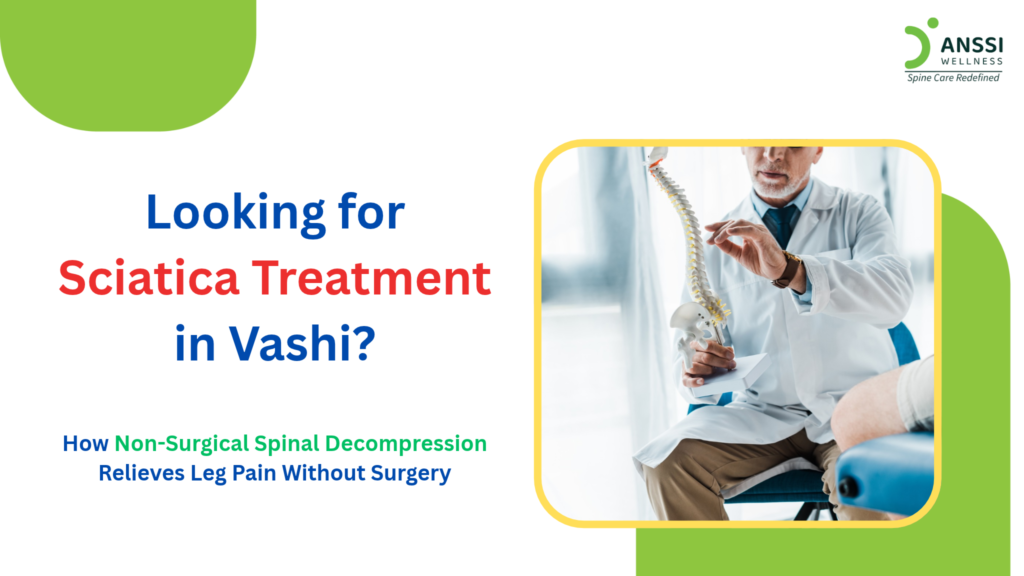
Shooting pain travelling from the lower back into the buttock and leg can make even simple activities such as walking, sitting, driving, or climbing stairs uncomfortable. This is a common experience for people suffering from sciatica. For residents of Vashi, Navi Mumbai, long working hours, daily commuting, and sedentary routines can make managing persistent back and leg pain particularly challenging.
Many patients initially depend on painkillers and anti-inflammatory medicines. However, when symptoms continue or repeatedly return, they begin searching for treatment options that address the underlying cause. Non-Surgical Spinal Decompression Treatment (NSSDT) is one approach that may be considered for selected patients with disc-related sciatica.
Understanding Sciatica and Its Causes
Sciatica is a group of symptoms caused by irritation or compression of a nerve root in the lower spine. The pain typically travels from the lower back through the buttock and down the back or side of the leg.
One possible cause is a lumbar disc bulge or herniation. Intervertebral discs act as cushions between the vertebrae. When disc material protrudes beyond its normal boundary, it may contribute to irritation or compression of a nearby nerve root.
The L4-L5 and L5-S1 spinal levels are commonly involved in disc-related sciatica.
Common symptoms include:
- Sharp, shooting, or burning pain travelling into the leg.
- Tingling or numbness in the buttock, thigh, calf, or foot.
- Lower back pain accompanied by leg discomfort.
- Increased pain during prolonged sitting, bending, or certain movements.
- Weakness in the affected leg or foot in some cases.
Not every instance of leg pain is sciatica. Hip conditions, peripheral nerve problems, and other medical conditions can produce similar symptoms. A clinical examination is necessary to identify the actual cause.
Why Medication Alone May Not Be Enough
Painkillers and anti-inflammatory medicines are frequently prescribed to manage sciatica symptoms. Depending on the patient’s condition, they may help reduce pain and inflammation and make daily activities more manageable.
However, medication does not necessarily resolve the underlying disc abnormality or nerve irritation.
Patients may experience temporary improvement, followed by recurring discomfort when they resume their usual activities. This can be frustrating, particularly when leg pain interferes with work, sleep, and mobility.
Medication can remain an important part of treatment, but persistent symptoms deserve further assessment. A doctor may recommend physiotherapy, activity modification, additional investigations, or specialist evaluation depending on the suspected cause.
How Non-Surgical Spinal Decompression Treatment Works
Non-Surgical Spinal Decompression Treatment (NSSDT) uses specialised computer-controlled equipment and a harness system to apply carefully regulated stretching forces to targeted lumbar spinal segments.
The treatment aims to modify mechanical loading around the affected spinal region. Controlled traction may influence pressure conditions within the intervertebral disc and surrounding structures. This may help some appropriately selected patients manage symptoms associated with disc-related sciatica.
Understanding the Treatment Mechanism
A commonly discussed mechanism of spinal decompression is the creation of changes in intradiscal pressure during controlled traction. These pressure changes may influence the mechanical environment around a disc.
What Happens During a Treatment Programme?
A treatment programme may involve several stages:
- Clinical assessment: The patient’s symptoms, medical history, physical examination, and relevant diagnostic reports are reviewed.
- MRI review: When available and clinically indicated, MRI findings are assessed to understand disc changes and possible nerve involvement.
- Treatment planning: The suitability of decompression is considered based on the diagnosis and individual health factors.
- Controlled decompression sessions: Computer-regulated equipment applies targeted traction under supervision.
- Progress monitoring: Symptoms, mobility, and functional changes are reviewed throughout the programme.
- Supportive physiotherapy: Suitable exercises and activity guidance may be included to support rehabilitation.
NSSDT Versus Discectomy: Understanding the Difference
For some patients with persistent, disabling sciatica caused by a herniated disc, a surgeon may recommend a procedure such as discectomy or microdiscectomy.
During discectomy, the surgeon removes the portion of disc material that is compressing or irritating the nerve. It can provide faster relief from leg pain in appropriately selected patients.
However, surgery involves procedural risks, including infection, bleeding, nerve injury, anaesthesia-related complications, and the possibility of persistent or recurring symptoms. Recovery may also require activity restrictions and rehabilitation.
NSSDT differs because it is non-invasive and does not involve surgical incisions or hospitalisation. Nevertheless, it is not risk-free or suitable for everyone, and its effectiveness is less certain.
| Consideration | NSSDT | Discectomy |
|---|---|---|
| Approach | Computer-controlled traction | Surgical removal of disc material |
| Incision | No surgical incision | Requires an incision |
| Hospitalisation | Generally not required | Depends on the procedure and patient |
| Recovery | Varies by individual | Postoperative recovery and rehabilitation |
| Suitability | Selected patients | Specific surgical indications |
Surgery should not be unnecessarily delayed when there is progressive neurological weakness, serious nerve compression, or another urgent medical indication. New bladder or bowel dysfunction or numbness around the groin requires emergency evaluation.
Explore Non-Surgical Sciatica Treatment at ANSSI Wellness, Vashi
Residents of Vashi experiencing persistent lower back pain and radiating leg symptoms can explore treatment options at ANSSI Wellness, Vashi.
The treatment approach may include clinical assessment, review of relevant MRI reports, Non-Surgical Spinal Decompression Treatment for suitable patients, physiotherapy, and individualised rehabilitation guidance.
The objective is to understand the patient’s condition and determine whether decompression is an appropriate option. Patients should discuss expected benefits, limitations, costs, and alternative treatments before beginning a programme.
About ANSSI:
ANSSI Wellness focuses on improving the quality of life for patients suffering from spinal issues, aiming to provide relief where other conventional treatments have failed. Through advanced Non-Surgical Spinal Decompression Treatment, ANSSI is committed to helping patients avoid surgery and recover in a safe, effective, and compassionate environment.
Book Consultation:
Call +91 9004726844 | 9920936844
Visit www.anssiwellness.com
Connect with ANSSI Wellness on LinkedIn, Instagram, and Facebook for expert guidance.