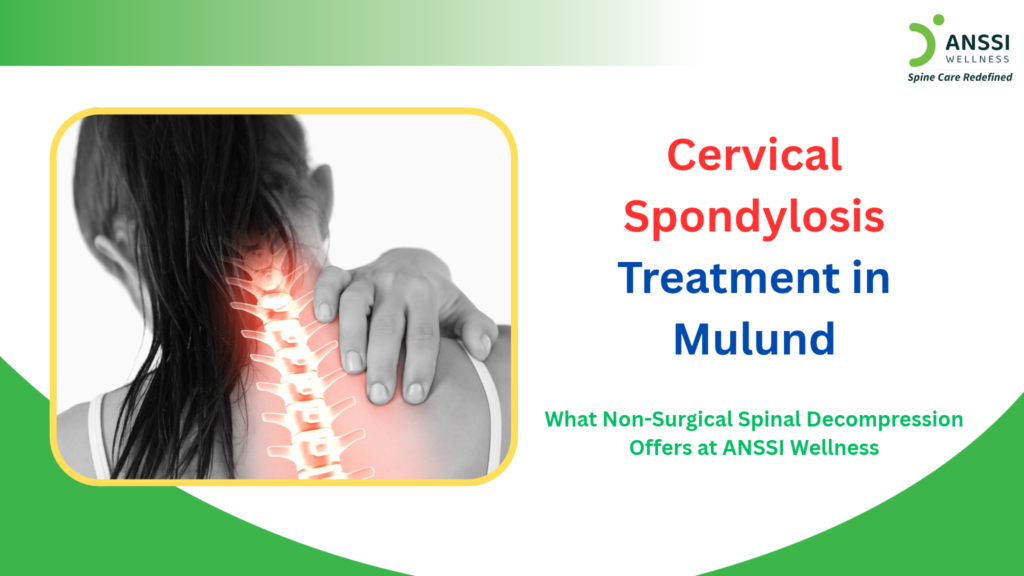
Persistent neck pain, stiffness, headaches, and discomfort extending into the shoulders or arms can make everyday activities difficult. For many residents of Mulund, long working hours, prolonged computer use, daily commuting, and age-related spinal changes can contribute to recurring neck problems.
When medication provides only temporary relief and symptoms return, patients often begin looking for treatment options beyond pain management. Non-Surgical Spinal Decompression Treatment (NSSDT) at ANSSI Wellness, Mulund, is one option that may be considered for carefully selected patients.
Understanding Cervical Spondylosis: More Than Temporary Neck Pain
Cervical spondylosis is a degenerative disorder that affects the neck’s disks, joints, and bones. Although these structural changes cannot always be reversed, appropriate treatment can help manage symptoms and improve mobility.
The cervical spine consists of seven vertebrae that support the head and allow neck movement. Between these vertebrae are intervertebral discs that provide cushioning and help distribute mechanical loads.
As people age, these discs and surrounding joints may undergo degenerative changes. These can include:
- Disc dehydration: The discs gradually lose some of their water content and flexibility.
- Reduced disc height: Degeneration may cause the space between adjacent vertebrae to decrease.
- Osteophyte formation: Bone spurs may develop along the edges of vertebrae.
- Joint changes: Facet joints may develop degenerative changes that contribute to stiffness and discomfort.
These changes are common and do not necessarily cause pain. However, in some individuals, they may contribute to irritation or narrowing around nearby nerve structures.
Common symptoms include persistent neck pain, reduced flexibility, shoulder discomfort, headaches associated with neck problems, and pain travelling into the arms. Tingling, numbness, or weakness in the hands may indicate nerve involvement and should be evaluated by a qualified clinician.
Why Medication May Not Provide Lasting Relief
Painkillers and anti-inflammatory medicines are commonly used to manage cervical spondylosis symptoms. They may reduce pain and inflammation, allowing patients to continue their daily activities more comfortably.
- However, medication does not reverse disc dehydration, restore lost disc height, or remove osteophytes. This explains why some patients experience temporary improvement but continue to have recurring symptoms.
- Long-term medication use also requires medical supervision because certain pain-relieving medicines can cause gastrointestinal, kidney, or cardiovascular complications depending on the medication, dosage, duration, and individual health factors.
Patients should not stop prescribed medicines independently. Instead, recurring symptoms should prompt a review of the diagnosis and treatment plan. Physiotherapy, suitable exercises, activity modification, and other conservative approaches may be considered depending on the patient’s condition.
What Non-Surgical Spinal Decompression Offers
Non-Surgical Spinal Decompression Treatment (NSSDT) is a non-invasive approach.
- It uses specialised computer-controlled equipment and a supporting harness system to apply carefully regulated stretching forces to selected spinal segments.
- For appropriately selected cervical spine patients, the objective is to modify mechanical loading around the targeted region.
- Controlled stretching may influence pressure conditions within the intervertebral discs and surrounding structures.
NSSDT may help some patients manage symptoms associated with selected disc-related cervical conditions.
What it may offer:
- A non-invasive treatment approach without surgical incisions.
- Controlled traction tailored to the patient’s condition and tolerance.
- A possible option for managing symptoms in selected disc-related cases.
- An opportunity to combine decompression with physiotherapy and rehabilitation.
Assessment and Personalised Treatment at ANSSI Wellness, Mulund
Before recommending NSSDT, understanding the patient’s symptoms and spinal condition is essential. At ANSSI Wellness, Mulund, the assessment process may include several important steps.
1. Medical history and symptom evaluation
The clinical team reviews the duration of neck pain, activities that aggravate symptoms, previous treatments, and whether discomfort travels into the shoulders, arms, or fingers.
2. Physical and neurological examination
Neck mobility, posture, muscle strength, reflexes, sensation, and relevant neurological signs may be assessed. This helps identify possible nerve involvement and determine whether further specialist evaluation is needed.
3. MRI and diagnostic report review
MRI reports may provide information about disc degeneration, disc bulges, osteophytes, and possible narrowing around nerve structures. However, imaging findings must be correlated with symptoms and physical examination results. Not every patient requires an MRI.
4. Individualised treatment planning
Based on the assessment, the team can discuss whether decompression is suitable or whether another treatment approach would be more appropriate.
When NSSDT is considered suitable, it may be incorporated into a programme involving supervised treatment sessions, physiotherapy, customised exercises, and progress monitoring.
What Results Can Patients Expect?
Treatment outcomes depend on the underlying condition, symptom severity, overall health, and individual response. Appropriately selected patients may experience reduced neck discomfort, improved mobility, and better tolerance for daily activities.
Progressive arm or hand weakness, difficulty walking, loss of hand coordination, or balance problems may indicate spinal cord involvement and require prompt specialist assessment. In certain cases, surgical treatment may be necessary.
About ANSSI:
ANSSI Wellness focuses on improving the quality of life for patients suffering from spinal issues, aiming to provide relief where other conventional treatments have failed. Through advanced Non-Surgical Spinal Decompression Treatment, ANSSI is committed to helping patients avoid surgery and recover in a safe, effective, and compassionate environment.
Book Consultation:
Call +91 9004726844 | 9920936844
Visit www.anssiwellness.com
Connect with ANSSI Wellness on LinkedIn, Instagram, and Facebook for expert guidance.