Lower back pain has become one of the most common health concerns today, especially among working professionals and individuals with sedentary lifestyles. Long hours of sitting, poor posture, lack of exercise, heavy lifting, and age-related wear and tear often place excessive pressure on the spine. One of the most serious outcomes of these habits is a slipped disc.
A slipped disc can significantly affect daily life, making simple tasks like sitting, walking, bending, or even sleeping uncomfortable. Many people search for quick relief and often come across options like chiropractic adjustments and non-surgical spinal decompression treatment. While both approaches aim to reduce pain, understanding which one offers long-term relief is important, especially for patients dealing with spinal disc problems.
What is a Slipped Disc?
A slipped disc, also known as a herniated or prolapsed disc, occurs when the soft inner portion of a spinal disc pushes out through its tougher outer layer. This usually happens in the lumbar spine (lower back), which carries most of the body’s weight and is more prone to strain.
When the disc bulges outward, it can press on nearby spinal nerves. This nerve compression leads to symptoms such as persistent lower back pain, sciatica (pain radiating down the leg), numbness, tingling sensations, and muscle weakness.
In many cases, patients also experience difficulty sitting for long periods, bending forward, or lifting objects. If left untreated, the condition can worsen and begin to affect mobility and quality of life.
Chiropractic Adjustment for Slipped Disc
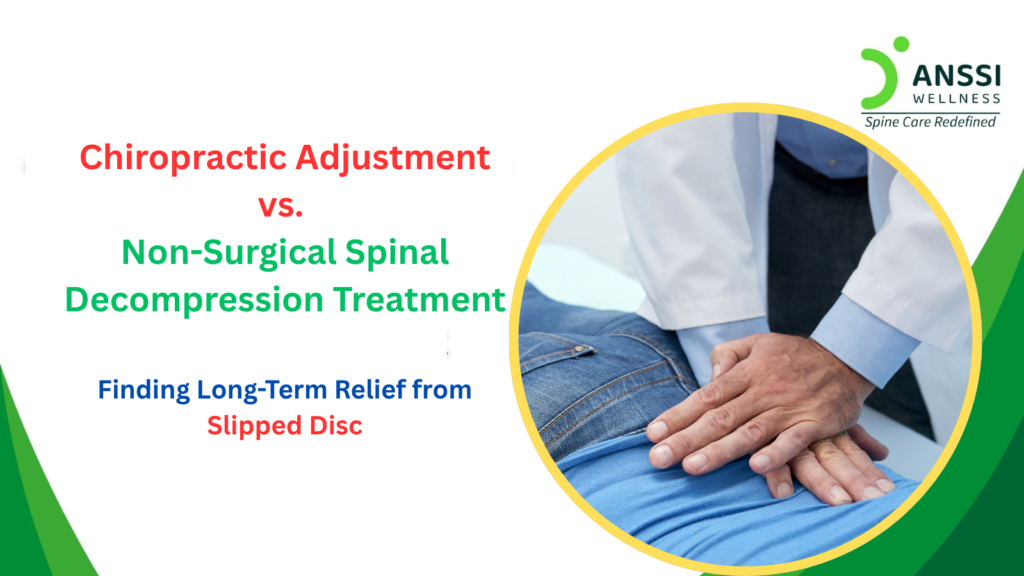
Chiropractic care is a commonly known treatment for spine-related pain. It usually involves manual spinal adjustments aimed at improving spinal alignment and reducing discomfort.
For some patients, chiropractic adjustments may help relieve muscle tension and improve short-term mobility. It can be useful in addressing posture-related discomfort and mild joint restrictions.
However, when it comes to slipped disc cases, chiropractic care has limitations. Since the main issue is disc bulging and nerve compression, spinal adjustments may not directly reduce the pressure inside the affected disc. Relief may be temporary if the root cause, that is disc compression, is not specifically treated.
This is why patients with chronic slipped disc symptoms often require a more targeted approach.
What is Non-Surgical Spinal Decompression Treatment?
Non-surgical spinal decompression treatment is an advanced, non-invasive technique specifically designed for spinal disc conditions such as slipped disc, disc bulge, sciatica, and degenerative disc disease.
This treatment uses specialised equipment to apply specific, targeted, and calculated stretching to the spine. Unlike general manual adjustments, the decompression mechanism focuses directly on the affected disc and surrounding nerves.
The gentle stretching creates negative pressure within the spinal discs. This negative pressure helps reduce the bulge by encouraging the disc material to move back toward its normal position. At the same time, it reduces pressure on compressed nerves and improves the healing conditions inside the spine.
It is a safe alternative for patients who want to avoid surgery and long-term dependence on medication.
How Spinal Decompression Supports Natural Healing
One of the biggest advantages of spinal decompression treatment is that it supports the body’s natural healing process.
When negative pressure is created inside the disc, oxygen, water, and essential nutrients are able to flow more effectively into the damaged area. This improved circulation helps repair injured disc tissue and reduce inflammation.
As pressure on the nerves decreases, patients often experience reduced pain, better mobility, and improved comfort during daily activities.
Unlike treatments that only focus on symptom relief, decompression treatment works at the source of the problem. It helps restore healthier disc function over time, which makes long-term recovery more achievable.
This is particularly valuable for patients suffering from chronic slipped disc pain who want lasting results rather than temporary relief.
Why It May Be More Effective for Slipped Disc Patients
For slipped disc patients, the main goal should be to reduce disc pressure and nerve compression, not just manage pain temporarily.
This is where non-surgical spinal decompression treatment often proves more effective than chiropractic adjustments. It directly targets the root cause of pain by relieving pressure within the spinal disc itself.
It is also a non-surgical treatment, meaning there are no incisions, injections, or hospital stays involved. Patients can usually continue their daily routines while undergoing treatment, with minimal downtime.
Compared to surgery, it is safer, more affordable, and involves fewer risks. Compared to repeated chiropractic sessions, it offers a more focused solution for disc-related problems rather than general alignment correction.
For patients with chronic back pain, sciatica, or nerve-related symptoms caused by disc issues, this makes decompression treatment a more suitable long-term option.
About ANSSI:
ANSSI Wellness focuses on improving the quality of life for patients suffering from spinal issues, aiming to provide relief where other conventional treatments have failed. Through advanced Non-Surgical Spinal Decompression Treatment, ANSSI is committed to helping patients avoid surgery and recover in a safe, effective, and compassionate environment.
Connect with ANSSI Wellness on LinkedIn, Instagram, and Facebook for expert guidance.