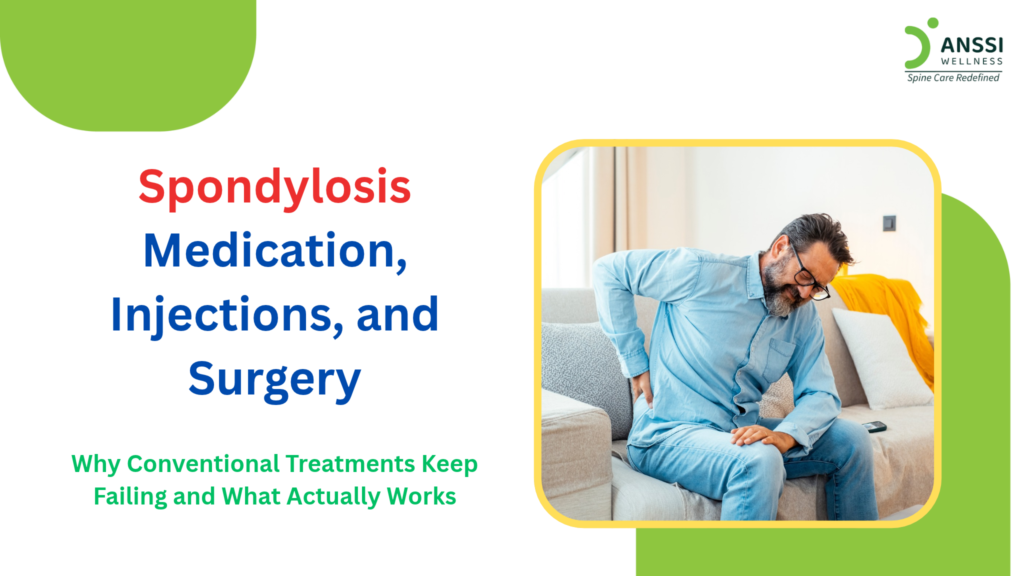
Living with persistent neck or back pain can be exhausting. For many people with spondylosis, medication, physiotherapy, injections, or even surgery may not provide the lasting improvement they hoped for. Pain may return, movement may remain restricted, and everyday activities can become difficult.
But does this mean conventional treatments always fail? Not necessarily. Each treatment has a specific role, and results depend on the underlying diagnosis, severity, and individual response. When symptoms persist, the next step is to reassess the cause and explore an appropriate, personalised treatment plan.
Understanding Spondylosis and Its Symptoms
Spondylosis refers to age- and wear-related changes in the spine, including degeneration of spinal discs and joints. It can affect the cervical spine (neck) or lumbar spine (lower back).
Some people experience stiffness or localised pain, while others may develop nerve-related symptoms such as tingling, numbness, or pain radiating into an arm or leg.
Importantly, imaging findings do not always explain symptoms. A disc bulge or degenerative change on an MRI must be considered alongside a clinical examination and the person’s actual complaints.
Spondylosis should also be distinguished from spondylitis, a term often used for inflammatory spinal conditions. These conditions may require very different treatment approaches.
Medication: Helpful for Symptoms, Not a Structural Cure
Medications such as non-steroidal anti-inflammatory drugs (NSAIDs) may reduce pain and inflammation, helping some people move more comfortably. However, they do not reverse disc degeneration or remove a mechanical narrowing of the spinal canal.
Long-term or frequent NSAID use can carry risks, including stomach irritation, ulcers or gastrointestinal bleeding, kidney problems, and cardiovascular complications. The level of risk depends on the specific medicine, dose, duration, and the person’s health history.
Clinical guidance recommends considering these risks, monitoring when appropriate, and using the lowest effective dose for the shortest necessary period.
For inflammatory spinal diseases, disease-modifying medicines or biologic therapies may be appropriate under specialist care. These treatments are not routinely used for ordinary degenerative spondylosis. The correct medication depends on the condition being treated.
Injections: Relief Can Vary
Spinal injections, including epidural steroid injections, may be considered for selected conditions involving nerve irritation or inflammation. Some patients experience meaningful symptom relief, while others experience limited or short-lived benefits.
Injections do not rebuild degenerated discs or permanently correct every cause of nerve compression. They also carry potential risks, such as infection, bleeding, or other procedure-related complications.
Their usefulness depends on the diagnosis and symptoms. For example, NICE guidance advises considering epidural injections for acute, severe sciatica, but not for neurogenic claudication caused by central spinal canal stenosis.
Therefore, injections should be selected carefully rather than repeated automatically whenever pain returns.
Surgery: Important for Selected Patients, Not Everyone
Spinal surgery may be recommended when a clearly identified structural problem is causing significant symptoms and appropriate non-surgical care has not helped. Depending on the diagnosis, procedures may decompress a nerve or spinal canal, remove a problematic disc fragment, or stabilise the spine.
Surgery can improve pain and function for appropriately selected patients. However, it is not guaranteed to eliminate all pain, and recovery can involve risks such as infection, bleeding, nerve injury, persistent symptoms, or complications related to stabilisation procedures.
Surgery for degenerative spondylosis is also different from treatment for inflammatory spinal disease. An operation may address a particular compression or instability, but it does not treat the underlying systemic inflammation.
The decision should be based on clinical findings, imaging, symptom severity, and a discussion of expected benefits, alternatives, and risks. Surgery is not automatically necessary simply because an MRI shows degeneration.
Exploring Non-Surgical Spinal Decompression Treatment (NSSDT)
For some patients with persistent back or neck symptoms, a clinician may consider a structured rehabilitation plan that includes non-surgical spinal decompression.
At ANSSI Wellness, Non-Surgical Spinal Decompression Treatment (NSSDT) uses a computer-controlled table and harness to apply controlled traction to selected spinal segments. The treatment is intended to alter mechanical loading around the spine and may be combined with physiotherapy, strengthening, posture guidance, and activity modification.
The goal is to help suitable patients manage symptoms and improve function without an operation. However, NSSDT should not be described as a proven way to reverse spondylosis, restore lost disc height, or permanently eliminate nerve compression. Evidence for traction-based treatments varies by condition, and not every patient is an appropriate candidate.
A medical assessment is essential to determine whether decompression-based therapy is suitable, particularly when imaging shows significant stenosis, instability, or other complex changes.
What Actually Helps: A Diagnosis-Led Treatment Plan
There is no single treatment that works for everyone with spondylosis. A comprehensive plan may include:
- A clinical examination and review of relevant MRI or X-ray findings.
- Appropriate medication, with attention to individual risks.
- Physiotherapy, mobility work, and progressive strengthening.
- Posture and activity adjustments to reduce aggravating loads.
- Injections or surgery when specific clinical indications support them.
- Non-surgical decompression as a possible component of care for selected patients.
The aim is to match treatment to the actual source of symptoms; not simply repeat a treatment that has provided inadequate relief.
About ANSSI:
ANSSI Wellness focuses on improving the quality of life for patients suffering from spinal issues, aiming to provide relief where other conventional treatments have failed. Through advanced Non-Surgical Spinal Decompression Treatment, ANSSI is committed to helping patients avoid surgery and recover in a safe, effective, and compassionate environment.
Book Consultation:
Call +91 9004726844 | 9920936844
Visit www.anssiwellness.com
Connect with ANSSI Wellness on LinkedIn, Instagram, and Facebook for expert guidance.
Clinical References:
- Binder AI. Cervical spondylosis and neck pain. BMJ. 2007;334(7592):527-531.
- Manchikanti L, Abdi S, Atluri S, et al. An update of comprehensive evidence-based guidelines for interventional techniques in chronic spinal pain. Pain Physician. 2013;16(2 Suppl):S49-S283.
- Shiri R, Karppinen J, Leino-Arjas P, Solovieva S, Viikari-Juntura E. The association between smoking and low back pain: a meta-analysis. American Journal of Medicine. 2010;123(1):87.e7-87.e35.
- Liu D, Ahmet A, Ward L, et al. A practical guide to the monitoring and management of the complications of systemic corticosteroid therapy.
- Naguszewski W., MD, Naguszewski R., MD, Gose E., Ph.D. Dermatosomal Somatosensory Evoked Potential Demonstration of Nerve Root Decompression After VAX-D Therapy. Journal of Neurological Research Vol 23 , No 7, October 2001.
- Tilaro F., MD. An Overview of Vertebral Axial Decompression. Canadian Journal of Clinical Medicine Vol. 5, No 1, January 1998.