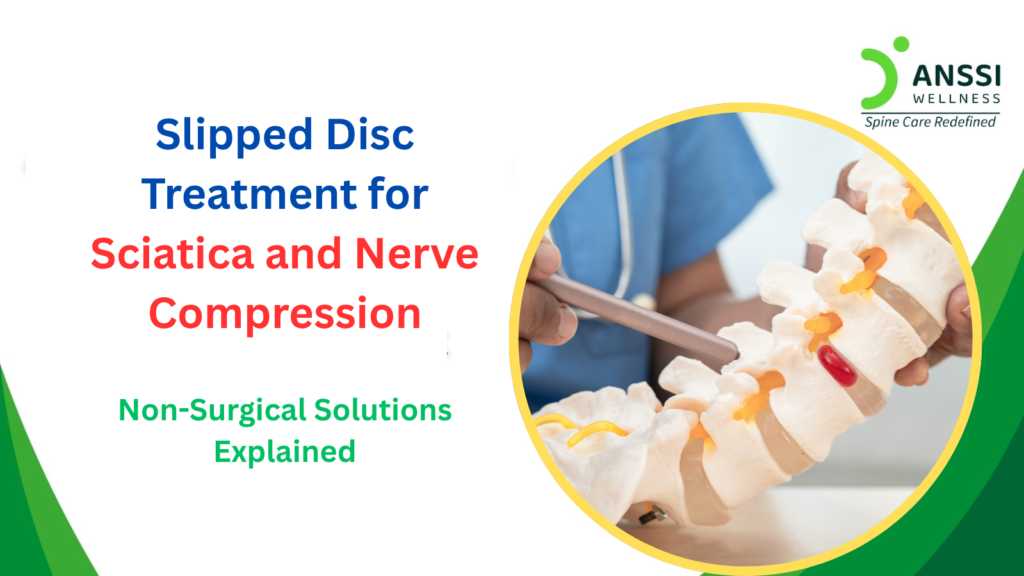
A slipped disc is one of the most common causes of sciatica and nerve compression. When a spinal disc herniates, it can press directly on the nerve roots that form the sciatic nerve, producing the characteristic radiating pain, numbness, and weakness that travels from the lower back into the leg and foot. Understanding this connection is the first step toward choosing the right treatment.
Let’s see how a slipped disc causes sciatica, why medication and surgery have significant limitations, and which non-surgical treatments can address the structural root cause for long-term relief.
What is a Slipped Disc?
Each intervertebral disc consists of two parts: a tough outer ring called the annulus fibrosus, and a soft inner core called the nucleus pulposus. The disc sits between two vertebrae and functions as a shock absorber, enabling movement and protecting the spinal cord.
A slipped disc, also called a herniated or prolapsed disc, occurs when the inner nucleus pushes through a weakened or torn section of the outer ring. This can happen gradually due to disc degeneration, or more suddenly due to injury or physical strain.
Disc herniation progresses through four stages:
- Disc Bulge: The nucleus pushes against the outer wall without penetrating it
- Disc Prolapse: The nucleus partially protrudes through the outer ring
- Disc Extrusion: The nucleus breaks fully through the annulus
- Disc Sequestration: A fragment of nucleus separates and floats freely within the spinal canal
Each stage increases the likelihood of nerve contact and compression. Early-stage herniation is more manageable by non-surgical treatment than advanced extrusion or sequestration.
How a Slipped Disc Causes Sciatica
The lumbar spine’s L4-L5 and L5-S1 disc levels are the most common sites of herniation. When disc material protrudes at these levels, it contacts the nerve roots that feed into the sciatic nerve, the longest nerve in the body, running from the lumbar spine through the buttock and down each leg to the foot.
This contact produces both mechanical compression and chemical inflammation of the nerve root, generating the symptoms known as sciatica. The specific symptom pattern depends on which nerve root is affected.
Because each nerve root supplies a specific region, the location of symptoms helps identify which disc level is involved and guides the treatment approach.
Symptoms of Disc-Related Sciatica
- Shooting, burning, or electric pain from the lower back through the buttock and down one leg
- Numbness or tingling in a specific part of the leg or foot
- Muscle weakness in the leg, including difficulty lifting the front of the foot (foot drop) in severe cases
- Pain that increases with sitting, bending forward, coughing, or sneezing
- Pain that may ease temporarily with walking or lying down
Bilateral leg pain or any change in bladder or bowel control requires immediate medical attention, as these are signs of a serious neurological emergency.
Why Medication is Not Enough
Painkillers, anti-inflammatory drugs (NSAIDs), and muscle relaxants are commonly prescribed for disc-related sciatica. While these medications reduce the perception of pain, they do not address the herniated disc pressing on the nerve root. The structural compression continues while symptoms are chemically suppressed.
Limitations and risks of long-term medication use include:
- NSAIDs: Gastrointestinal ulceration, cardiovascular risk, and kidney stress with prolonged use
- Muscle relaxants: Relieve spasm but have no effect on disc pathology
- Steroid injections: Temporary anti-inflammatory relief that typically wears off; repeated use risks bone density loss and adrenal suppression
Medication is appropriate as short-term adjunct support, not as a primary or long-term treatment for structural disc herniation.
Risks of Surgery for Slipped Disc
When medication fails, discectomy or microdiscectomy is often recommended. These procedures involve surgically removing the herniated disc material pressing on the nerve root.
Surgical risks include:
- Infection at the operation site
- Nerve damage due to the proximity of nerve structures during surgery
- Dural tears causing cerebrospinal fluid leakage
- Epidural fibrosis, post-surgical scar tissue that can create new nerve compression
- Recurrent herniation at the same or adjacent disc level
- Failed Back Surgery Syndrome (FBSS), persistent or worsened pain after technically successful surgery
Surgery also removes disc material, permanently reducing disc height and altering load distribution across adjacent spinal segments, accelerating their degeneration over time.
Non-Surgical Solutions That Treat the Root Cause
A slipped disc causing sciatica requires a treatment that directly addresses the disc herniation and nerve compression, not one that masks symptoms or removes disc tissue permanently.
Non-Surgical Spinal Decompression Treatment (NSSDT)
NSSDT applies a properly calibrated decompression mechanism to the afflicted lumbar spinal segments using a computer-controlled decompression table. This creates a negative pressure, or vacuum effect, inside the herniated disc, which draws the protruding nucleus material back toward its natural position and away from the compressed nerve root.
Simultaneously, NSSDT:
- Widens the foraminal space through which the nerve root exits the spinal canal
- Draws oxygen, water, and nutrients back into the dehydrated disc
- Stimulates repair of the damaged disc tissue
- Relieves sciatic nerve compression without incision or anaesthesia
Non-Surgical Spinal Decompression Treatment is the only non-surgical treatment that directly targets the herniated disc itself, rather than managing the symptoms it produces.
Targeted Physiotherapy
Strengthening the deep spinal stabilising muscles, the multifidus and transversus abdominis, reduces mechanical load on the recovering disc and lowers the risk of re-herniation.
Postural correction addresses the movement patterns that contribute to disc loading.
Lifestyle and Ergonomic Modification
Correcting sitting posture, adjusting workstation ergonomics, and managing body weight reduces compressive forces on the lumbar spine during recovery and supports long-term spinal health.
When to See a Doctor
Consult a spine specialist promptly if:
- Sciatica symptoms have persisted for more than 4-6 weeks without improvement
- Pain is worsening despite rest and over-the-counter medication
- Leg weakness or foot drop is developing
- Bladder or bowel function is affected
Early specialist assessment, including MRI of the lumbar spine, is essential to confirm the diagnosis and determine the correct non-surgical treatment plan before the condition progresses further.
Clinical References:
- Saal JA, Saal JS. Nonoperative treatment of herniated lumbar intervertebral disc with radiculopathy. Spine. 1989;14(4):431-437.
- Beattie PF, Nelson R, Michener L, Cammarata J, Donely J. Short and long-term outcomes following treatment with the VAX-D protocol for patients with chronic, activity limiting low back pain. Journal of Orthopaedic & Sports Physical Therapy. 2005;35(1).
- Ramos G., MD, Martin W., MD. Effects of Vertebral Axial Decompression On Intradiscal Pressure. Journal of Neurosurgery 81: 350-353, 1994
About ANSSI:
ANSSI Wellness focuses on improving the quality of life for patients suffering from spinal issues, aiming to provide relief where other conventional treatments have failed. Through advanced Non-Surgical Spinal Decompression Treatment, ANSSI is committed to helping patients avoid surgery and recover in a safe, effective, and compassionate environment.
Book Consultation:
Call +91 9004726844 | 9920936844
Visit www.anssiwellness.com
Connect with ANSSI Wellness on LinkedIn, Instagram, and Facebook for expert guidance.