
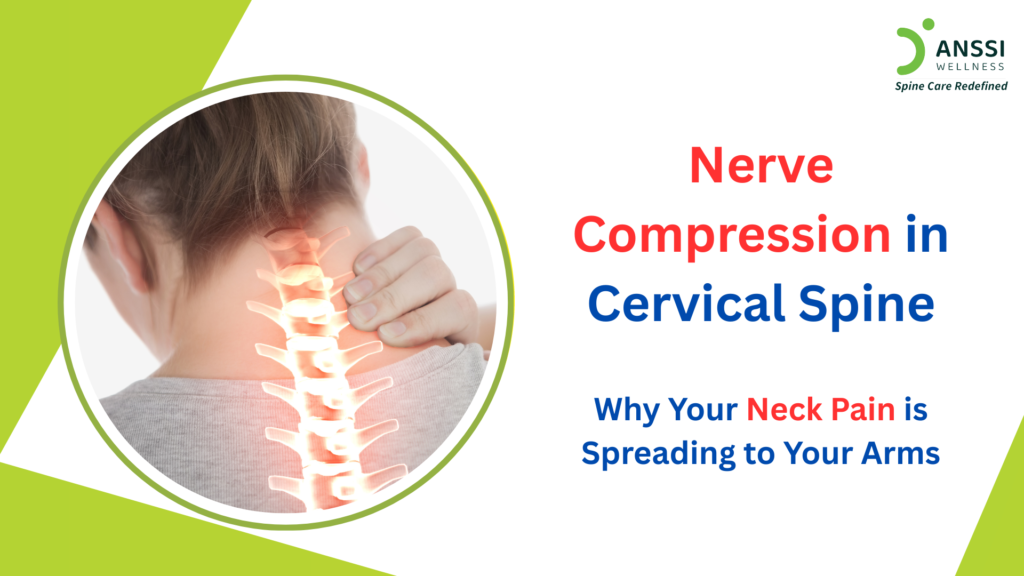
Many people begin experiencing neck pain and assume it is caused by stress, poor sleeping posture, or muscle strain. However, when that pain starts spreading into the shoulders, arms, hands, or fingers, it often indicates a more specific spinal problem. Tingling, numbness, burning sensations, and weakness in the arm are often the signs of a nerve in the neck being compressed.
This condition, known as cervical radiculopathy, occurs when a nerve root exiting the cervical spine becomes irritated or compressed. Understanding how cervical disc problems create symptoms far away from the neck can help patients seek the right treatment before the condition worsens.
Understanding the Cervical Spine and Nerve Roots
The cervical spine consists of seven vertebrae located in the neck. Between these vertebrae are intervertebral discs, which act as shock absorbers and help maintain flexibility.
Each level of the cervical spine also contains nerve roots that exit through openings called foramina. These nerves travel from the neck into the shoulders, arms, hands, and fingers.
Their functions include:
- Providing sensation to the upper limbs
- Controlling muscle movement
- Supporting grip strength and coordination
When a cervical nerve root becomes compressed, symptoms can develop anywhere along the pathway of that nerve.
How Increased Disc Pressure Develops
The cervical discs are designed to absorb forces generated by everyday movement. However, several factors can increase pressure within these discs and contribute to degeneration.
Disc Dehydration and Degeneration
As people age, spinal discs gradually lose water content.
This process can lead to:
- Reduced disc height
- Loss of flexibility
- Decreased shock absorption
- Increased mechanical stress on surrounding structures
Degenerated discs are more vulnerable to bulging and herniation.
Postural Loading and Screen Time
Modern lifestyles place considerable stress on the cervical spine.
Long hours spent:
- Using computers,
- Looking at smartphones,
- Working at desks, and
- Driving,
often encourage a forward head posture.
For every few centimetres the head moves forward, the load placed on the cervical spine increases significantly. Over time, this excessive stress can accelerate disc degeneration and increase intradiscal pressure.
Disc Bulge and Herniation
As disc degeneration progresses, the outer layers of the disc may weaken.
This can result in:
- Disc bulges
- Disc protrusions
- Disc herniations
When disc material extends into the space occupied by nearby nerves, nerve compression can occur.
Why Neck Pain Spreads into the Arms
Many patients are surprised to learn that symptoms in the arm can originate from a problem in the neck.
Local Neck Pain
The damaged disc itself can produce pain by irritating surrounding structures, such as:
- Ligaments
- Facet joints
- Muscles
- Nerve endings within the disc
This typically causes stiffness and discomfort in the neck.
Radiating Arm Symptoms
When a cervical nerve root becomes compressed, the nerve may send abnormal signals along its entire pathway.
As a result, patients may experience:
- Shoulder pain
- Arm pain
- Tingling sensations
- Numbness
- Burning pain
- Muscle weakness
This pattern of symptoms is known as cervical radiculopathy.
What Your Symptoms Reveal
One of the most useful aspects of cervical radiculopathy is that symptom location often helps identify which nerve root is affected.
C5 Nerve Root Compression
Compression of the C5 nerve root may cause:
- Shoulder pain
- Pain in the upper arm
- Weakness when lifting the arm
Patients often notice difficulty performing overhead activities.
C6 Nerve Root Compression
C6 nerve compression commonly produces:
- Pain extending into the arm
- Tingling or numbness in the thumb
- Symptoms involving the index finger
This is one of the most frequently affected cervical nerve roots.
C7 Nerve Root Compression
When the C7 nerve root is compressed, symptoms often include:
- Pain extending down the arm
- Numbness in the middle finger
- Triceps weakness
Patients may notice difficulty pushing objects away from the body.
C8 Nerve Root Compression
Compression of the C8 nerve root may cause:
- Tingling in the ring finger
- Numbness in the little finger
- Reduced grip strength
- Difficulty handling small objects
The specific location of symptoms often provides important clues regarding the exact level of cervical pathology.
Warning Signs That Require Medical Assessment
While occasional neck discomfort may improve with rest, certain symptoms require prompt evaluation.
Seek medical attention if you experience:
- Persistent arm pain
- Progressive numbness
- Muscle weakness
- Loss of grip strength
- Difficulty performing daily tasks
- Symptoms that disturb sleep
- Increasing neurological symptoms
Early assessment can help prevent long-term nerve damage and functional loss.
Diagnostic Evaluation
Accurate diagnosis is essential because treatment depends on identifying the precise source of nerve compression.
Clinical Examination
A specialist will typically evaluate:
- Pain distribution
- Muscle strength
- Reflexes
- Sensory changes
- Neck mobility
The pattern of symptoms often provides valuable information about the affected nerve root.
Imaging Studies
Imaging may be recommended to confirm the diagnosis.
MRI
MRI is particularly useful because it can visualise:
- Disc bulges
- Disc herniations
- Nerve root compression
- Soft tissue structures
X-Rays
X-rays may help identify:
- Disc space narrowing
- Spinal alignment issues
- Degenerative changes
Together, these investigations help create an accurate treatment plan.
Treating the Structural Cause of Cervical Radiculopathy
Successful treatment requires addressing the underlying cause of nerve compression rather than simply masking symptoms.
Conservative Management
Many patients benefit from:
- Posture correction
- Ergonomic modifications
- Physiotherapy
- Rehabilitation exercises
- Activity adjustments
These measures help reduce spinal stress and improve neck function.
The Role of Non-Surgical Spinal Decompression Treatment (NSSDT)
For patients with disc-related cervical radiculopathy, Non-Surgical Spinal Decompression Treatment (NSSDT) is often a crucial part of a comprehensive treatment plan.
NSSDT uses advanced decompression technology to gently and precisely reduce pressure within affected cervical discs.
Potential benefits include:
- Reduced intradiscal pressure
- Decompression of affected nerve roots
- Improved disc hydration
- Enhanced spinal mobility
- Reduction in neck pain
- Relief of radiating arm symptoms
By addressing the structural source of nerve compression, Non-Surgical Spinal Decompression Treatment aims to improve both local neck symptoms and the neurological symptoms extending into the upper limbs.
References:
- Stookey B. Compression of Spinal Cord and Nerve Roots by Herniation of the Nucleus Pulposus in the Cervical Region. Arch Surg. 1940;40(3):417–432.
- Tanaka, Nobuhiro MD*; Fujimoto, Yoshinori MD, PhD*; An, Howard S. MD†; Ikuta, Yoshikazu MD, PhD*; Yasuda, Mineo MD, PhD‡. The Anatomic Relation Among the Nerve Roots, Intervertebral Foramina, and Intervertebral Discs of the Cervical Spine. Spine 25(3):p 286-291, February 1, 2000.
- Massie, J., Lind, B., Rydevik, B., & Garfin, S. (1995). Spinal Nerve Root Compression. Spine, 20(16), 1810–1820.
- Ramos G., MD, Martin W., MD. Effects of Vertebral Axial Decompression On Intradiscal Pressure. Journal of Neurosurgery 81: 350-353, 1994.
- Tilaro F., MD. An Overview of Vertebral Axial Decompression. Canadian Journal of Clinical Medicine Vol. 5, No 1, January 1998.
About ANSSI:
ANSSI Wellness focuses on improving the quality of life for patients suffering from spinal issues, aiming to provide relief where other conventional treatments have failed. Through advanced Non-Surgical Spinal Decompression Treatment, ANSSI is committed to helping patients avoid surgery and recover in a safe, effective, and compassionate environment.
Book Consultation:
Call +91 9004726844 | 9920936844
Visit www.anssiwellness.com
Connect with ANSSI Wellness on LinkedIn, Instagram, and Facebook for expert guidance.