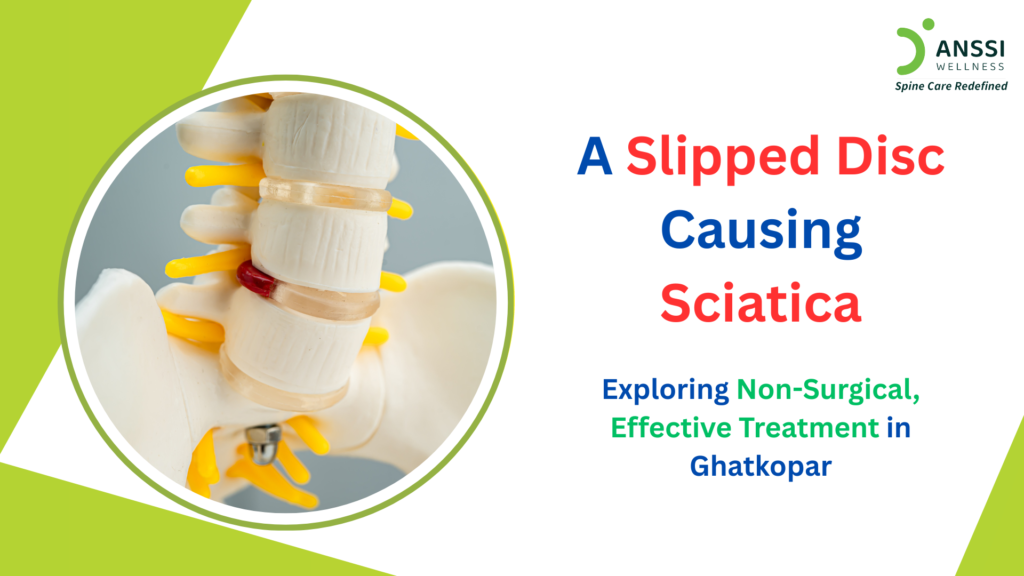
Sciatica has become an increasingly common health problem among residents of Ghatkopar and the surrounding suburbs of Mumbai. Long office hours, stressful commutes, prolonged sitting, and sedentary lifestyles are putting tremendous pressure on the spine. For many people, persistent lower back pain that gradually spreads down the leg is often a sign of an underlying spinal problem rather than a simple muscle strain.
One of the most common structural causes of sciatica is a slipped disc. While many people initially manage their symptoms with painkillers or temporary therapies, these approaches often fail to provide lasting relief because they do not address the root cause of the problem.
Fortunately, modern non-surgical treatments are now available that can effectively target slipped disc-related sciatica and help patients achieve long-term recovery.
Understanding the Connection Between a Slipped Disc and Sciatica
What is a Slipped Disc?
A slipped disc, also known as a herniated disc, occurs when the soft inner material of an intervertebral disc pushes through its tougher outer layer.
The spinal discs act as cushions between the vertebrae and help absorb shock during movement. Over time, these discs can become weakened due to ageing, repetitive stress, poor posture, or prolonged sitting.
When the disc protrudes outward, it may begin pressing against nearby nerves.
How a Slipped Disc Causes Sciatica
The sciatic nerve is the largest nerve in the body. It originates from several nerve roots in the lower spine and travels through the buttocks, down the legs, and into the feet.
When a slipped disc compresses one or more of these nerve roots, sciatica develops.
This nerve compression can trigger symptoms that extend far beyond the lower back.
Common Symptoms of Slipped Disc-Related Sciatica
Symptoms may vary from person to person, but commonly include:
- Persistent lower back pain
- Pain radiating into the buttocks
- Sharp pain travelling down the thigh and calf
- Tingling sensations
- Numbness in the legs or feet
- Burning sensations
- Muscle weakness
- Difficulty sitting, standing, or walking for prolonged periods
Many patients notice that prolonged sitting, which is common among office workers and daily commuters in Mumbai, can significantly worsen their symptoms.
If left untreated, the condition may progressively affect mobility and quality of life.
Why Temporary Treatments Often Fail
Many patients initially choose conservative methods to manage their pain. Although these approaches may temporarily reduce symptoms, they often do not resolve the underlying problem.
Limitations of Medication
Painkillers and anti-inflammatory medications can reduce pain and inflammation temporarily.
However, they do not:
- Repair the damaged disc
- Reverse disc degeneration
- Relieve structural nerve compression
- Restore spinal function
As a result, symptoms frequently return after the medication wears off.
Long-term use of painkillers may also increase the risk of unwanted side effects.
Is Surgery Always Necessary?
Many people assume that surgery is the only solution once a slipped disc has been diagnosed.
However, this is not always true.
Limitations and Risks of Surgery
While surgery may be necessary in certain severe cases, it is not required for every patient.
Potential concerns include:
- Surgical complications
- Infection risks
- Long recovery periods
- Rehabilitation requirements
- Temporary disruption of work and daily life
Many patients with mild-to-moderate slipped disc conditions may benefit from advanced non-surgical treatments before considering surgery.
Why Root-Cause Treatment is Important
Sciatica is a symptom, not a disease. The actual problem often lies within the spinal disc and the pressure it places on the nerves.
Therefore, successful treatment should focus on:
- Reducing nerve compression
- Improving spinal function
- Supporting disc recovery
- Preventing future recurrence
This approach provides more sustainable results than simply masking symptoms.
The Importance of Accurate Diagnosis
Every effective treatment plan begins with an accurate diagnosis.
Comprehensive Clinical Assessment
At a specialised spine centre, clinicians may perform:
- Detailed medical history evaluation
- Physical examination
- Neurological assessment
- Functional movement analysis
MRI-Based Evaluation
MRI scans help identify:
- Slipped discs
- Disc degeneration
- Nerve compression
- Severity of structural damage
This information allows clinicians to create a personalised treatment strategy.
Non-Surgical Treatment Options at ANSSI Wellness Ghatkopar
ANSSI Wellness Ghatkopar focuses on treating the root cause of slipped disc-related sciatica through personalised rehabilitation programs.
Personalised Treatment Plans
Every patient’s treatment program is customised according to:
- Diagnosis
- Symptom severity
- Occupation
- Activity level
- Recovery goals
The objective is to reduce pain while improving long-term spinal health.
Non-Surgical Spinal Decompression Treatment (NSSDT)
One of the advanced technologies integrated into treatment programs is Non-Surgical Spinal Decompression Treatment (NSSDT).
How NSSDT Works
NSSDT uses specialised computer-controlled technology to gently stretch the spine in a precise and controlled manner.
The treatment aims to:
- Reduce pressure inside the spinal discs
- Support retraction of bulging disc material
- Relieve nerve compression
- Improve nutrient exchange
- Promote disc hydration and recovery
By addressing the structural source of pain, NSSDT offers a comprehensive treatment approach.
Integrated Rehabilitation Approach
Treatment programs at ANSSI Wellness Ghatkopar may also integrate several supportive therapies.
Physiotherapy
Physiotherapy helps improve mobility, flexibility, and muscle function.
Core Strengthening Exercises
Strengthening the muscles surrounding the spine improves stability.
Posture Correction
Proper posture reduces excessive strain on the lower back.
Flexibility Training
Improved flexibility supports healthy spinal movement.
Ergonomic Guidance
Patients are educated on workstation setup, sitting posture, and movement habits to prevent recurrence.
Benefits of Early Non-Surgical Intervention
Patients who seek treatment early may experience several benefits, including:
- Reduced lower back pain
- Relief from leg pain
- Reduced tingling and numbness
- Improved mobility
- Better spinal function
- Reduced dependence on medication
- Potential avoidance of surgery
Early intervention often prevents the condition from progressing further.
About ANSSI:
ANSSI Wellness focuses on improving the quality of life for patients suffering from spinal issues, aiming to provide relief where other conventional treatments have failed. Through advanced Non-Surgical Spinal Decompression Treatment, ANSSI is committed to helping patients avoid surgery and recover in a safe, effective, and compassionate environment.
Book Consultation:
Call +91 9004726844 | 9920936844
Visit www.anssiwellness.com
Connect with ANSSI Wellness on LinkedIn, Instagram, and Facebook for expert guidance.
Clinical References:
- Kreiner DS et al. North American Spine Society. An evidence-based clinical guideline for the diagnosis and treatment of lumbar disc herniation with radiculopathy. Spine J. 2014 Jan;14(1):180-91.
- El Melhat AM, Youssef ASA, Zebdawi MR, Hafez MA, Khalil LH, Harrison DE. Non-Surgical Approaches to the Management of Lumbar Disc Herniation Associated with Radiculopathy: A Narrative Review. J Clin Med. 2024 Feb 8;13(4):974.
- Gose E., Ph.D, Naguszewski W., MD, Naguszewski R., MD. Vertebral Axial Decompression Therapy for Pain Associated with Herniated or Degenerated Discs or Facet Syndrome: An Outcome Study. Journal of Neurological Research, Volume 20, No 3, April 1998.
- Tilaro F., MD, Miskovich D. MD. The Effects of Vertebral Axial Decompression On Sensory Nerve Dysfunction In Patients with Low Back Pain and Radiculopathy. Canadian Journal of Clinical Medicine Vol. 6, No 1, January 1999.
- Gugliotta M, da Costa BR, Dabis E, Theiler R, Jüni P, Reichenbach S, Landolt H, Hasler P. Surgical versus conservative treatment for lumbar disc herniation: a prospective cohort study. BMJ Open. 2016 Dec 21;6(12):e012938.