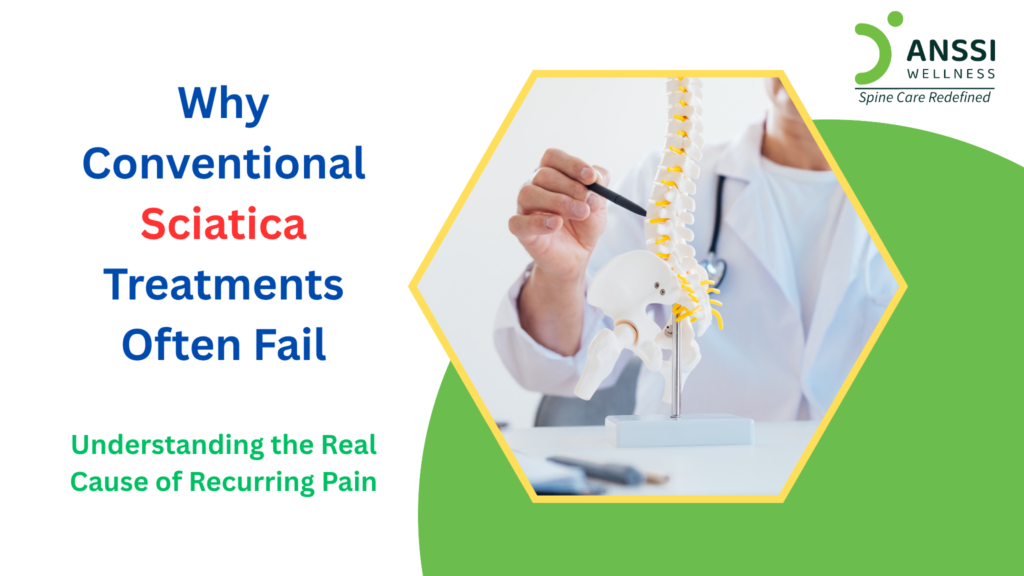
Sciatica is one of the most common causes of pain radiating from the lower back into the buttock, thigh, calf, and even the foot. For many patients, the first episode improves with rest or medication. However, others find themselves trapped in a frustrating cycle: pain subsides for a while, only to return weeks or months later.
If your sciatica keeps coming back despite treatment, it does not necessarily mean that nothing can be done. In many cases, the underlying cause has not been fully addressed.
Understanding why sciatica recurs is the first step toward choosing the most appropriate treatment for long-term relief.
What Causes Sciatica?
Sciatica is not a disease itself but a symptom caused by irritation or compression of one or more nerve roots that form the sciatic nerve. These nerve roots originate in the lower (lumbar) spine before travelling through the buttock and down each leg.
Several spinal conditions can cause sciatica, including:
- Herniated (slipped) disc
- Bulging disc
- Degenerative disc disease
- Lumbar spinal stenosis
- Spondylolisthesis
Less commonly, sciatica-like symptoms may occur due to piriformis syndrome, where the sciatic nerve is irritated by the piriformis muscle in the buttock.
When a lumbar nerve root is compressed or inflamed, patients may experience:
- Lower back pain
- Pain radiating into the leg
- Tingling or numbness
- Burning sensations
- Muscle weakness
- Difficulty walking or standing for long periods
Because several different conditions can produce similar symptoms, accurate diagnosis is essential before selecting the most appropriate treatment.
Why Conventional Sciatica Treatments May Not Provide Lasting Relief
Many patients initially receive conservative treatment, which is appropriate in numerous cases. However, symptoms may return if the underlying problem continues to affect the spinal nerves.
Bed Rest
Years ago, prolonged bed rest was commonly recommended for sciatica. Today, medical evidence suggests that extended inactivity may actually slow recovery for many patients.
While short periods of rest may help during severe pain episodes, remaining inactive for too long can:
- Weaken supporting muscles
- Reduce spinal stability
- Increase stiffness
- Delay functional recovery
Remaining appropriately active under medical guidance is generally considered more beneficial than prolonged bed rest.
Medications
Painkillers, muscle relaxants, and anti-inflammatory medicines often help reduce discomfort during acute episodes.
However, these medications mainly manage symptoms. They do not correct structural problems such as a prolapsed disc or significant nerve compression. As a result, pain may return once the medication is stopped if the underlying cause remains.
Physiotherapy
Physiotherapy plays an important role in managing sciatica.
Treatment may include:
- Stretching exercises
- Core strengthening
- Posture correction
- Flexibility training
- Activity modification
These interventions improve muscle function, spinal stability, and movement patterns. However, when significant disc-related nerve compression persists, physiotherapy alone may not completely resolve symptoms. In such situations, additional treatment options may be considered based on specialist evaluation.
Surgery
Surgery is an important treatment option for carefully selected patients.
It may be recommended when there is:
- Progressive muscle weakness
- Cauda equina syndrome
- Severe neurological deficit
- Persistent disabling symptoms despite appropriate conservative treatment
Although many patients benefit from surgery, outcomes vary between individuals. Recovery requires rehabilitation, and some patients may experience recurrent disc herniation or persistent symptoms depending on their underlying condition.
For this reason, surgery is generally reserved for patients in whom the expected benefits outweigh the potential risks.
Why Accurate Diagnosis Matters
Recurring sciatica should never be treated by simply repeating pain medication or extending rest without identifying the exact cause.
A spine specialist typically performs:
- Detailed medical history
- Physical examination
- Neurological assessment
- MRI evaluation where clinically indicated
MRI helps identify whether symptoms arise from:
- Disc prolapse
- Degenerative disc disease
- Spinal stenosis
- Spondylolisthesis
- Other spinal conditions
Treatment decisions should always be based on the patient’s symptoms, neurological findings, and imaging, not MRI findings alone.
Can Non-Surgical Spinal Decompression Help?
For appropriately selected patients with disc-related sciatica, Non-Surgical Spinal Decompression Treatment (NSSDT) may be incorporated into a personalised rehabilitation programme.
Using computer-controlled technology, NSSDT is designed to gently reduce pressure within affected spinal discs and decrease mechanical stress on compressed nerve roots. When combined with physiotherapy, posture correction, ergonomic advice, and activity modification, this approach aims to improve spinal function and reduce symptoms in suitable patients.
It is important to understand that Non-Surgical Spinal Decompression Treatment is not appropriate for every patient with sciatica. Individuals with severe neurological deficits, spinal instability, certain fractures, infections, tumours, or other medical conditions may require different forms of treatment. Suitability should always be determined by a qualified spine specialist after comprehensive evaluation.
When Should You See a Spine Specialist?
Do not ignore recurring sciatica if you experience:
- Pain lasting several weeks
- Repeated episodes despite treatment
- Progressive muscle weakness
- Persistent numbness
- Difficulty walking
- Increasing difficulty performing daily activities
Immediate medical attention is essential if sciatica is accompanied by:
- Loss of bladder or bowel control
- Numbness around the groin or saddle area
- Rapidly worsening leg weakness
These symptoms may indicate serious neurological conditions requiring urgent treatment.
About ANSSI:
ANSSI Wellness focuses on improving the quality of life for patients suffering from spinal issues, aiming to provide relief where other conventional treatments have failed. Through advanced Non-Surgical Spinal Decompression Treatment, ANSSI is committed to helping patients avoid surgery and recover in a safe, effective, and compassionate environment.
Book Consultation:
Call +91 9004726844 | 9920936844
Visit www.anssiwellness.com
Connect with ANSSI Wellness on LinkedIn, Instagram, and Facebook for expert guidance.
Clinical References:
- El Melhat AM, Youssef ASA, Zebdawi MR, Hafez MA, Khalil LH, Harrison DE. Non-Surgical Approaches to the Management of Lumbar Disc Herniation Associated with Radiculopathy: A Narrative Review. J Clin Med. 2024 Feb 8;13(4):974.
- Vroomen PC, de Krom MC, Slofstra PD, Knottnerus JA. Conservative treatment of sciatica: a systematic review. Journal of Spinal Disorders. 2000;13(6):463-469.
- Peul WC, van Houwelingen HC, van den Hout WB, et al. Surgery versus prolonged conservative treatment for sciatica. New England Journal of Medicine. 2007;356(22):2245-2256.
- Gose E., Ph.D, Naguszewski W., MD, Naguszewski R., MD. Vertebral Axial Decompression Therapy for Pain Associated with Herniated or Degenerated Discs or Facet Syndrome: An Outcome Study. Journal of Neurological Research, Volume 20, No 3, April 1998.
- Tilaro F., MD, Miskovich D. MD. The Effects of Vertebral Axial Decompression On Sensory Nerve Dysfunction In Patients with Low Back Pain and Radiculopathy. Canadian Journal of Clinical Medicine Vol. 6, No 1, January 1999.