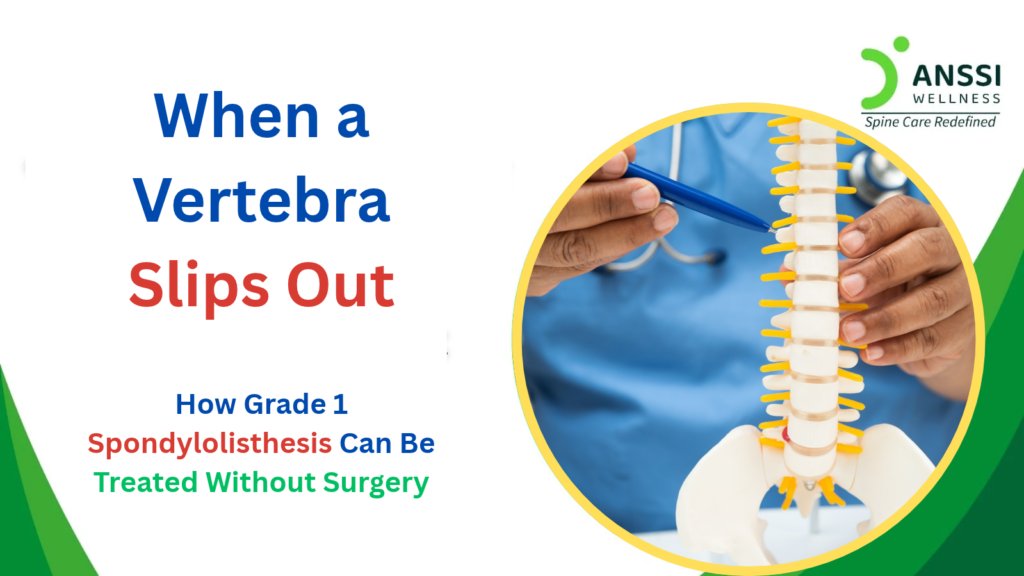
Persistent lower back pain, stiffness, or discomfort that spreads into the legs can sometimes be associated with a condition called spondylolisthesis. The term may sound complicated, but it describes a relatively straightforward structural change: one vertebra slips forward in relation to the vertebra beneath it.
For patients diagnosed with Grade 1 spondylolisthesis, the news is not necessarily alarming. Many people can manage their symptoms with appropriate non-surgical treatment, depending on the cause of the slippage, spinal stability, and whether nerves are affected.
Understanding the diagnosis early can help patients make informed decisions about their care.
What is Spondylolisthesis?
The spine consists of individual bones called vertebrae, separated by intervertebral discs that help absorb loads and allow movement. Ligaments, joints, and muscles help maintain spinal stability.
- In spondylolisthesis, one vertebra moves forward relative to the vertebra below it.
- This may occur because of age-related changes in the discs and joints, a stress-related defect in part of a vertebra, a previous injury, or other less common causes.
- The condition can occur in different parts of the spine. For example, lumbar spondylolisthesis affects the lower back.
- Some people have no symptoms, while others experience back pain, stiffness, buttock pain, or symptoms caused by irritation or compression of spinal nerves.
- Importantly, the degree of vertebral slippage does not always correspond to the severity of pain.
- A clinical examination and appropriate imaging help determine what the finding means for an individual patient.
Understanding the Meyerding Grading System
Doctors commonly use the Meyerding grading system to describe how far one vertebra has slipped forward relative to the vertebra beneath it. The measurement is expressed as a percentage of the width of the vertebral body.
The five grades are:
- Grade 1: 0–25% slippage. This is a relatively small displacement.
- Grade 2: More than 25% to 50%. The displacement is greater than in Grade 1.
- Grade 3: More than 50% to 75%. More than half of the vertebral body has slipped forward.
- Grade 4: More than 75% up to 100%. The displacement is substantial.
- Grade 5: More than 100%. The vertebra has moved completely beyond the vertebra below it, a condition known as spondyloptosis.
Grade 1 is often managed conservatively when symptoms and spinal stability permit. However, it is not automatically an early stage of a condition that will progress through every grade. Some cases remain stable for years, while others require closer monitoring.
The priority is to identify the cause of the slippage, assess neurological function, and establish whether the spine is stable.
Why Early Assessment Matters in Grade 1 Spondylolisthesis
Early assessment can help clarify whether pain arises from the slipped vertebra, associated disc degeneration, facet joint changes, muscular problems, or nerve compression.
Depending on the symptoms:
- A doctor may recommend X-rays to assess vertebral alignment and, when appropriate, MRI to evaluate discs, nerves, and surrounding structures.
- In selected cases, movement-based X-rays may be used to investigate spinal instability.
Non-Surgical Treatment Options
A Grade 1 diagnosis does not automatically mean surgery is required. If the condition is stable and there are no concerning neurological findings, treatment may begin with conservative measures aimed at reducing pain and improving function.
1. Physiotherapy and core strengthening
A physiotherapist can develop a programme that strengthens the abdominal, back, and hip muscles while improving movement control. Exercises may be modified to avoid movements that aggravate symptoms, particularly excessive lumbar extension when it is uncomfortable.
The goal is to improve support and function, not to force the vertebra back into its original position.
2. Activity modification
Prolonged inactivity can reduce physical conditioning, but repeatedly performing painful activities may also aggravate symptoms.
- A balanced approach involves maintaining tolerable movement, taking regular breaks from sitting, and gradually returning to daily activities.
- Heavy lifting, repeated bending, or other aggravating movements may need temporary modification based on professional advice.
3. Symptom management and monitoring
A healthcare professional may recommend suitable pain-relief measures or medication after considering individual risks and medical history. Follow-up appointments help assess whether symptoms are improving and whether further investigation is needed.
Can NSSDT Help with Grade 1 Spondylolisthesis?
Non-Surgical Spinal Decompression Treatment (NSSDT) uses a specialised table and advanced technology to apply controlled decompression forces to selected spinal segments.
- It may be considered as part of a broader non-surgical programme for selected patients with spinal pain.
- The proposed rationale is that controlled decompression may temporarily alter pressure across the treated spinal segments.
- Some decompression approaches aim to reduce pressure-related symptoms associated with certain disc conditions.
For patients with vertebral slippage, suitability must be assessed individually, especially if instability or nerve compression is suspected.
When is Specialist Treatment Necessary?
Some patients with spondylolisthesis require more than conservative care.
- Persistent disabling pain despite appropriate treatment, significant spinal instability, or nerve compression may warrant assessment by a spine specialist.
- Seek prompt medical evaluation for new or progressive weakness, increasing difficulty walking, or significant changes in sensation.
- An urgent doctor’s visit is necessary if there is a recent loss of bladder or bowel control or numbness in the groin or saddle area.
Surgery may be appropriate in selected cases, but the decision depends on the patient’s symptoms, examination, imaging findings, and response to other treatments.
About ANSSI:
ANSSI Wellness focuses on improving the quality of life for patients suffering from spinal issues, aiming to provide relief where other conventional treatments have failed. Through advanced Non-Surgical Spinal Decompression Treatment, ANSSI is committed to helping patients avoid surgery and recover in a safe, effective, and compassionate environment.
Book Consultation:
Call +91 9004726844 | 9920936844
Visit www.anssiwellness.com
Connect with ANSSI Wellness on LinkedIn, Instagram, and Facebook for expert guidance.