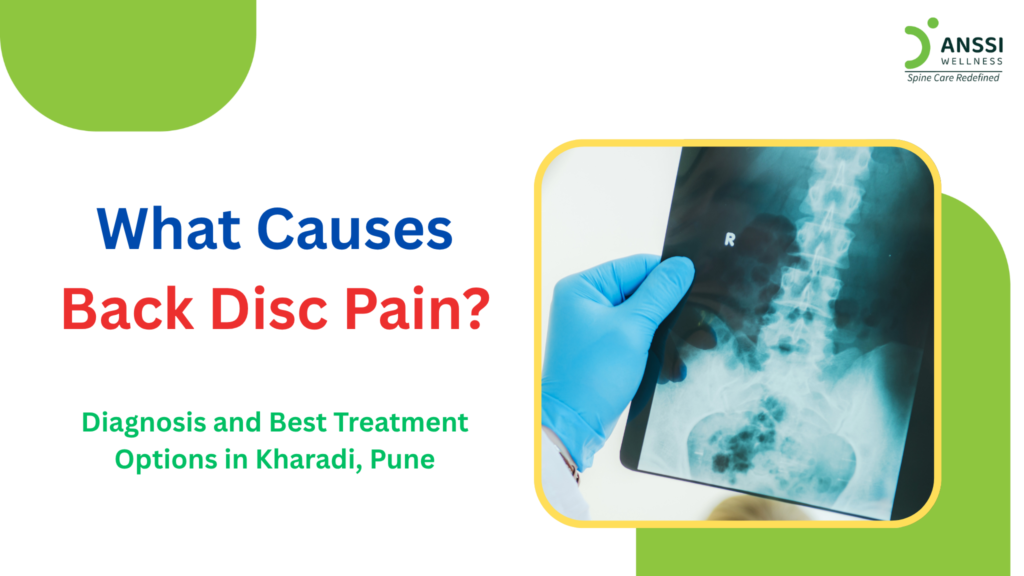
Back pain is one of the most common health problems affecting adults today. For many people, the pain is not simply caused by tired muscles or temporary strain. Problems involving the intervertebral discs can become an important source of persistent, recurring, or radiating back pain.
This can be particularly relevant for people living and working in areas such as Kharadi, Pune, where long working hours, prolonged sitting, commuting, and limited physical activity can place repeated stress on the spine. Understanding what causes disc-related pain, how it is diagnosed, and what non-surgical treatment options are available can help patients make more informed decisions about their spine health.
What Are Intervertebral Discs?
Intervertebral discs are flexible structures positioned between the vertebrae of the spine. They act as cushions, helping absorb forces generated during activities such as walking, bending, lifting, and sitting.
A healthy disc allows movement while helping distribute mechanical loads across the spine. However, discs can undergo wear and structural changes because of ageing, degeneration, repetitive loading, injury, or other factors.
When these changes become symptomatic, they may contribute to different types of back and leg pain.
Common Disc Problems That Can Cause Back Pain
Several conditions involving the intervertebral discs can contribute to lower-back symptoms.
Disc Bulge
A disc bulge occurs when the disc extends beyond its normal boundary. Some disc bulges cause no symptoms and may be discovered incidentally during an MRI. In other cases, a bulging disc can contribute to local back pain or irritation of nearby nerves.
Disc Protrusion and Herniation
A disc protrusion occurs when part of the disc extends outward beyond its usual boundary. With a herniated disc, disc material can extend through a weakened portion of the outer disc.
If the protruding or herniated material irritates a nerve, the patient may experience pain travelling from the lower back into the buttock or leg. This is commonly associated with sciatica and may also involve tingling, numbness, or weakness.
Disc Extrusion
An extrusion is a more specific type of disc herniation in which the displaced disc material extends beyond the outer disc layer. The clinical significance depends on its location, size, relationship to nearby nerves, and the patient’s symptoms.
Degenerative Disc Changes
As discs age, they can lose some of their normal flexibility and hydration. Degenerative changes may contribute to back pain and may occur together with disc bulges or other spinal changes.
It is important to remember that an abnormal MRI finding does not automatically mean it is the cause of pain. The imaging findings must be interpreted along with symptoms and clinical examination.
Why Accurate Diagnosis Matters
Treating back pain effectively starts with understanding its cause. A proper evaluation generally begins with a detailed medical history and physical examination.
A doctor may assess the location and nature of pain, movement limitations, muscle strength, sensation, reflexes, and neurological symptoms. When clinically appropriate, imaging such as an MRI can provide detailed information about discs, nerves, and other spinal structures.
An MRI may help identify disc bulges, protrusions, herniations, degenerative changes, or possible nerve compression. However, treatment should not be based on an MRI report alone.
The patient’s symptoms and clinical findings are equally important.
Does Every Disc Problem Require Surgery?
A diagnosis of a disc bulge or herniation does not automatically mean that surgery is necessary. Depending on the condition, severity, and symptoms, many patients may initially be considered for non-surgical management.
Spinal surgery can be beneficial and necessary in selected situations, but like any major procedure, it can involve risks. These may include infection, bleeding, anaesthesia-related complications, nerve injury, persistent symptoms, and the possibility of additional procedures.
Therefore, patients should discuss the potential benefits, risks, alternatives, and expected recovery with an appropriately qualified specialist before making a decision about surgery.
Non-Surgical Disc Pain Treatment at ANSSI Wellness Kharadi
For appropriately selected patients, a comprehensive non-surgical treatment program may help manage disc-related back pain.
At ANSSI Wellness Kharadi, treatment can be personalised according to the patient’s diagnosis, symptoms, clinical findings, and treatment response.
Physiotherapy can help improve mobility, flexibility, strength, posture, and functional movement. A structured rehabilitation program may include exercises designed to strengthen the muscles supporting the spine.
Posture and ergonomic correction can also be important, particularly for people who spend several hours sitting at a desk. Adjusting the workstation, taking regular movement breaks, learning appropriate lifting techniques, and avoiding prolonged positions that aggravate symptoms may help reduce unnecessary mechanical stress.
Activity modification and lifestyle changes can further support recovery.
Non-Surgical Spinal Decompression Treatment
Another treatment option that may be considered for selected patients with certain disc-related conditions is Non-Surgical Spinal Decompression Treatment (NSSDT).
NSSDT uses controlled, computer-regulated decompressive forces directed at selected spinal segments. The intended objective is to reduce mechanical loading on the affected area and support the management of appropriate disc-related conditions.
NSSDT may form part of a personalised program alongside physiotherapy and other rehabilitation measures. The treatment approach and duration can vary depending on the patient’s condition and response.
Importantly, Non-Surgical Spinal Decompression Treatment is not suitable for every type of back pain or every disc condition. A proper assessment is necessary to determine whether a patient is an appropriate candidate.
Looking Beyond Temporary Pain Relief
When back pain repeatedly returns after rest, medication, or temporary treatment, patients may benefit from reassessing the underlying cause rather than simply managing each painful episode separately.
The objective of comprehensive non-surgical care is to address relevant structural, mechanical, muscular, postural, and lifestyle factors wherever possible. For suitable patients, combining NSSDT with physiotherapy and rehabilitation may provide a structured approach to managing disc-related symptoms.
However, no treatment can guarantee permanent relief for every patient. Outcomes depend on the underlying diagnosis, severity of the condition, individual health, and response to treatment.
When Should You Seek Medical Attention?
Disc-related symptoms should not be ignored when they persist or progressively interfere with daily life. Seek medical evaluation if back pain is accompanied by persistent leg pain, numbness, tingling, weakness, difficulty walking, or worsening neurological symptoms.
New loss of bladder or bowel control, numbness around the groin or saddle region, or rapidly progressing weakness requires urgent medical attention.
About ANSSI:
ANSSI Wellness focuses on improving the quality of life for patients suffering from spinal issues, aiming to provide relief where other conventional treatments have failed. Through advanced Non-Surgical Spinal Decompression Treatment, ANSSI is committed to helping patients avoid surgery and recover in a safe, effective, and compassionate environment.
Book Consultation:
Call +91 9004726844 | 9920936844
Visit www.anssiwellness.com
Connect with ANSSI Wellness on LinkedIn, Instagram, and Facebook for expert guidance.
Clinical References:
- Hoy D, Bain C, Williams G, et al. A systematic review of the global prevalence of low back pain. Arthritis & Rheumatism. 2012;64(6):2028-2037.
- Punnett L, Wegman DH. Work-related musculoskeletal disorders: the epidemiology and cost. Journal of Electromyography and Kinesiology. 2004;14(1):13-23.
- Deyo RA, Weinstein JN. Low back pain. New England Journal of Medicine. 2001;344(5):363-370.
- Yasuma, T; Koh, S; Okamura, T; Yamauchi, Y. Histological changes in aging lumbar intervertebral discs. Their role in protrusions and prolapses.. The Journal of Bone & Joint Surgery 72(2):p 220-229, Feb 1990.
- Ramos G., MD. Efficacy of Vertebral Axial Decompression (VAX-D) on Chronic Low Back Pain: A Study of Dosage Regimen. Journal of Neurological Research, Volume 26, April 2004.
- Gose E., Ph.D, Naguszewski W., MD, Naguszewski R., MD. Vertebral Axial Decompression Therapy for Pain Associated with Herniated or Degenerated Discs or Facet Syndrome: An Outcome Study. Journal of Neurological Research, Volume 20, No 3, April 1998.