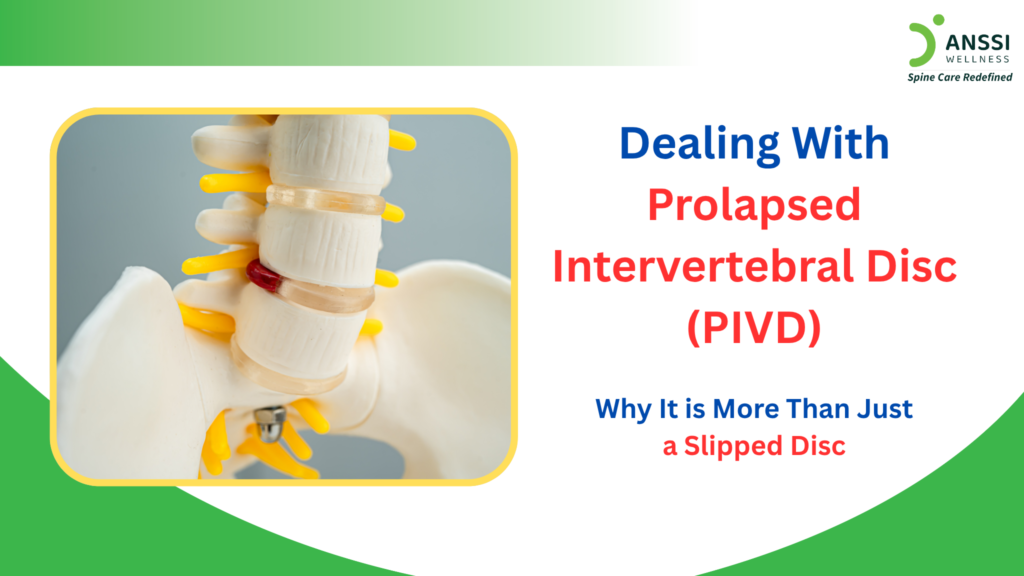
Back pain and neck pain are among the most common health complaints in India today. When these symptoms become severe or start radiating into the arms or legs, many patients are told they have a “slipped disc.” While the term is widely used, it often creates confusion about the actual condition affecting the spine.
In many cases, the diagnosis is Prolapsed Intervertebral Disc (PIVD), a condition that is much more complex than the simple phrase “slipped disc” suggests. Understanding what PIVD is, how it develops, and why it requires timely treatment can help patients make informed decisions about their spinal health and potentially avoid long-term complications.
Understanding the Anatomy of an Intervertebral Disc
The human spine is made up of vertebrae separated by intervertebral discs. These discs act as natural shock absorbers, allowing the spine to move while cushioning it from everyday stresses.
Each disc consists of two main parts:
- Annulus Fibrosus: This is the tough outer ring of the disc made of strong fibrous tissue. It provides structural support and helps contain the inner disc material.
- Nucleus Pulposus: This is the soft, gel-like centre of the disc that absorbs shock and distributes pressure across the spine.
A healthy disc allows smooth spinal movement and protects the vertebrae from excessive stress. However, when a disc begins to deteriorate, it can progress through several stages of damage.
The Progression of Disc Disease: Understanding the Stages
Many patients assume a disc problem develops suddenly, but disc pathology often progresses gradually over time.
Stage 1: Disc Degeneration
The process typically begins with disc degeneration.
As discs age, they lose water content and elasticity. This causes:
- Reduced disc height
- Loss of flexibility
- Increased stress on spinal structures
- Early stiffness and discomfort
At this stage, symptoms may be mild or intermittent.
Stage 2: Disc Bulge
As degeneration progresses, the disc may begin to bulge outward.
In a disc bulge:
- The outer annulus remains intact.
- The disc extends beyond its normal boundary.
- Nearby nerves may become irritated.
Patients may experience occasional pain, stiffness, or mild nerve-related symptoms.
Stage 3: Disc Prolapse (PIVD)
This stage represents a significant progression of disc damage.
In a prolapsed disc:
- The inner nucleus pulposus pushes into weakened areas of the annulus fibrosus.
- The disc structure becomes unstable.
- The risk of nerve compression increases substantially.
This is the stage commonly referred to as Prolapsed Intervertebral Disc (PIVD).
Symptoms often become more noticeable and may include severe pain, tingling, numbness, or weakness.
Stage 4: Disc Extrusion and Sequestration
In advanced cases, disc material may break through the outer disc layers completely.
This can lead to:
- Significant nerve compression
- Severe pain
- Neurological symptoms
- Reduced mobility
In sequestration, a fragment of disc material separates entirely from the disc and moves into the spinal canal, creating further complications.
Common Causes of PIVD in the Indian Population
Several factors contribute to the development of PIVD.
Age-Related Disc Degeneration
Natural wear and tear remains one of the most common causes. As people age, spinal discs gradually lose hydration and become more vulnerable to damage.
Chronic Postural Overload
Modern lifestyles place significant strain on the spine.
Contributing factors include:
- Long hours at computers
- Desk-based occupations
- Smartphone use
- Poor sitting posture
These habits increase pressure on spinal discs and accelerate degeneration.
Sudden Compressive Trauma
Falls, accidents, sports injuries, or lifting heavy objects improperly can place excessive force on the spine and trigger disc injury.
Repetitive Spinal Flexion
Occupations that require repeated bending, twisting, or lifting can gradually weaken disc structures.
Genetic Predisposition
Some individuals may inherit a tendency toward earlier disc degeneration, making them more susceptible to PIVD.
Lumbar PIVD vs Cervical PIVD
The symptoms of PIVD vary depending on the spinal region affected.
Lumbar PIVD
Lumbar PIVD affects the lower back and is one of the most common causes of sciatica.
Typical symptoms include:
- Chronic lower back pain
- Buttock pain
- Leg pain
- Tingling sensations
- Numbness in the legs or feet
- Muscle weakness
When lumbar nerve roots become compressed, symptoms may travel along the course of the sciatic nerve.
Cervical PIVD
Cervical PIVD affects the neck region.
Common symptoms include:
- Neck pain
- Shoulder pain
- Arm pain
- Tingling in the hands or fingers
- Numbness
- Reduced grip strength
These symptoms occur when cervical nerve roots become compressed.
Why Treatment Approaches Differ
Although both conditions involve disc prolapse, the anatomy and nerve pathways differ significantly.
Cervical PIVD typically affects upper limb function, whereas lumbar PIVD mostly affects lower limb function. Therefore, treatment plans must be tailored to the specific spinal region involved.
Importance of Early Diagnosis
Many patients attempt to manage symptoms with rest, painkillers, or home remedies for months before seeking professional help.
Unfortunately, delayed diagnosis can allow nerve compression and spinal degeneration to progress.
Clinical Evaluation
A specialist will assess:
- Pain patterns
- Neurological symptoms
- Muscle strength
- Reflexes
- Range of motion
This helps identify the likely source of symptoms.
MRI-Based Diagnosis
MRI is considered one of the most valuable tools for evaluating PIVD.
It can clearly show:
- Disc degeneration
- Disc bulges
- Disc prolapse
- Nerve compression
- Severity of spinal involvement
Accurate diagnosis allows treatment to target the root cause rather than simply masking symptoms.
Non-Surgical Treatment Options for PIVD
Many patients fear that a PIVD diagnosis automatically means surgery. However, numerous patients can benefit from non-surgical treatment approaches.
Activity Modification and Lifestyle Changes
Reducing activities that place excessive strain on the spine can help minimise further damage.
Important measures include:
- Maintaining proper posture
- Avoiding heavy lifting
- Regular movement and exercise
- Ergonomic workplace adjustments
Physiotherapy and Rehabilitation
A personalised rehabilitation program may help:
- Improve flexibility
- Strengthen supporting muscles
- Enhance spinal stability
- Promote healthier movement patterns
Non-Surgical Spinal Decompression Treatment (NSSDT)
One of the advanced non-surgical options available for disc-related conditions is Non-Surgical Spinal Decompression Treatment (NSSDT).
NSSDT uses specialised technology to gently reduce pressure within affected spinal discs.
Potential benefits include:
- Reduced intradiscal pressure
- Relief of nerve compression
- Improved disc hydration
- Enhanced mobility
- Support for the body’s natural healing processes
Non-Surgical Spinal Decompression Treatment may be incorporated into personalised treatment programs for both lumbar and cervical PIVD patients.
References:
- Jennifer L. Kelsey, Anne L. Golden, Diane J. Mundt. Low Back Pain/Prolapsed Lumbar Intervertebral Disc. Rheumatic Disease Clinics of North America. Volume 16, Issue 3, 1990. Pages 699-716, ISSN 0889-857X. https://doi.org/10.1016/S0889-857X(21)00896-6.
- Yasuma, T; Koh, S; Okamura, T; Yamauchi, Y. Histological changes in aging lumbar intervertebral discs. Their role in protrusions and prolapses.. The Journal of Bone & Joint Surgery 72(2):p 220-229, Feb 1990.
- Adams, M.A. (2015). Intervertebral Disc Tissues. In: Derby, B., Akhtar, R. (eds) Mechanical Properties of Aging Soft Tissues. Engineering Materials and Processes. Springer, Cham.
Gose E., Ph.D, Naguszewski W., MD, Naguszewski R., MD. Vertebral Axial Decompression Therapy for Pain Associated with Herniated or Degenerated Discs or Facet Syndrome: An Outcome Study. Journal of Neurological Research, Volume 20, No 3, April 1998. - Tilaro F., MD, Miskovich D. MD. The Effects of Vertebral Axial Decompression On Sensory Nerve Dysfunction In Patients with Low Back Pain and Radiculopathy. Canadian Journal of Clinical Medicine Vol. 6, No 1, January 1999.
About ANSSI:
ANSSI Wellness focuses on improving the quality of life for patients suffering from spinal issues, aiming to provide relief where other conventional treatments have failed. Through advanced Non-Surgical Spinal Decompression Treatment, ANSSI is committed to helping patients avoid surgery and recover in a safe, effective, and compassionate environment.
Book Consultation:
Call +91 9004726844 | 9920936844
Visit www.anssiwellness.com
Connect with ANSSI Wellness on LinkedIn, Instagram, and Facebook for expert guidance.