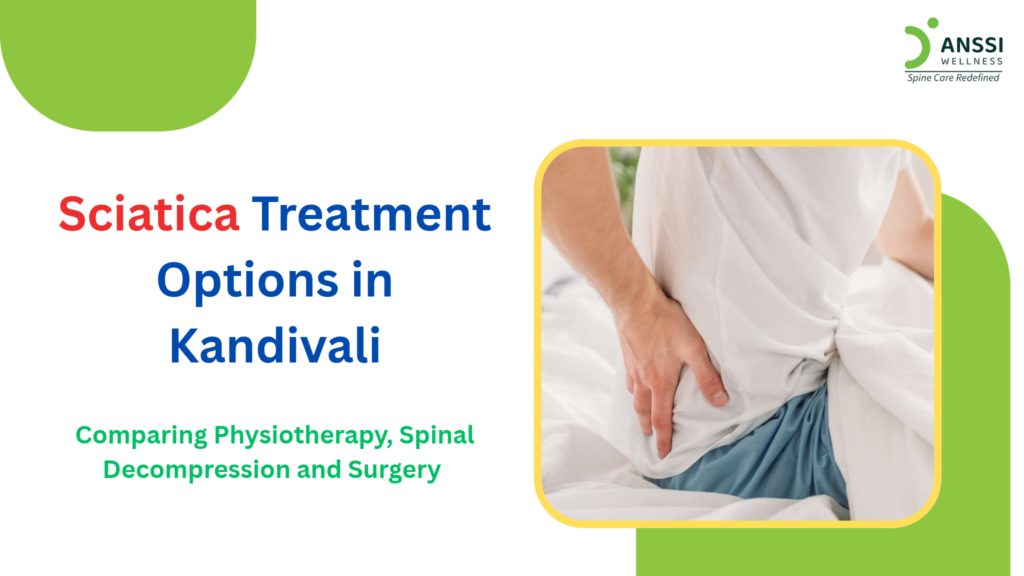
Sciatica is a common source of lower back and leg pain that can make everyday activities difficult. For residents of Kandivali, long working hours, prolonged sitting, daily commuting, and physically demanding routines can make persistent sciatica particularly challenging. When pain continues despite medication or basic exercises, patients often wonder which treatment offers the best chance of long-term relief.
Three commonly considered treatment pathways are conventional physiotherapy, Non-Surgical Spinal Decompression Treatment (NSSDT), and spine surgery. Each has different benefits, limitations, costs, and recovery requirements. Understanding these differences can help patients make informed decisions based on their diagnosis, symptoms, and financial circumstances.
Understanding Disc-Related Sciatica
Sciatica refers to pain that travels from the lower back through the buttock and into one or both legs. It commonly occurs when a lumbar nerve root becomes irritated or compressed.
One possible cause is a herniated or bulging intervertebral disc, particularly at the L4-L5 or L5-S1 spinal levels. Other causes include spinal stenosis and degenerative changes.
Common symptoms include:
- Pain radiating from the lower back into the buttock or leg.
- Tingling, numbness, or burning sensations.
- Discomfort while sitting, bending, or walking.
- Weakness in the affected leg or foot.
Not every case of sciatica is caused by a slipped disc. Therefore, an appropriate clinical examination is essential before selecting a treatment.
Option 1: Conventional Physiotherapy
Conventional physiotherapy is often an important first-line treatment for many patients with sciatica, particularly when there are no serious neurological complications.
A physiotherapy programme may include:
- Strengthening exercises: Improving the strength and endurance of the abdominal, back, and hip muscles.
- Mobility exercises: Supporting comfortable movement of the lower back and hips.
- Nerve mobilisation: Carefully selected movements that may help reduce sensitivity around irritated nerves.
- Posture and movement education: Learning safer ways to sit, bend, lift, and perform daily activities.
- Activity modification: Avoiding prolonged bed rest while gradually returning to suitable activities.
Benefits and Limitations
Physiotherapy is generally less expensive than surgery and does not involve hospitalisation. It also helps patients develop long-term movement and exercise habits.
However, improvement may take time and requires consistent participation. Some patients may continue experiencing symptoms despite completing an appropriate rehabilitation programme.
For middle-income families in Kandivali, physiotherapy can be a practical starting point because it is generally accessible and has an established role in conservative sciatica management.
Option 2: Non-Surgical Spinal Decompression Treatment (NSSDT)
Non-Surgical Spinal Decompression Treatment is another option that may be considered for selected patients with disc-related lower back pain and sciatica.
The treatment uses a specialised computer-controlled table and harness system to apply carefully regulated stretching forces to targeted spinal segments.
The objective is to modify mechanical loading around the affected spinal region. This approach may help some patients manage disc-related symptoms, although clinical evidence remains mixed and its effectiveness is not established as superior to conventional physiotherapy.
Potential Benefits and Limitations
NSSDT is non-invasive and does not involve surgical incisions or hospitalisation. It may be considered when a patient has persistent disc-related symptoms and a clinician determines that decompression is appropriate.
However, patients should understand that:
- It is not suitable for every type of sciatica.
- Treatment outcomes vary between individuals.
At ANSSI Wellness, Kandivali, patients can explore Non-Surgical Spinal Decompression Treatment alongside physiotherapy and individualised rehabilitation guidance, subject to clinical assessment.
Option 3: Spine Surgery
Surgery may be recommended when sciatica is severe, persistent, and significantly affects daily functioning despite appropriate non-surgical treatment.
One commonly performed procedure for disc-related sciatica is a discectomy or microdiscectomy. During this procedure, the surgeon removes the portion of the herniated disc that is irritating or compressing the nerve.
Benefits and Risks
For appropriately selected patients, surgery can provide faster relief from leg pain than continued conservative treatment. It may be particularly beneficial when neurological symptoms are worsening, or nerve compression is substantial.
However, surgery also involves potential risks, including:
- Infection and bleeding.
- Nerve injury or complications related to anaesthesia.
- Persistent or recurring symptoms.
- Recurrent disc herniation.
- Recovery restrictions and rehabilitation requirements.
Patients may need time away from work and may face additional expenses related to hospitalisation, surgery, medication, and follow-up care.
Surgery should not be considered a last resort in every situation. Progressive weakness, serious nerve compression, or other urgent conditions may require prompt surgical evaluation.
Comparing the Three Treatment Options
| Factor | Physiotherapy | NSSDT | Surgery |
|---|---|---|---|
| Approach | Exercise-based rehabilitation | Computer-controlled decompression | Surgical intervention |
| Invasiveness | Non-invasive | Non-invasive | Invasive |
| Evidence | Established conservative approach | Mixed and variable | Established for selected indications |
| Cost | Generally lower | Varies by programme | Usually higher |
| Recovery | Gradual improvement | Varies between patients | Postoperative recovery required |
| Main consideration | Consistency and participation | Suitability and uncertain benefits | Surgical risks and recovery |
Actual costs depend on the clinic, treatment plan, hospital, and individual medical requirements. Patients should request a clear estimate rather than relying on general price comparisons.
Which Sciatica Treatment is Right for You in Kandivali?
There is no single treatment that is best for every patient with sciatica.
For many patients without serious neurological complications, physiotherapy and other conservative measures are appropriate initial options. NSSDT may be explored in selected disc-related cases after a clinical assessment, particularly when patients want to understand additional non-surgical approaches.
Surgery may offer meaningful benefits when symptoms remain disabling or neurological complications require intervention.
Residents of Kandivali should consider the diagnosis, severity of symptoms, MRI findings where indicated, medical history, expected outcomes, treatment costs, and recovery requirements before making a decision.
About ANSSI:
ANSSI Wellness focuses on improving the quality of life for patients suffering from spinal issues, aiming to provide relief where other conventional treatments have failed. Through advanced Non-Surgical Spinal Decompression Treatment, ANSSI is committed to helping patients avoid surgery and recover in a safe, effective, and compassionate environment.
Book Consultation:
Call +91 9004726844 | 9920936844
Visit www.anssiwellness.com
Connect with ANSSI Wellness on LinkedIn, Instagram, and Facebook for expert guidance.