
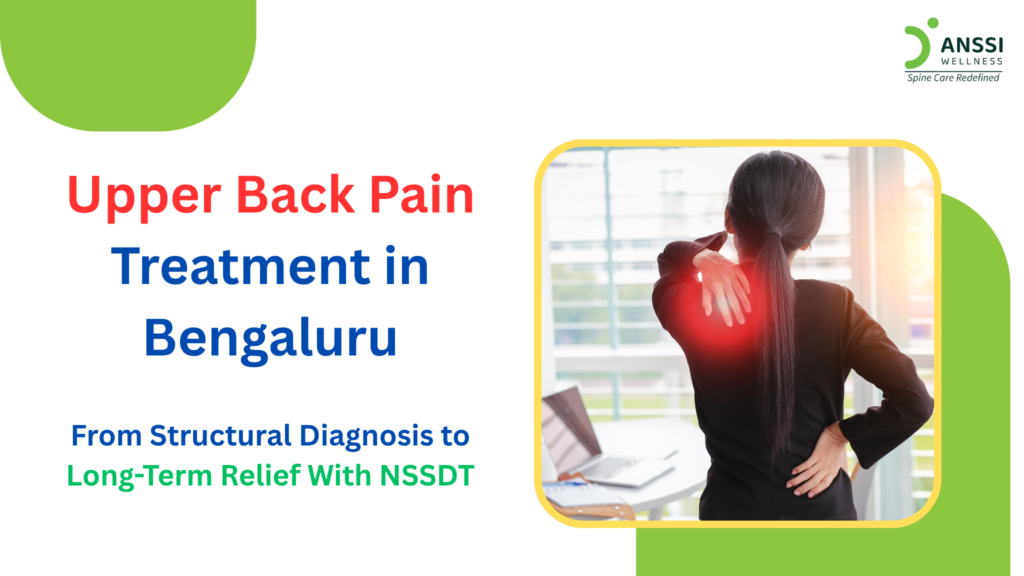
Bengaluru, often known as India’s IT capital, is home to millions of professionals who spend long hours working on computers, commuting through heavy traffic, and maintaining largely sedentary lifestyles. These factors have contributed to a growing incidence of upper back pain among the city’s residents.
Poor posture while using laptops and smartphones, prolonged sitting, inadequate ergonomic support, and work-related stress can place excessive strain on the thoracic spine, muscles, and surrounding joints. While many people initially assume their discomfort is due to simple muscle tension, persistent upper back pain may be linked to underlying structural conditions such as thoracic disc degeneration, nerve compression, facet joint dysfunction, or postural overload.
Unfortunately, structural causes of upper back pain are frequently overlooked, leading to delayed diagnosis and prolonged suffering. The first step to obtaining long-term relief from thoracic spine discomfort is to comprehend its underlying cause. With modern diagnostic techniques and advanced treatments such as Non-Surgical Spinal Decompression Treatment (NSSDT), patients now have access to effective non-surgical solutions that address the root cause of their symptoms.
Understanding Upper Back Pain: The Thoracic Spine
The upper and middle back are formed by the thoracic spine, which consists of twelve vertebrae located between the neck and lower back. Unlike the cervical and lumbar regions, the thoracic spine is connected to the rib cage, providing stability and protection to vital organs.
Several structures within the thoracic spine can contribute to pain, including:
- Intervertebral discs
- Facet joints
- Costovertebral joints (where ribs connect to the spine)
- Ligaments and muscles
- Spinal nerves
When any of these structures become damaged, inflamed, or compressed, chronic upper back pain can develop.
Structural Causes of Chronic Upper Back Pain
Thoracic Disc Degeneration and Herniation
Like discs in other parts of the spine, thoracic discs can gradually lose water content and elasticity with age and repetitive stress.
As degeneration progresses, discs may:
- Lose height
- Become less effective shock absorbers
- Develop bulges or herniations
A herniated thoracic disc can place pressure on nearby nerves and contribute to persistent pain.
Thoracic Nerve Compression
Compressed thoracic nerves may produce symptoms beyond the spine itself.
Patients may experience:
- Pain between the shoulder blades
- Pain wrapping around the ribs
- Chest wall discomfort
- Tingling or burning sensations
Because these symptoms can mimic other conditions, thoracic nerve compression is sometimes overlooked.
Facet Joint and Costovertebral Joint Dysfunction
The facet joints and rib-spine joints help facilitate movement and stability.
Degeneration or irritation of these joints can result in:
- Localised upper back pain
- Pain during twisting movements
- Stiffness and reduced mobility
Postural Overload
Modern work habits place considerable stress on the thoracic spine.
Prolonged:
- Computer work,
- Smartphone use,
- Sitting in poor posture, and
- Driving,
can increase mechanical loading on the thoracic discs and joints, accelerating degeneration over time.
The Importance of Accurate Structural Diagnosis
Many patients spend months or even years treating symptoms without receiving a precise diagnosis.
Clinical Assessment
A thorough evaluation begins with understanding:
- Pain patterns
- Aggravating activities
- Postural habits
- Neurological symptoms
- Functional limitations
A detailed physical examination can help identify potential sources of thoracic pain.
MRI-Based Evaluation
MRI plays a crucial role in identifying structural abnormalities within the thoracic spine.
MRI can reveal:
- Disc degeneration
- Disc bulges and herniations
- Nerve compression
- Joint degeneration
- Soft tissue changes
Without imaging, structural causes may remain undetected, leading to incomplete treatment.
Why Conventional Treatments Often Fall Short
Painkillers and Temporary Relief
Pain medication can provide short-term symptom relief, particularly during painful flare-ups.
However, painkillers do not:
- Restore disc height
- Reduce disc pressure
- Relieve structural nerve compression
- Correct spinal degeneration
As a result, symptoms often return when medication is discontinued.
General Physiotherapy
Physiotherapy can improve flexibility, posture, and muscular support.
Many patients benefit from:
- Strengthening exercises
- Stretching programs
- Mobility training
However, when significant thoracic disc pathology or nerve compression is present, physiotherapy alone may not fully address the underlying structural problem.
This highlights the importance of combining rehabilitation with treatments that target the source of pain.
NSSDT: A Structural Non-Surgical Solution
Non-Surgical Spinal Decompression Treatment (NSSDT) is an advanced treatment approach designed to address disc-related spinal conditions without surgery.
Restoring Thoracic Disc Height
One of the primary goals of NSSDT is to gently reduce compressive forces acting on the spinal discs.
Improving disc spacing may help:
- Reduce pressure on spinal nerves
- Improve joint mechanics
- Enhance spinal mobility
Negative Intradiscal Pressure
NSSDT creates controlled decompressive forces within the spine.
This process may:
- Reduce intradiscal pressure
- Encourage disc rehydration
- Support the retraction of disc bulges and herniations
Improved disc health can contribute to reduced pain and better spinal function.
Reducing Joint Loading
By reducing excessive pressure within the thoracic spine, NSSDT may also decrease stress on:
- Facet joints
- Costovertebral joints
- Supporting spinal structures
This can improve comfort during daily movement.
Benefits of NSSDT
Potential benefits include:
- Reduced upper back pain
- Improved mobility
- Better posture
- Relief of nerve-related symptoms
- Enhanced quality of life
Because NSSDT is non-invasive, patients can often pursue treatment without the risks associated with surgery.
The ANSSI Wellness Treatment Pathway
At ANSSI Wellness, upper back pain treatment begins with understanding the specific structural cause of each patient’s symptoms.
Comprehensive Diagnostic Assessment
The process includes:
- Detailed clinical examination
- Review of MRI findings
- Functional assessment
- Identification of contributing lifestyle factors
This comprehensive evaluation helps create an accurate diagnosis.
Personalised NSSDT Program Design
Every patient receives an individualised treatment plan based on:
- Diagnosis
- Symptom severity
- Functional limitations
- Overall spinal health
The goal is to address both the source of pain and factors contributing to its progression.
Expected Treatment Progression
As treatment progresses, patients may experience:
- Reduction in pain intensity
- Improved flexibility
- Better posture
- Enhanced ability to perform daily activities
Progress is monitored throughout the treatment program.
Post-Treatment Rehabilitation
Recovery extends beyond symptom relief.
Patients are guided through rehabilitation strategies, including:
- Thoracic posture correction
- Strengthening exercises
- Mobility training
- Functional movement education
These measures help support long-term results.
Long-Term Spine Health Maintenance
Maintaining spinal health requires ongoing attention to daily habits.
Patients are encouraged to adopt:
- Ergonomic workplace practices
- Regular movement breaks
- Thoracic mobility exercises
- Healthy posture habits
These strategies help reduce future stress on the spine.
About ANSSI:
ANSSI Wellness focuses on improving the quality of life for patients suffering from spinal issues, aiming to provide relief where other conventional treatments have failed. Through advanced Non-Surgical Spinal Decompression Treatment, ANSSI is committed to helping patients avoid surgery and recover in a safe, effective, and compassionate environment.
Book Consultation:
Call +91 9004726844 | 9920936844
Visit www.anssiwellness.com
Connect with ANSSI Wellness on LinkedIn, Instagram, and Facebook for expert guidance.
Clinical References:
- Ruiz Santiago F, Láinez Ramos-Bossini AJ, Wáng YXJ, Martínez Barbero JP, García Espinosa J, Martínez Martínez A. The value of magnetic resonance imaging and computed tomography in the study of spinal disorders.
- Ramos G., MD, Martin W., MD. Effects of Vertebral Axial Decompression On Intradiscal Pressure. Journal of Neurosurgery 81: 350-353, 1994
- Gose E., Ph.D, Naguszewski W., MD, Naguszewski R., MD. Vertebral Axial Decompression Therapy for Pain Associated with Herniated or Degenerated Discs or Facet Syndrome: An Outcome Study. Journal of Neurological Research, Volume 20, No 3, April 1998.
- Tilaro F., MD. An Overview of Vertebral Axial Decompression. Canadian Journal of Clinical Medicine Vol. 5, No 1, January 1998.