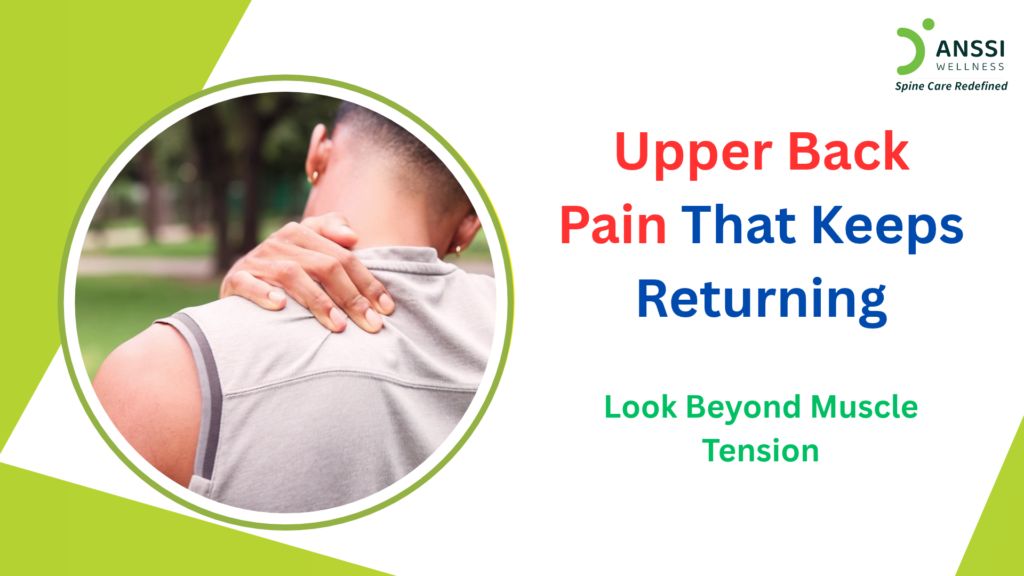
When Upper Back Pain Keeps Coming Back
Pain between the shoulder blades is a common complaint among people who spend long hours sitting at desks, working on computers, driving, or performing repetitive activities. It is often dismissed as muscle tension caused by poor posture, stress, or physical fatigue.
Massage, heat therapy, and muscle relaxants may provide temporary relief. However, for some individuals, the discomfort returns within a few days or weeks. This recurring pattern raises an important question: Is the pain really coming from the muscles, or could an underlying spinal condition be responsible?
The thoracic spine, which forms the middle portion of the back, contains vertebrae, intervertebral discs, joints, ligaments, and nerves. Problems affecting these structures can produce pain between the shoulder blades. Understanding the possible causes is essential for choosing appropriate treatment.
Thoracic Disc Degeneration: When Spinal Discs Begin to Change
The thoracic spine consists of 12 vertebrae, extending from the base of the neck to the lower back. Between these vertebrae are intervertebral discs that help absorb mechanical forces and allow controlled spinal movement.
With ageing and degeneration, these discs may gradually lose water content and elasticity. Their structure can change, sometimes resulting in reduced disc height, small tears in the outer disc fibres, or disc bulging.
These changes are known as thoracic disc degeneration.
Although thoracic disc degeneration does not always cause symptoms, it may contribute to discomfort when associated with inflammation, mechanical stress, or irritation of nearby structures.
Possible symptoms include:
- Persistent aching in the middle or upper back.
- Pain that becomes worse after prolonged sitting.
- Discomfort during certain twisting or bending movements.
- Pain that spreads around the rib cage in some cases.
- Tingling, numbness, or other neurological symptoms if a nerve is affected.
Thoracic disc problems are less common than cervical or lumbar disc conditions. Therefore, persistent symptoms should be evaluated rather than automatically attributed to a disc problem.
Facet Joint Dysfunction: An Often-Overlooked Cause
The facet joints are small joints located at the back of the spine. They connect neighbouring vertebrae and help guide and limit spinal movement.
Like other joints, thoracic facet joints can develop degenerative changes over time. Irritation, inflammation, joint stiffness, or altered mechanical loading may contribute to pain.
Facet-related upper back pain may be experienced as:
- Localised discomfort near the spine or between the shoulder blades.
- Pain that increases when twisting or extending the upper back.
- Stiffness after remaining in one position.
- Tenderness around the affected joint region.
Because facet joint pain can resemble muscular discomfort, it may be difficult to identify without a proper clinical examination. Imaging can reveal degenerative changes, but these findings alone cannot confirm that a particular joint is responsible for the pain.
Cervicothoracic Referred Pain: When the Neck Causes Upper Back Discomfort
Not all pain between the shoulder blades originates in the thoracic spine. Sometimes, the source is higher up, in the cervical spine (neck).
The lower cervical vertebrae and upper thoracic region work together during everyday movements. Degenerative changes, joint irritation, or muscular and ligament-related problems in this area may produce referred pain.
This means that discomfort originating in one region is felt somewhere else.
For example, cervical disc or facet joint problems may contribute to pain around the shoulder blades, even when the person does not experience severe neck pain.
Some individuals may also experience:
- Neck stiffness alongside upper back discomfort.
- Pain spreading towards one shoulder.
- Discomfort that increases when turning or tilting the head.
- Pain radiating into an arm.
- Tingling or numbness when cervical nerves are involved.
A detailed examination of both the cervical and thoracic spine may therefore be necessary to identify the source of recurring pain.
Why Massage and Muscle Relaxants May Provide Only Temporary Relief
Massage, heat therapy, and muscle relaxants can help reduce muscular tension and discomfort. They may be useful when muscle strain or spasm is contributing to the symptoms.
However, temporary symptom relief does not necessarily mean that the underlying cause has been corrected.
For example, if pain is associated with thoracic disc degeneration, facet joint irritation, or cervical referred pain, relaxing the surrounding muscles may not resolve the contributing spinal problem.
This is why recurring upper back pain deserves a proper assessment. A healthcare professional may review the patient’s symptoms, examine spinal movement and neurological function, and recommend imaging such as an MRI when clinically necessary.
The objective is to distinguish muscular pain from disc-related, joint-related, neurological, or other medical causes.
NSSDT: Exploring Non-Surgical Spinal Decompression
Non-Surgical Spinal Decompression Treatment (NSSDT) uses a specialised, computer-controlled table and harness to apply carefully regulated decompression to selected spinal segments.
- The proposed mechanism involves changing the mechanical forces acting on the targeted spinal region. Controlled traction may temporarily alter intradiscal pressure and loading around selected spinal structures.
- For patients with certain disc-related conditions, these mechanical changes are proposed to help reduce stress around affected segments.
- Its suitability for thoracic spinal conditions must be assessed individually.
When clinically appropriate, it may be considered as one component of a broader rehabilitation plan that includes physiotherapy, movement training, and activity modification.
When Should You Seek Medical Attention?
Do not ignore persistent or worsening pain between the shoulder blades, especially when accompanied by numbness, weakness, difficulty walking, or other neurological symptoms.
Upper back pain can sometimes arise from conditions outside the spine, including heart, lung, or gastrointestinal problems. Seek emergency medical attention if pain is accompanied by chest pressure, breathlessness, sweating, fainting, or sudden severe discomfort.
New bladder or bowel dysfunction, rapidly worsening weakness, or significant balance problems also require urgent medical assessment.
About ANSSI:
ANSSI Wellness focuses on improving the quality of life for patients suffering from spinal issues, aiming to provide relief where other conventional treatments have failed. Through advanced Non-Surgical Spinal Decompression Treatment, ANSSI is committed to helping patients avoid surgery and recover in a safe, effective, and compassionate environment.
Book Consultation:
Call +91 9004726844 | 9920936844
Visit www.anssiwellness.com
Connect with ANSSI Wellness on LinkedIn, Instagram, and Facebook for expert guidance.