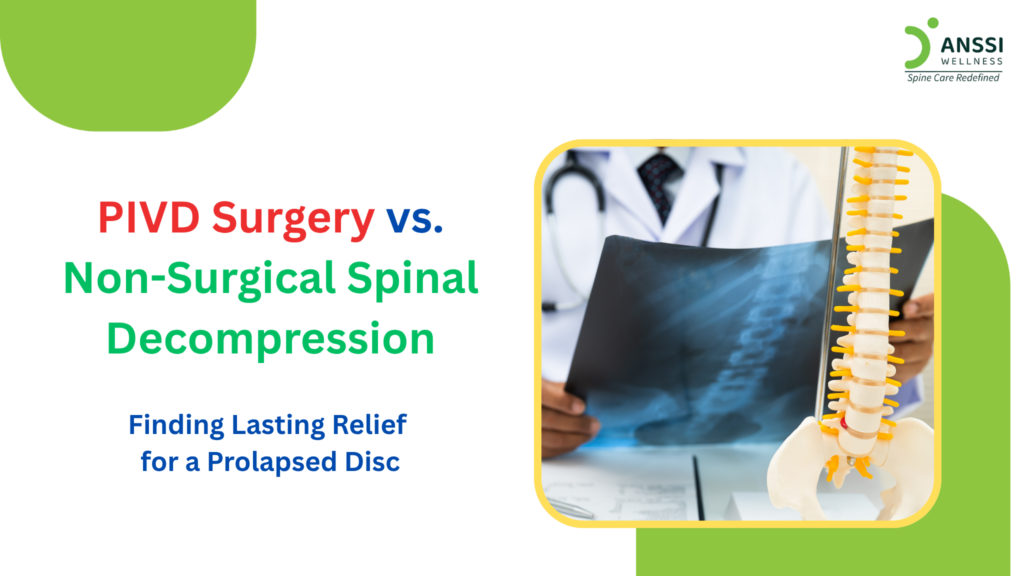
A diagnosis of Prolapsed Intervertebral Disc (PIVD) can be overwhelming. Many patients experience severe back or neck pain, sciatica, tingling, numbness, or muscle weakness, and are often told that surgery may be necessary. Naturally, this leads to an important question: Should you undergo surgery immediately, or is there a safe non-surgical option that can provide lasting relief?
The answer depends on the severity of your condition, your symptoms, neurological findings, and imaging results. While surgery is the right choice for some patients, many others may benefit from comprehensive conservative treatment. Understanding the differences between surgical treatment and Non-Surgical Spinal Decompression Treatment (NSSDT) can help you make a more informed decision with your spine specialist.
Understanding PIVD
The spine consists of vertebrae separated by intervertebral discs, which function as shock absorbers and allow flexibility during movement.
In PIVD, the tough outer layer of the disc weakens or tears, allowing part of the soft inner material to protrude outward. This prolapsed disc may irritate or compress nearby spinal nerve roots, resulting in symptoms such as:
- Persistent back or neck pain
- Pain radiating into the arms or legs
- Sciatica
- Tingling or numbness
- Muscle weakness
- Difficulty walking or performing daily activities
Not every prolapsed disc causes severe symptoms, and treatment recommendations should always be based on both clinical findings and imaging results.
When is Surgery Recommended?
Two commonly performed operations for PIVD are discectomy and microdiscectomy.
In these procedures, the surgeon removes part of the prolapsed disc that is compressing the nerve root. Microdiscectomy uses specialised instruments and smaller incisions, while the overall objective remains the same: to relieve nerve compression and reduce symptoms.
Surgery may be appropriate in situations such as:
- Progressive muscle weakness
- Cauda equina syndrome (loss of bladder or bowel control with severe neurological symptoms)
- Significant neurological deficits confirmed during examination
- Persistent disabling symptoms that have not improved despite appropriate conservative treatment
For these patients, timely surgery may help prevent permanent neurological damage.
Understanding the Limitations and Risks of Surgery
Although spinal surgery has helped many patients, it is important to understand that every surgical procedure carries certain risks and limitations.
General surgical risks include:
- Infection
- Bleeding
- Anaesthetic complications
- Recovery time following the procedure
In addition, some patients may experience:
Recurrent Disc Herniation
After surgery, a disc may herniate again at the same level of the spine, especially if underlying degenerative abnormalities persist.
Epidural Fibrosis
Scar tissue may develop around the surgical site. While scar formation is a normal part of healing, in some patients it may contribute to persistent nerve irritation.
Persistent or Recurrent Pain
Although many patients experience improvement after surgery, some continue to have pain due to multiple contributing factors. Recovery varies between individuals and depends on the underlying pathology, surgical findings, and overall health.
Changes in Spinal Mechanics
Removing disc material may alter the biomechanics of the affected spinal segment to some degree. The long-term significance of these changes varies between patients and depends on several clinical factors.
Because outcomes differ from one individual to another, surgery should be recommended only after careful assessment of the patient’s symptoms, neurological examination, and imaging findings.
Comprehensive Non-Surgical Treatment
Many patients with PIVD improve without surgery through structured conservative care.
Treatment commonly includes:
- Physiotherapy
- Core strengthening exercises
- Posture correction
- Ergonomic advice
- Activity modification
- Guided rehabilitation
- Medications for symptom control when clinically appropriate
These approaches aim to reduce pain, improve spinal stability, and restore normal function.
The Role of Non-Surgical Spinal Decompression Treatment
For appropriately selected patients with disc-related PIVD, Non-Surgical Spinal Decompression Treatment (NSSDT) may be incorporated into a personalised rehabilitation programme.
Using computer-controlled technology, NSSDT is designed to apply carefully controlled distraction forces to the affected spinal segment. The treatment aims to:
- Reduce pressure within the affected disc
- Decrease mechanical stress on compressed nerve roots
- Support disc hydration
- Improve spinal function when combined with physiotherapy and rehabilitation
Unlike surgery, NSSDT does not involve an incision, general anaesthesia, or hospitalisation.
However, it is important to recognise that treatment outcomes vary between individuals. While some studies suggest spinal decompression may improve symptoms in selected patients with disc-related conditions, it should not be viewed as a guaranteed solution for every prolapsed disc. Suitability depends on careful evaluation by a qualified spine specialist.
Which Patients May Benefit Most from NSSDT?
NSSDT may be considered for carefully selected patients who have:
- Mild to moderate disc prolapse
- Persistent symptoms despite initial conservative care
- No severe neurological deficit
- A desire to avoid surgery where clinically appropriate
The decision is based on:
- MRI findings
- Neurological examination
- Duration of symptoms
- Functional limitations
- Overall clinical assessment
When Surgery May Still Be the Better Option
Although conservative treatment helps many patients, surgery remains the preferred option in specific situations.
These include:
- Progressive muscle weakness
- Significant spinal cord or nerve root compression
- Cauda equina syndrome
- Severe neurological deterioration
- Persistent disabling symptoms despite appropriate non-surgical treatment
In such cases, delaying surgery may increase the risk of permanent nerve damage.
Why Early Specialist Evaluation Matters
Choosing the right treatment begins with an accurate diagnosis.
A qualified spine specialist performs:
- Detailed medical history
- Physical examination
- Neurological assessment
- MRI review where clinically indicated
Treatment decisions should never rely on MRI findings alone. Instead, they should consider the patient’s symptoms, neurological function, and overall health.
About ANSSI:
ANSSI Wellness focuses on improving the quality of life for patients suffering from spinal issues, aiming to provide relief where other conventional treatments have failed. Through advanced Non-Surgical Spinal Decompression Treatment, ANSSI is committed to helping patients avoid surgery and recover in a safe, effective, and compassionate environment.
Book Consultation:
Call +91 9004726844 | 9920936844
Visit www.anssiwellness.com
Connect with ANSSI Wellness on LinkedIn, Instagram, and Facebook for expert guidance.
Clinical References:
- Kreiner DS et al. North American Spine Society. An evidence-based clinical guideline for the diagnosis and treatment of lumbar disc herniation with radiculopathy. Spine J. 2014 Jan;14(1):180-91.
- Yasuma, T; Koh, S; Okamura, T; Yamauchi, Y. Histological changes in aging lumbar intervertebral discs. Their role in protrusions and prolapses.. The Journal of Bone & Joint Surgery 72(2):p 220-229, Feb 1990.
- Beattie PF., Nelson R., Michener L., Cammarata J., Donely J. Short And Long-Term Outcomes Following Treatment with the VAX-D Protocol for Patients with Chronic, Activity Limiting Low Back Pain. Journal of Orthopaedic & Sports Physical Therapy, Volume 35, Number 1, January 2005.
- Ramos G., MD. Efficacy of Vertebral Axial Decompression (VAX-D) on Chronic Low Back Pain: A Study of Dosage Regimen. Journal of Neurological Research, Volume 26, April 2004.