Lower back pain that travels into the leg is one of the most common reasons people seek medical attention. For many residents of Ghatkopar, persistent back pain, numbness, tingling, or weakness eventually leads to an MRI scan, which often reveals a slipped disc, also known as a disc herniation. Receiving this diagnosis can be worrying, especially if surgery is suggested as a possible treatment.
While surgery is necessary for certain severe spinal conditions, many patients with slipped discs can benefit from carefully planned non-surgical treatment. Understanding the condition and the available treatment options can help patients make informed decisions about their recovery.
Understanding a Slipped Disc
The spine is made up of vertebrae separated by intervertebral discs that act as shock absorbers. Each disc has a tough outer layer and a soft, gel-like centre.
A slipped disc occurs when a portion of the inner material bulges or protrudes outward due to the weakening or tearing of the outer layer. This herniated disc may press against nearby spinal nerves, causing inflammation and nerve irritation.
The symptoms depend on the location and severity of the herniation. Common symptoms include:
- Persistent lower back or neck pain
- Pain radiating into the leg (sciatica) or arm
- Tingling or numbness
- Muscle weakness
- Difficulty standing, walking, bending, or lifting
- Pain that worsens during coughing, sneezing, or prolonged sitting
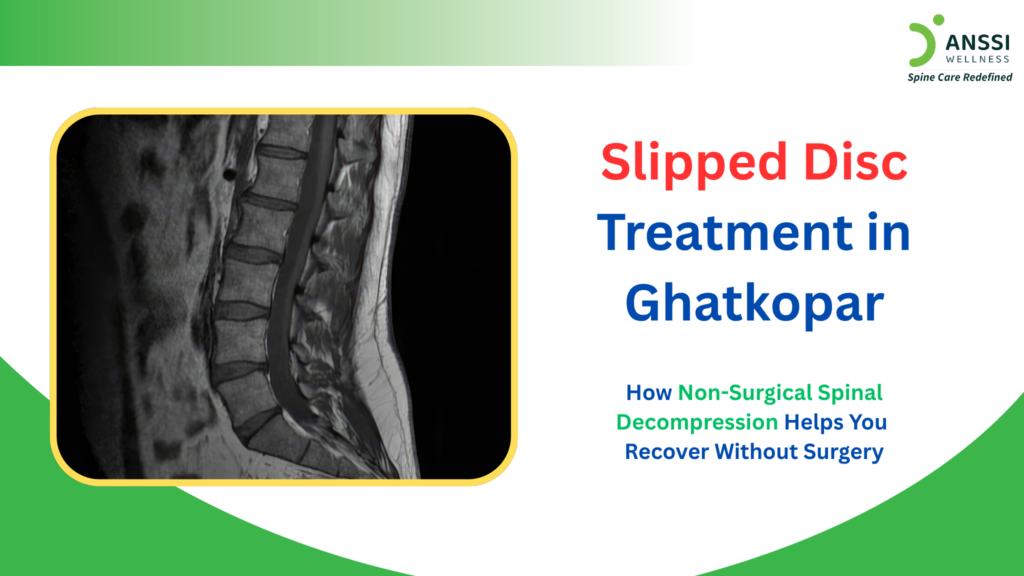
MRI scans play an important role in identifying disc herniation and nerve compression. However, it is important to remember that MRI findings should always be interpreted alongside
a patient’s symptoms and clinical examination, as not every disc bulge causes pain or requires intervention.
Why Surgery is Not Always the First Choice
When conservative treatments fail to relieve symptoms or significant nerve compression is present, surgery may sometimes be recommended.
Common procedures include microdiscectomy and lumbar discectomy, both of which aim to remove the portion of the disc compressing the nerve.
Although many patients experience good outcomes after surgery, every surgical procedure carries recognised risks. These include:
- Infection
- Bleeding
- Nerve injury
- Recurrent disc herniation
- Scar tissue formation around the nerve (epidural fibrosis)
- Persistent pain following surgery, sometimes referred to as Failed Back Surgery Syndrome (FBSS)
FBSS describes situations in which patients continue to experience chronic pain despite technically successful surgery. While this complication does not occur in every patient, it highlights the importance of carefully evaluating whether surgery is truly necessary.
There are situations where surgery remains essential. Conditions such as cauda equina syndrome, progressive muscle weakness, or severe neurological deterioration require urgent surgical assessment to prevent permanent nerve damage.
For many patients without these emergency indications, comprehensive conservative management may be considered before surgery.
How Non-Surgical Spinal Decompression Treatment (NSSDT) Works
For appropriately selected patients with disc-related spinal disorders, Non-Surgical Spinal Decompression Treatment (NSSDT) forms a crucial part of the comprehensive rehabilitation programme.
NSSDT uses a computer-controlled spinal decompression system that gently applies carefully regulated decompression forces to the affected area of the spine. This creates controlled negative pressure within the intervertebral disc.
The reduction in intradiscal pressure is designed to:
- Reduce mechanical stress on compressed nerve roots
- Encourage gradual disc retraction
- Support natural disc hydration
- Improve the environment for disc healing
Unlike surgery, NSSDT does not require incisions, general anaesthesia, or hospital admission. Treatment is provided on an outpatient basis, allowing many patients to continue their normal daily routine during rehabilitation.
Spinal decompression is not often performed as a standalone treatment. Instead, it is combined with:
- Physiotherapy
- Posture correction
- Core strengthening exercises
- Flexibility training
- Ergonomic education
- Lifestyle modification
This multidisciplinary approach aims to improve spinal function while addressing the mechanical factors that contribute to chronic pain.
Who May Benefit?
Following a detailed orthopaedic consultation and clinical assessment, NSSDT may be considered for appropriately selected patients with conditions such as:
- Lumbar disc herniation
- Cervical disc herniation
- Disc bulges
- Disc-related sciatica
- Degenerative disc disease
Treatment suitability depends on several important factors, including:
- Clinical examination
- Neurological assessment
- MRI findings
- Overall health status
- Severity and duration of symptoms
Not every patient with a slipped disc is a suitable candidate for spinal decompression. Some individuals with advanced neurological deficits or emergency spinal conditions require surgical management instead. For this reason, an accurate diagnosis by an experienced spine specialist is essential before selecting the most appropriate treatment.
About ANSSI:
ANSSI Wellness focuses on improving the quality of life for patients suffering from spinal issues, aiming to provide relief where other conventional treatments have failed. Through advanced Non-Surgical Spinal Decompression Treatment, ANSSI is committed to helping patients avoid surgery and recover in a safe, effective, and compassionate environment.
Book Consultation:
Call +91 9004726844 | 9920936844
Visit www.anssiwellness.com
Connect with ANSSI Wellness on LinkedIn, Instagram, and Facebook for expert guidance.
Clinical References:
- North American Spine Society. Evidence-based recommendations for the diagnosis and conservative and surgical management of lumbar disc herniation.
- Kreiner DS et al. North American Spine Society. An evidence-based clinical guideline for the diagnosis and treatment of lumbar disc herniation with radiculopathy. Spine J. 2014 Jan;14(1):180-91.
- Yasuma, T; Koh, S; Okamura, T; Yamauchi, Y. Histological changes in aging lumbar intervertebral discs. Their role in protrusions and prolapses.. The Journal of Bone & Joint Surgery 72(2):p 220-229, Feb 1990.
- Naguszewski W., MD, Naguszewski R., MD, Gose E., Ph.D. Dermatosomal Somatosensory Evoked Potential Demonstration of Nerve Root Decompression After VAX-D Therapy. Journal of Neurological Research Vol 23 , No 7, October 2001.
- Gose E., Ph.D, Naguszewski W., MD, Naguszewski R., MD. Vertebral Axial Decompression Therapy for Pain Associated with Herniated or Degenerated Discs or Facet Syndrome: An Outcome Study. Journal of Neurological Research, Volume 20, No 3, April 1998.