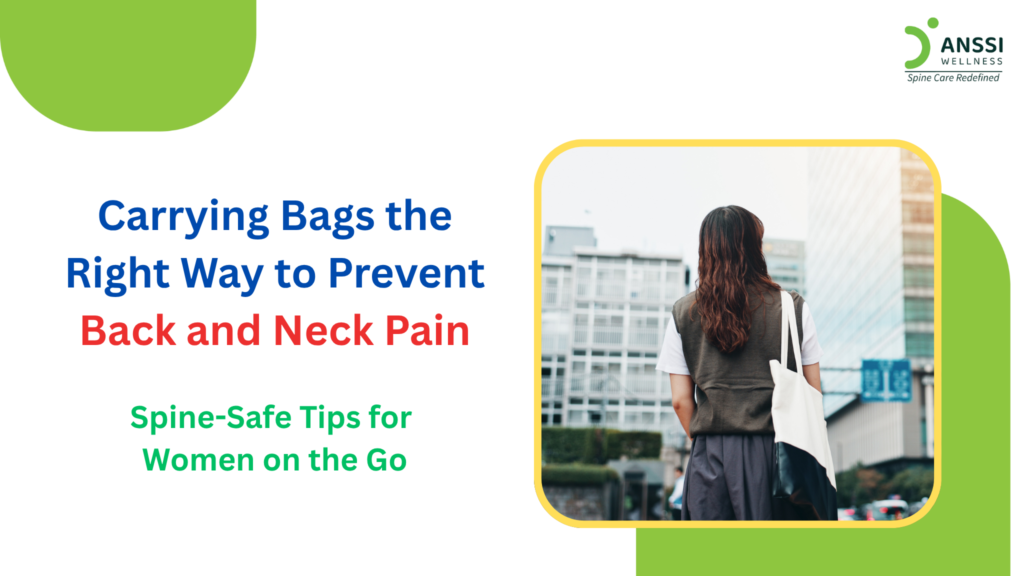
For many women, carrying a handbag, purse, laptop bag, or backpack is an unavoidable part of everyday life. Whether travelling to work, attending college, shopping, managing household responsibilities, or commuting across the city, a bag often carries everything needed throughout the day.
But have you ever wondered whether the weight of your bag could be contributing to your neck or back pain?
A heavy bag does not automatically cause a spinal condition. However, repeatedly carrying excessive weight, placing it unevenly on the body or using poor posture can increase strain on the muscles and joints supporting the spine. Over time, these habits may contribute to discomfort and can aggravate existing spinal problems.
Understanding how to carry your bag correctly can therefore be an important part of protecting your spine.
How Can a Heavy Bag Affect Your Spine?
Your spine naturally maintains a balanced alignment while your muscles work together to support your head, shoulders, and torso. Carrying a heavy bag can change this balance.
When a handbag is carried on one shoulder, the body may compensate by lifting one shoulder, leaning to one side or shifting the torso. If this happens regularly, muscles on one side may remain under greater tension.
A heavy backpack can also affect posture when it is carried incorrectly. Wearing it on one shoulder instead of both can create uneven loading. If the straps are too loose, the backpack may hang away from the body, increasing the effort required from the shoulders and upper back.
The neck can also be affected. A person carrying a heavy bag may unconsciously move the head forward or round the shoulders to compensate for the additional load. Prolonged forward-head posture can place additional stress on the muscles around the neck and upper back.
Can Bags Contribute to Disc-Related Problems?
Poor carrying habits are not necessarily the sole cause of a disc problem. Conditions such as cervical or lumbar disc bulges, degeneration, and nerve irritation can develop for multiple reasons, including age-related changes, repetitive strain, physical weight, and other factors.
However, excessive or uneven weight may aggravate symptoms in someone who already has a spinal problem.
For example, an individual with an existing cervical disc problem may notice increased neck or shoulder discomfort when carrying a heavy laptop bag. Someone with a lumbar disc condition may experience increased lower back discomfort when carrying weight while walking or standing for long periods.
This is why persistent symptoms should not simply be blamed on a bag.
Simple Spine-Safe Ways to Carry Your Bag
Small changes to your daily habits can reduce unnecessary strain.
Keep Your Bag as Light as Possible
Carry only what you genuinely need. Regularly remove unused books, bottles, chargers, and other unnecessary items. The lighter the load, the less mechanical stress your body has to manage.
Use Both Backpack Straps
If you use a backpack, wear it on both shoulders rather than hanging it from one side. Adjust the straps so that the bag sits comfortably and relatively close to your body.
Distribute Weight Evenly
Place heavier objects closer to your back rather than allowing them to hang at the outer edge of the bag. This can help keep the load closer to your body’s centre.
Alternate Shoulders
If you prefer a single-shoulder handbag, avoid carrying it on the same side throughout the day. Alternating shoulders can help prevent continuous loading on one side.
Maintain Good Posture
While walking with a bag, try to keep your head aligned over your shoulders. Avoid excessively rounding your upper back or leaning to one side to compensate for the load.
Take Regular Breaks
If you need to carry a laptop bag or other equipment for an extended period, take opportunities to put the bag down. During long journeys, brief breaks can reduce continuous loading.
Pain Symptoms You Should Not Ignore
Occasional muscle fatigue after carrying a heavy bag may settle with rest. Persistent or recurring symptoms, however, deserve greater attention.
Seek professional evaluation if you experience:
- Persistent neck or back pain
- Neck or lower back stiffness
- Pain spreading into the shoulder, arm, or leg
- Tingling or numbness in the hands, arms, feet, or legs
- Weakness in an arm or leg
- Difficulty moving the neck or back normally
- Pain that repeatedly returns despite rest
Symptoms such as progressive weakness, significant difficulty walking, or new bladder or bowel problems require urgent medical attention.
What If the Pain Continues?
If changing your bag-carrying habits does not resolve persistent pain, the underlying cause should be investigated.
Depending on the symptoms, a healthcare professional may recommend a clinical examination and, when appropriate, imaging tests such as an MRI to evaluate the spinal discs and surrounding structures.
Treatment depends on the diagnosis.
For many patients, non-surgical approaches may include physiotherapy, posture correction, strengthening exercises, ergonomic modifications, and lifestyle changes.
For appropriately selected patients with disc-related spinal conditions, Non-Surgical Spinal Decompression Treatment (NSSDT) may also be considered. This treatment uses controlled decompressive forces with the aim of reducing mechanical stress on affected spinal segments and supporting a healthier mechanical environment around the affected disc and nerve structures.
However, NSSDT is not appropriate for every cause of neck or back pain. A proper clinical assessment is essential before selecting any treatment.
About ANSSI:
ANSSI Wellness focuses on improving the quality of life for patients suffering from spinal issues, aiming to provide relief where other conventional treatments have failed. Through advanced Non-Surgical Spinal Decompression Treatment, ANSSI is committed to helping patients avoid surgery and recover in a safe, effective, and compassionate environment.
Book Consultation:
Call +91 9004726844 | 9920936844
Visit www.anssiwellness.com
Connect with ANSSI Wellness on LinkedIn, Instagram, and Facebook for expert guidance.