
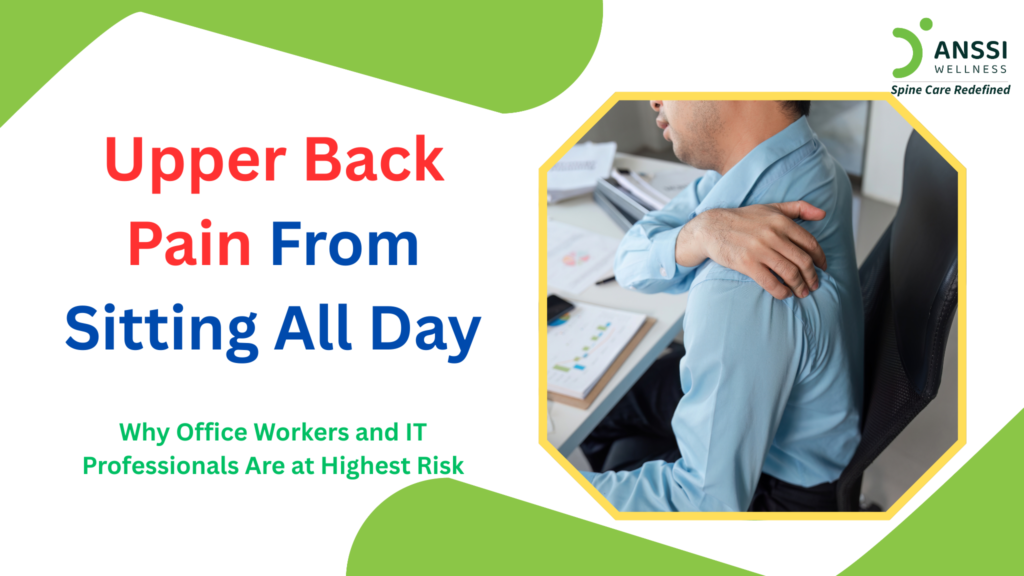
For millions of professionals and students in India, the workday begins at a desk and often ends at the same desk. Eight, ten or even twelve hours may pass with very little movement. Between laptops, multiple screens, online meetings and smartphones, the neck and upper back can remain in almost the same position for hours.
The result? Upper back pain, stiffness and aching between the shoulder blades are becoming increasingly common, even among younger people.
While occasional discomfort may simply reflect muscle fatigue, recurring or chronic upper back pain should not always be dismissed as “just bad posture.” Prolonged sitting can place repeated mechanical stress on the spine, joints, discs and surrounding muscles. Understanding what happens inside the spine can help you take the right steps before the problem starts interfering with work and everyday life.
What Happens to Your Spine When You Sit All Day?
The human spine is designed for movement, not for remaining in one position throughout the working day.
When you sit at a desk for extended periods, particularly while leaning towards a laptop or screen, your head tends to move forward, and your upper back becomes rounded. This is commonly referred to as forward-head posture and sustained thoracic flexion.
The further the head moves forward from its natural position, the greater the mechanical demand placed on the muscles and structures supporting the neck and upper back. Muscles may remain contracted for prolonged periods, while the joints of the spine experience sustained loading.
Over time, repeatedly maintaining these positions can contribute to discomfort, stiffness and reduced mobility.
How Poor Posture Can Contribute to Upper Back Pain
The thoracic spine is the middle section of the spine and is closely connected with the ribs. Several joints and discs work together to provide stability and movement.
When poor posture is maintained for long periods, it can increase stress across the thoracic facet joints and the joints connecting the ribs to the spine, known as the costovertebral articulations.
The muscles between the shoulder blades may also have to work continuously to stabilise the upper body. Instead of contracting and relaxing naturally as you move, they may remain under tension for extended periods.
This can contribute to the characteristic symptoms many desk workers recognise:
- Aching between the shoulder blades
- Pain around or underneath the shoulder blades
- Upper back stiffness
- Tightness across the shoulders
- Discomfort after prolonged sitting
- Difficulty maintaining an upright posture
- Pain or stiffness when changing position
Persistent spinal loading may also contribute to degenerative changes in discs and joints over time. However, not every case of upper back pain is caused by disc degeneration or joint pathology. Muscle strain, injuries and other medical conditions can also produce similar symptoms.
That is why persistent or unexplained pain deserves appropriate professional assessment.
Why Are IT Professionals and Office Workers at Higher Risk?
India has a huge population of IT professionals, finance employees, executives, students and other desk-based workers. Many of them spend most of their working or studying hours sitting.
The problem is not simply sitting itself. It is the combination of prolonged sitting, limited movement and poor workstation habits.
An IT professional may spend hours switching between a laptop and a second monitor. A finance professional may remain seated while analysing spreadsheets. Executives may move from one meeting to another without changing their posture significantly. Students can spend long periods studying or attending online classes.
Add smartphone use, commuting and limited exercise to the equation, and the spine may receive very little opportunity to move throughout the day.
This helps explain why upper back discomfort can appear at increasingly younger ages.
Simple Ergonomic Changes Can Make a Difference
You do not necessarily need to completely change your job to reduce unnecessary stress on your upper back. Small changes throughout the working day can be valuable.
- Position your screen correctly: Keep the primary monitor at a height that allows you to look forward without constantly bending your neck.
- Support your back: Use a chair that provides appropriate support and allows you to maintain a comfortable upright position.
- Keep your keyboard and mouse within reach: Avoid repeatedly stretching forward to operate your equipment.
- Avoid prolonged phone-neck posture: Holding your phone low for extended periods can encourage forward neck positioning.
- Move regularly: Do not remain seated continuously for several hours. Stand up, walk around and change your position regularly.
- Stretch and strengthen appropriately: Exercises recommended by a qualified physiotherapist can help improve mobility and strengthen muscles supporting the neck, shoulders and upper back.
Ergonomics should be viewed as part of prevention and long-term management rather than a substitute for diagnosis when persistent pain is present.
When Posture Correction Isn’t Enough
What if you have already improved your workstation, started exercising and attended physiotherapy, but the pain keeps returning?
Persistent symptoms may indicate that something beyond temporary muscular fatigue is contributing to your problem. Disc-related changes, joint problems, nerve irritation or other spinal conditions can sometimes contribute to chronic pain.
This is where professional evaluation becomes important.
Instead of assuming that every case is simply a posture problem, a spine specialist can assess your symptoms and determine whether further investigation or a specialised treatment approach is appropriate.
Can Non-Surgical Spinal Decompression Help?
For appropriately selected patients with certain spine and disc-related conditions, Non-Surgical Spinal Decompression Treatment (NSSDT) may be considered as a non-invasive treatment option.
At ANSSI Wellness, NSSDT uses a computer-controlled system to provide controlled decompressive forces to targeted areas of the spine. The treatment is designed to reduce mechanical stress on affected spinal structures and may be considered when disc-related problems are contributing to persistent spinal symptoms.
The objective is different from simply taking a painkiller. Medication can help manage symptoms, while decompression treatment is intended to address certain mechanical factors associated with spinal and disc-related conditions.
However, it is important to understand that spinal decompression is not appropriate for every type of upper back pain. Treatment suitability depends on the individual’s diagnosis, symptoms and clinical assessment. Upper back pain can have many causes, and some require completely different approaches.
When appropriate, spinal decompression may be combined with physiotherapy, posture correction, mobility exercises and strengthening to create a more comprehensive treatment programme.
About ANSSI:
ANSSI Wellness focuses on improving the quality of life for patients suffering from spinal issues, aiming to provide relief where other conventional treatments have failed. Through advanced Non-Surgical Spinal Decompression Treatment, ANSSI is committed to helping patients avoid surgery and recover in a safe, effective, and compassionate environment.
Book Consultation:
Call +91 9004726844 | 9920936844
Visit www.anssiwellness.com
Connect with ANSSI Wellness on LinkedIn, Instagram, and Facebook for expert guidance.
Clinical References:
- Punnett L, Wegman DH. Work-related musculoskeletal disorders: the epidemiology and cost. Journal of Electromyography and Kinesiology. 2004;14(1):13-23.
- Cagnie B, Danneels L, Van Tiggelen D, De Loose V, Cambier D. Individual and work related risk factors for neck pain among office workers: a cross sectional study. European Spine Journal. 2007;16(5):679-686.
- Briggs AM, Smith AJ, Straker LM, Bragge P. Thoracic spine pain in the general population: prevalence, incidence and associated factors in children, adolescents and adults. A systematic review. BMC Musculoskeletal Disorders. 2009;10:77.
- Gose E., Ph.D, Naguszewski W., MD, Naguszewski R., MD. Vertebral Axial Decompression Therapy for Pain Associated with Herniated or Degenerated Discs or Facet Syndrome: An Outcome Study. Journal of Neurological Research, Volume 20, No 3, April 1998.