A slipped disc can turn ordinary activities such as sitting, walking, bending or travelling into a daily struggle. For residents of Ambernath, an eastern suburb of Thane, finding effective spine care close to home can become a priority when back or neck pain continues to interfere with everyday life.
A slipped disc may cause local pain, stiffness or symptoms that travel into the arms or legs. Depending on the affected spinal level, patients may experience sciatica, tingling, numbness or weakness. While medication and physiotherapy are commonly recommended, some patients may eventually be advised to consider surgery.
But surgery is not automatically the only option.
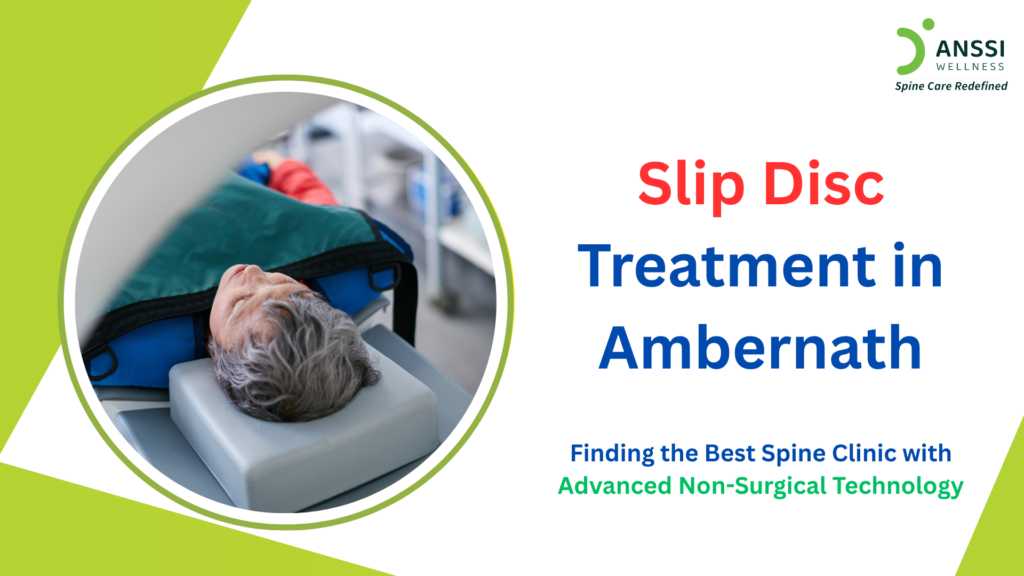
For appropriately selected patients, Non-Surgical Spinal Decompression Treatment (NSSDT) offers an advanced, non-invasive approach that focuses on disc-related spinal problems.
Understanding the condition, obtaining an accurate diagnosis and choosing an experienced spine clinic are important steps before beginning treatment.
What is a Slipped Disc?
The spine consists of individual vertebrae separated by flexible structures called intervertebral discs. These discs act as cushions, helping absorb forces generated during everyday movements.
With ageing, repetitive stress, poor posture, physical loading or injury, a disc can weaken and change shape. It may develop a bulge or herniation, sometimes irritating or compressing a nearby spinal nerve.
A slipped disc in the lower back may cause:
- Lower back pain
- Pain travelling into the buttocks or legs
- Tingling or numbness
- Leg stiffness
- Difficulty sitting or standing comfortably
- Weakness in severe cases
A cervical disc problem can produce neck pain accompanied by symptoms extending into the shoulder, arm or hand.
Importantly, not everyone with a disc bulge experiences symptoms. MRI findings need to be considered alongside the patient’s symptoms and clinical examination.
Why Does a Slip Disc Keep Causing Problems?
A disc-related problem can involve more than pain alone. Changes in disc structure may influence the mechanical environment around nearby nerves and spinal joints.
When a disc loses hydration or height, the space available around certain neural structures can become reduced. A bulging or herniated portion of the disc can further contribute to nerve irritation.
This is one reason why simply suppressing pain may not always provide lasting improvement.
Painkillers and anti-inflammatory medicines can help control symptoms in appropriate situations. However, they do not necessarily restore disc structure or correct the mechanical factors associated with a disc problem.
This does not imply that taking prescription drugs should be discontinued without consulting a doctor. Instead, persistent or recurring symptoms should prompt a reassessment of the underlying cause.
Does Every Slipped Disc Require Surgery?
No. The appropriate treatment depends on the severity of the condition, symptoms, neurological findings and response to conservative care.
Some patients improve with activity modification, physiotherapy, exercise and medication. Others with persistent disc-related symptoms may explore additional non-surgical approaches before considering an invasive procedure.
Surgery can be a crucial and occasionally required medical procedure. However, it is an invasive intervention and can involve risks such as infection, bleeding, nerve injury, recurrent symptoms and postoperative recovery requirements.
There can also be practical considerations, including hospitalisation, time away from work, rehabilitation and financial costs.
For these reasons, many Ambernath patients may want to understand suitable non-surgical alternatives before making a decision about surgery.
How Does Non-Surgical Spinal Decompression Treatment Work?
Non-Surgical Spinal Decompression Treatment (NSSDT) uses controlled, computer-regulated forces to target specific spinal segments.
The underlying objective is to reduce mechanical stress affecting an identified disc and create conditions that may support improved disc function. Depending on the patient’s diagnosis, decompression may help reduce stress around irritated nerve structures and improve spinal mobility.
The treatment is designed to work differently from conventional symptom-control approaches.
Instead of relying exclusively on medication to reduce pain, NSSDT focuses on the mechanical environment surrounding the affected spinal segment. It may be considered for appropriately selected patients with conditions such as disc bulges, herniated discs and certain degenerative disc-related problems.
Potential treatment goals can include:
- Reducing mechanical pressure on affected spinal structures
- Supporting disc hydration
- Supporting disc height in suitable cases
- Reducing nerve irritation
- Improving mobility and functional movement
However, NSSDT should not be presented as a treatment for every type of spinal stenosis, disc problem or back pain. Severe structural abnormalities, significant instability or progressive neurological problems may require different medical management.
Why Accurate Diagnosis Matters
Choosing an advanced treatment is only one part of successful spine care. Correct diagnosis comes first.
A reputable spine clinic should evaluate the patient’s symptoms and medical history, perform an appropriate physical and neurological examination and review relevant imaging such as MRI scans when indicated.
The MRI may reveal the location and extent of disc degeneration, bulging, herniation or nerve compression. But an imaging report should not be interpreted independently of the patient’s symptoms.
A personalised treatment plan can then combine appropriate non-surgical interventions.
For example, NSSDT may be accompanied by physiotherapy, strengthening exercises, posture correction and lifestyle guidance. These complementary measures can help patients improve movement patterns and develop habits that support spinal health.
Why Choose ANSSI Wellness Ambernath?
For residents searching online for slip disc treatment in Ambernath, accessibility is an important consideration. Regular treatment and rehabilitation can be easier to manage when specialised care is available locally.
ANSSI Wellness Ambernath provides non-surgical spine care for patients dealing with disc-related back and neck conditions. Its treatment approach includes assessment of the patient’s condition and development of an individualised treatment programme.
The clinic’s NSSDT approach uses advanced decompression technology for appropriately selected patients. Physiotherapy and rehabilitation can also form part of the overall treatment programme, helping address posture, muscular support and functional movement.
For someone considering surgery after months of persistent symptoms, consulting a qualified professional about suitable non-surgical options can provide valuable information before making an irreversible treatment decision.
When Should You Seek Medical Attention?
Persistent back or neck pain should not simply be ignored. Professional evaluation is especially important when symptoms include:
- Pain that repeatedly returns
- Pain travelling into an arm or leg
- Tingling or numbness
- Increasing stiffness
- Difficulty performing normal activities
- Weakness in an arm or leg
Certain symptoms require urgent medical assessment. Sudden or progressive weakness, significant difficulty walking, or new bladder or bowel dysfunction can indicate serious neurological involvement and should not be managed through routine non-surgical treatment alone.
About ANSSI:
ANSSI Wellness focuses on improving the quality of life for patients suffering from spinal issues, aiming to provide relief where other conventional treatments have failed. Through advanced Non-Surgical Spinal Decompression Treatment, ANSSI is committed to helping patients avoid surgery and recover in a safe, effective, and compassionate environment.
Book Consultation:
Call +91 9004726844 | 9920936844
Visit www.anssiwellness.com
Connect with ANSSI Wellness on LinkedIn, Instagram, and Facebook for expert guidance.
Clinical References:
- Kreiner DS et al. North American Spine Society. An evidence-based clinical guideline for the diagnosis and treatment of lumbar disc herniation with radiculopathy. Spine J. 2014 Jan;14(1):180-91.
- Hoy D, Bain C, Williams G, et al. A systematic review of the global prevalence of low back pain. Arthritis & Rheumatism. 2012;64(6):2028-2037.
- Urban JP, Roberts S. Degeneration of the intervertebral disc. Arthritis Research & Therapy. 2003;5(3):120-130.
- Yasuma, T; Koh, S; Okamura, T; Yamauchi, Y. Histological changes in aging lumbar intervertebral discs. Their role in protrusions and prolapses.. The Journal of Bone & Joint Surgery 72(2):p 220-229, Feb 1990.
- Gose E., Ph.D, Naguszewski W., MD, Naguszewski R., MD. Vertebral Axial Decompression Therapy for Pain Associated with Herniated or Degenerated Discs or Facet Syndrome: An Outcome Study. Journal of Neurological Research, Volume 20, No 3, April 1998.