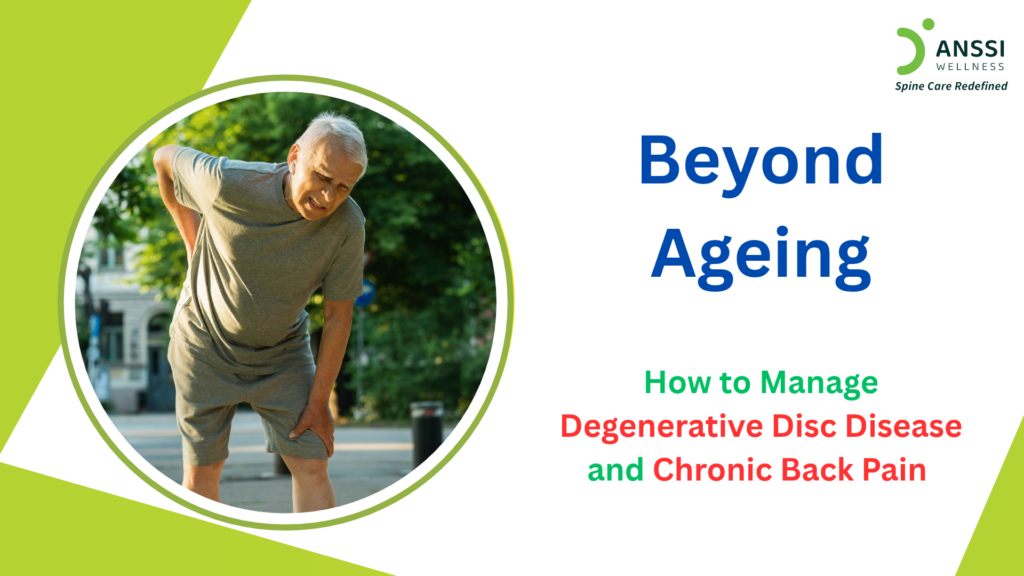
Have you been diagnosed with Degenerative Disc Disease (DDD) and told that it is simply a normal part of ageing? Many people receive this diagnosis after an MRI scan and assume that nothing can be done to improve their condition.
While age-related changes in the spinal discs are common, living with persistent pain and restricted movement is not something you should automatically accept as inevitable.
Degenerative disc disease describes changes in the discs between the vertebrae. These changes may contribute to pain in some people, but others have similar MRI findings without experiencing any symptoms.
The important question is not just whether your discs have degenerated, but whether those changes explain your symptoms and what can be done to improve your comfort, mobility, and quality of life.
Understanding Degenerative Disc Disease
Your spinal discs are flexible structures positioned between the vertebrae.
- They help distribute pressure, absorb forces during movement, and allow the spine to bend and twist.
- Each disc contains a central, gel-like nucleus pulposus surrounded by a tougher outer ring called the annulus fibrosus.
- Healthy discs contain substantial water, which contributes to their flexibility and load-bearing properties.
As people age, discs may gradually lose water content and elasticity. Their internal structure can change, and small tears may develop in the outer ring. These changes are commonly described as disc degeneration.
The Degenerative Cycle: From Disc Dehydration to Possible Nerve Irritation
Degenerative disc disease can involve several interconnected changes.
- Loss of Disc Hydration: With age and degeneration, the disc’s ability to retain water may decline. Changes in its internal components can reduce its capacity to distribute mechanical pressure effectively.
- Changes in Disc Height and Function: As disc structure and hydration change, disc height may decrease. This can alter how forces travel through the spine and increase stress on surrounding joints and other structures.
- Possible Nerve Irritation or Compression: In some people, degeneration occurs alongside disc bulging, bone-spur formation, or narrowing of the spaces through which spinal nerves pass. These changes may irritate or compress nerve roots.
Depending on the affected spinal level, symptoms can include persistent neck or lower back pain, pain radiating into an arm or leg, tingling, or numbness. Weakness may also occur when nerve function is affected.
This progression is not inevitable. Not everyone with disc dehydration develops significant disc-height loss, and not everyone with degeneration experiences nerve compression.
Is Degenerative Disc Disease Treatable?
Although established degenerative changes may not be fully reversible, treatment can help many people manage symptoms and improve everyday function.
The appropriate approach depends on the severity of the condition, the location of the affected discs, neurological findings, and the individual’s overall health.
Common treatment options include:
- Physiotherapy: Individualised exercises can improve strength, mobility, and tolerance for everyday activities.
- Activity modification: Adjusting lifting techniques, taking movement breaks, and gradually returning to normal activities can help manage symptoms.
- Pain management: Appropriate medication may help control symptoms when recommended by a doctor.
- Rehabilitation: A structured programme can help improve movement confidence and support long-term physical function.
- Further medical assessment: Persistent symptoms, significant nerve involvement, or worsening function may require additional tests and specialist advice.
Surgery is not necessary for every person with DDD. However, it may be appropriate in selected cases, particularly when significant neurological problems or other specific surgical indications are present.
The goal is to identify the source of the symptoms and choose treatment accordingly.
Non-Surgical Spinal Decompression Treatment and Disc Rehydration Mechanism
Non-Surgical Spinal Decompression Treatment (NSSDT) is a treatment approach that uses a specialised, computer-controlled technique to apply controlled stretching to selected spinal segments.
- The proposed mechanism involves changing the mechanical forces acting on the spine.
- During treatment, controlled stretching may alter intradiscal pressure and reduce certain loading forces on the affected segment.
- These pressure changes can facilitate fluid movement within a disc. This proposed process is sometimes described as disc rehydration. The changes in pressure can encourage fluid exchange within disc tissue under certain conditions.
Non-Surgical Spinal Decompression Treatment is often considered as part of a broader conservative care plan for selected patients, often alongside physiotherapy and rehabilitation. It is not suitable for everyone and should not delay necessary surgical care.
When Should You Seek Professional Help?
If neck or back pain persists, repeatedly returns, or interferes with sleep, walking, work, or everyday activities, seek an assessment from a qualified doctor.
Pain radiating into an arm or leg, persistent tingling, numbness, or weakness may indicate nerve involvement and deserves appropriate evaluation.
Seek urgent medical care if you develop new bladder or bowel control problems, numbness around the groin or saddle area, or rapidly worsening weakness. These symptoms may indicate a serious neurological condition.
About ANSSI:
ANSSI Wellness focuses on improving the quality of life for patients suffering from spinal issues, aiming to provide relief where other conventional treatments have failed. Through advanced Non-Surgical Spinal Decompression Treatment, ANSSI is committed to helping patients avoid surgery and recover in a safe, effective, and compassionate environment.
Book Consultation:
Call +91 9004726844 | 9920936844
Visit www.anssiwellness.com
Connect with ANSSI Wellness on LinkedIn, Instagram, and Facebook for expert guidance.