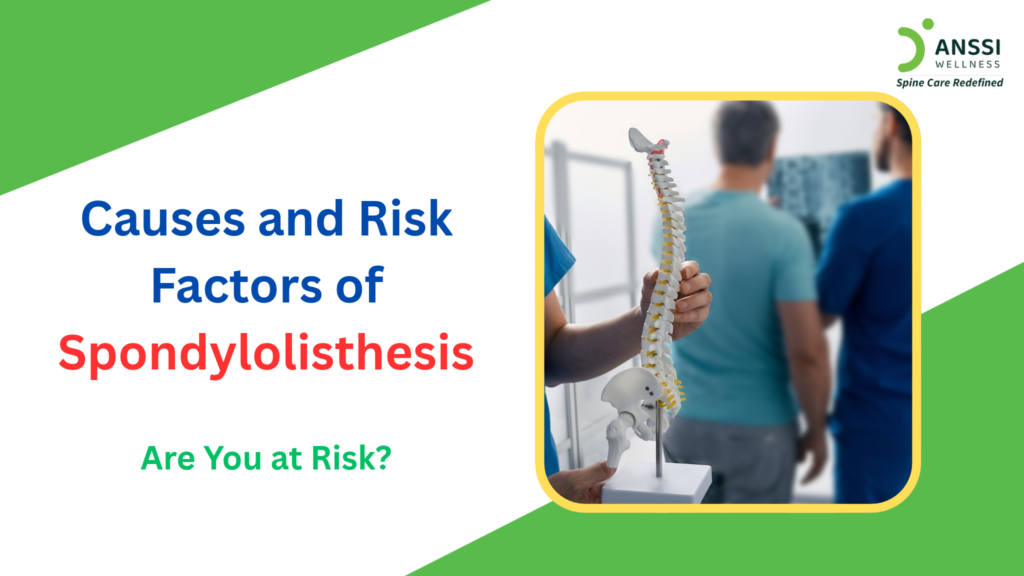
Persistent lower back pain is often attributed to ageing, poor posture, or muscle strain. However, in some people, the underlying problem may involve the alignment and stability of the spine. Spondylolisthesis is one such condition, in which one vertebra shifts relative to the vertebra below it. The movement may occur forward or, less commonly, backward, and its clinical significance varies from person to person.
Some people with spondylolisthesis have few or no symptoms, while others may experience lower back pain, stiffness, buttock pain, or symptoms extending into the legs. Understanding the potential causes and risk factors can help you to identify when professional evaluation may be appropriate.
What Causes Spondylolisthesis?
Spondylolisthesis does not have one single cause. It can develop because of age-related changes, a stress injury or fracture, trauma, developmental differences in the spine, or other conditions that affect spinal stability.
The location and type of spondylolisthesis also matter. For example, degenerative spondylolisthesis is commonly associated with age-related changes, while isthmic spondylolisthesis can result from a defect or stress fracture in a portion of the vertebra known as the pars interarticularis.
1. Ageing and Degenerative Changes
Age is an important risk factor for degenerative changes in the spine. Over time, the spinal discs can lose some of their height and elasticity, while the facet joints may undergo arthritis and other degenerative changes.
These changes can affect the way forces are distributed across the spinal segment. In some individuals, the combination of disc degeneration and facet-joint changes can contribute to vertebral slippage, resulting in degenerative spondylolisthesis.
However, ageing alone does not mean that someone will develop spondylolisthesis. Many people have degenerative spinal changes without significant symptoms or vertebral instability.
2. Trauma and Stress Injuries
A sudden injury can sometimes affect the structures responsible for maintaining spinal stability. Falls, vehicle accidents, sports injuries, or other significant trauma may damage the vertebrae or supporting structures.
Repetitive stress can also be relevant. Activities involving frequent spinal extension and loading may contribute to stress injuries in susceptible individuals. This is particularly associated with certain forms of isthmic spondylolisthesis, where a stress fracture or defect develops in the pars interarticularis.
Athletes participating in activities involving repeated spinal extension and rotation may therefore require attention to training technique, conditioning, and recovery.
3. Overuse and Repetitive Spinal Loading
The spine is designed to tolerate everyday movement, but repeated loading without adequate recovery can increase mechanical stress.
Repetitive lifting, frequent bending and straightening, heavy physical work, or sports involving repeated extension can place additional demands on the lower back.
It is important, however, not to assume that overuse directly causes spondylolisthesis in everyone. These activities may contribute to spinal stress or aggravate symptoms in people who already have an underlying structural vulnerability.
Using appropriate lifting techniques, maintaining adequate muscle strength, and allowing recovery between demanding activities can help support spinal health.
4. Poor Posture and Sedentary Habits
Poor posture is frequently blamed for back problems, but its relationship with spondylolisthesis is more nuanced.
Prolonged sitting, slouched posture, inadequate core conditioning, and poorly designed workstations can contribute to back discomfort and altered mechanical loading. They may also aggravate symptoms in someone who already has a spinal condition.
However, poor posture should not be considered a direct cause of vertebral slippage in every individual. A person with persistent back pain should be evaluated rather than assuming that correcting posture alone will resolve the problem.
Regular movement, ergonomic adjustments, appropriate strengthening, and avoiding prolonged static positions can nevertheless be valuable components of spinal care.
5. Genetic and Developmental Predisposition
Some people may have anatomical or developmental characteristics that make them more susceptible to certain forms of spondylolisthesis.
In particular, differences in the shape or development of spinal structures can influence how forces are distributed across the spine. Certain forms of spondylolisthesis can also occur more frequently within families, suggesting that genetic and anatomical factors may contribute to susceptibility.
This does not mean that having a family history guarantees that a person will develop the condition. It simply represents one factor that may be relevant when combined with other risks.
What Symptoms Should You Watch For?
Spondylolisthesis does not always cause symptoms. When symptoms occur, they can include:
- Persistent lower back pain
- Lower-back stiffness
- Pain extending into the buttocks or legs
- Tingling or numbness
- Muscle tightness or hamstring discomfort
- Reduced tolerance for prolonged standing or activity
If the displaced vertebra or associated degenerative changes affect nearby nerves, symptoms may extend into the legs.
Progressive weakness, significant difficulty walking, new bladder or bowel problems, or numbness around the saddle area require urgent medical assessment.
How is Spondylolisthesis Diagnosed?
Diagnosis generally begins with a medical history and physical examination. A doctor may assess your spinal movement, muscle strength, reflexes, sensation, and symptoms suggesting nerve involvement.
Imaging can then help evaluate the structure and alignment of the spine. X-rays may demonstrate vertebral alignment and slippage, while MRI can provide information about discs, nerves, and other soft tissues when clinically indicated.
Importantly, the presence of vertebral slippage on an image does not automatically explain every symptom. Imaging findings need to be interpreted alongside the patient’s clinical presentation.
Can Early Spondylolisthesis Be Managed Without Surgery?
Treatment depends on the type and severity of spondylolisthesis, symptoms, neurological findings, spinal stability, and response to conservative care.
For appropriately selected patients, non-surgical management may include physiotherapy, core and trunk strengthening, flexibility exercises, activity modification, ergonomic guidance, and appropriate pain management.
Non-Surgical Spinal Decompression Treatment (NSSDT) may also be considered for selected patients with spinal conditions after clinical assessment.
NSSDT uses a computer-controlled treatment table and harness system to apply controlled forces to selected spinal segments. The intended approach is to provide periods of controlled spinal unloading and reduce mechanical stress. It may be incorporated with physiotherapy and rehabilitation rather than being treated as a standalone solution.
It is important to understand that NSSDT should not be presented as a method that can reverse vertebral slippage or restore spinal alignment in every patient. Its suitability depends on the your diagnosis and clinical findings.
About ANSSI:
ANSSI Wellness focuses on improving the quality of life for patients suffering from spinal issues, aiming to provide relief where other conventional treatments have failed. Through advanced Non-Surgical Spinal Decompression Treatment, ANSSI is committed to helping patients avoid surgery and recover in a safe, effective, and compassionate environment.
Book Consultation:
Call +91 9004726844 | 9920936844
Visit www.anssiwellness.com
Connect with ANSSI Wellness on LinkedIn, Instagram, and Facebook for expert guidance.
Clinical References:
- Fredrickson BE, Baker D, McHolick WJ, Yuan HA, Lubicky JP. The natural history of spondylolysis and spondylolisthesis. Journal of Bone and Joint Surgery. 1984;66(5):699-707.
- Kalichman L, Kim DH, Li L, Guermazi A, Hunter DJ. Computed tomography-evaluated features of spinal degeneration: prevalence, intercorrelation, and association with self-reported low back pain. Spine Journal. 2010;10(3):200-208.
- Ghiselli G, Wang JC, Bhatia NN, Hsu WK, Dawson EG. Adjacent segment degeneration in the lumbar spine. Journal of Bone and Joint Surgery. 2004;86(7):1497-1503.
- Sato K, Kikuchi S, Yonezawa T. In vivo intradiscal pressure measurement in healthy individuals and in patients with ongoing back problems. Spine. 1999;24(23):2468-2474.
- Ramos G., MD, Martin W., MD. Effects of Vertebral Axial Decompression On Intradiscal Pressure. Journal of Neurosurgery 81: 350-353, 1994.