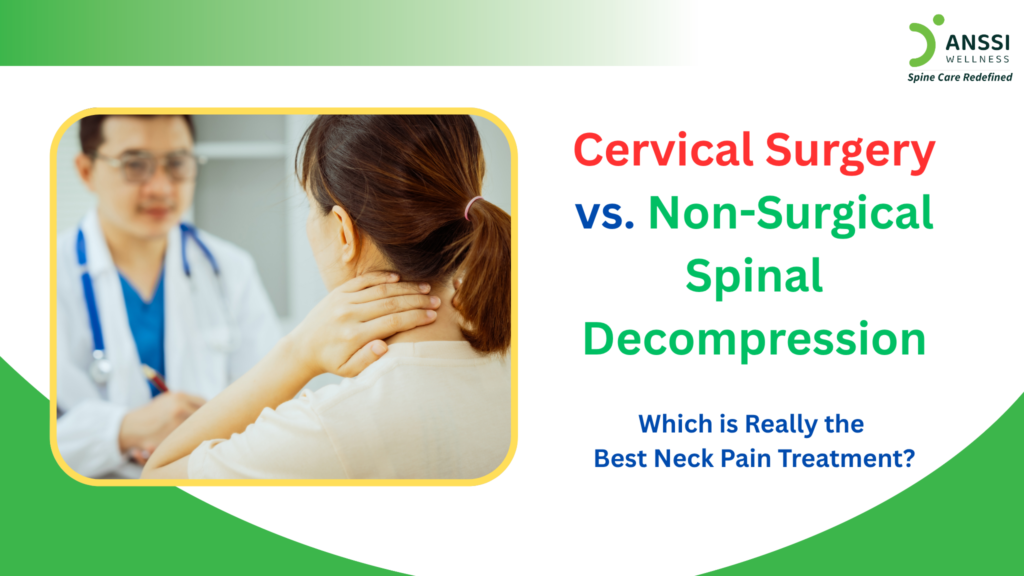
Neck pain can begin as a minor stiffness but may gradually become a persistent problem that affects sleep, work, driving, and everyday activities. When neck pain is accompanied by arm pain, tingling, numbness, or weakness, the underlying problem may involve the cervical discs, nerves or spinal cord.
For some patients, cervical spine surgery may be medically necessary. For others, surgery may not be the first or only option. This is why understanding the cause and severity of the condition is important before choosing a treatment.
One increasingly discussed non-surgical option is Non-Surgical Spinal Decompression Treatment (NSSDT). But can it really be considered an alternative to cervical surgery? The answer depends on the individual diagnosis.
When May Cervical Surgery Be Necessary?
Cervical spine surgery is generally considered when there is significant structural or neurological compromise that cannot be adequately managed through conservative treatment.
Some conditions that may require surgical evaluation include severe cervical disc herniation with progressive neurological deficits, cervical myelopathy, significant spinal canal stenosis, spinal instability, fractures, tumours, or other serious structural abnormalities.
For example, a severely herniated cervical disc can compress a nerve root and cause persistent arm pain, numbness, or weakness. In more serious cases, compression of the spinal cord can result in cervical myelopathy, potentially affecting balance, coordination, walking, and hand function.
Surgery may also become an option when symptoms remain severe despite appropriate non-surgical treatment or when neurological function is progressively deteriorating.
Therefore, having a cervical disc bulge or spondylosis does not automatically mean that surgery is required. The MRI findings must be considered alongside symptoms, physical examination, and neurological findings.
Understanding the Risks of Cervical Spine Surgery
Cervical spine surgery can be highly beneficial when appropriately indicated, but like any major procedure, it carries potential risks.
Depending on the type of operation, these may include infection, bleeding, blood-vessel injury, nerve or spinal cord injury, complications related to anaesthesia, swallowing or voice-related problems in some anterior procedures, persistent symptoms, and the possibility of requiring additional surgery.
There can also be a recovery period involving restrictions on physical activity, rehabilitation, and time away from work or normal routines.
Another consideration is that surgery addresses a specific structural problem, but long-term spinal health can still depend on posture, muscle strength, physical activity, ergonomics, and other lifestyle factors.
This does not mean surgery should be avoided when it is medically necessary. Rather, patients should understand both the potential benefits and risks before making a treatment decision.
What is Non-Surgical Spinal Decompression Treatment?
Non-Surgical Spinal Decompression Treatment is a non-invasive treatment approach designed to apply controlled, computer-regulated decompressive forces to targeted areas of the spine.
The treatment uses a specialised decompression table and harness system. The objective is to gently alter the loading conditions around the affected spinal segment and reduce mechanical stress on discs and surrounding structures.
Non-Surgical Spinal Decompression Treatment is a USA Protocol-Based medical procedure for selected patients with spine-related conditions.
The approach is particularly focused on conditions involving the spinal discs and mechanical irritation of nerves. A treatment programme may also be combined with supportive measures such as physiotherapy, posture correction, and strengthening exercises, depending on the patient’s needs.
Can Decompression Treat the Same Problems as Surgery?
This is an important distinction.
NSSDT may be considered for appropriately selected patients with conditions such as cervical disc bulge, certain cervical disc herniations, cervical spondylosis, degenerative disc disease, and some forms of nerve-related neck and arm pain.
However, it would be inaccurate to say that decompression can treat every condition for which cervical surgery might be required.
For example, a patient with severe spinal cord compression, progressive neurological weakness, significant instability, a fracture, or a spinal tumour may require urgent specialist or surgical management. Non-surgical decompression should not be used to delay necessary medical care in such situations.
The goal is therefore not to claim that decompression replaces surgery in every case. Instead, for suitable patients, it may provide a non-surgical treatment option that can be considered before surgery becomes necessary.
Potential Benefits Compared With Cervical Surgery
For an appropriately selected patient, a non-surgical approach can have several practical advantages.
- No surgical incision: NSSDT does not require an operative incision or surgical access to the spine.
- No surgical anaesthesia: Because it is a non-surgical treatment, it does not involve the anaesthesia-related risks associated with an operation.
- No hospitalisation for the treatment itself: Patients undergoing decompression typically receive treatment in a clinical setting rather than undergoing an inpatient surgical procedure.
- Less disruption to daily life: A non-surgical treatment programme may allow patients to continue many normal activities, depending on their condition and doctor’s advice.
- Avoidance of surgical risks: Patients may avoid procedure-specific risks such as infection, bleeding and surgical injury when surgery is not medically required.
- Personalised treatment: Decompression can be planned according to the patient’s symptoms, diagnosis and treatment response rather than using the same approach for every patient.
- A conservative option: For patients who are suitable candidates, NSSDT may offer an opportunity to pursue non-surgical care before considering an invasive procedure.
About ANSSI:
ANSSI Wellness focuses on improving the quality of life for patients suffering from spinal issues, aiming to provide relief where other conventional treatments have failed. Through advanced Non-Surgical Spinal Decompression Treatment, ANSSI is committed to helping patients avoid surgery and recover in a safe, effective, and compassionate environment.
Book Consultation:
Call +91 9004726844 | 9920936844
Visit www.anssiwellness.com
Connect with ANSSI Wellness on LinkedIn, Instagram, and Facebook for expert guidance.
Clinical References:
- Caridi JM, Pumberger M, Hughes AP. Cervical radiculopathy: a review. HSS Journal. 2011;7(3):265-272.
- Borghouts JA, Koes BW, Bouter LM. The clinical course and prognostic factors of non-specific neck pain: a systematic review. Pain. 1998;77(1):1-13.
- Nikolaidis I, Fouyas IP, Sandercock PA, Statham PF. Surgery for cervical radiculopathy or myelopathy. Cochrane Database of Systematic Reviews. 2010;(1):CD001466.
- Ramos G., MD, Martin W., MD. Effects of Vertebral Axial Decompression On Intradiscal Pressure. Journal of Neurosurgery 81: 350-353, 1994.
- Naguszewski W., MD, Naguszewski R., MD, Gose E., Ph.D. Dermatosomal Somatosensory Evoked Potential Demonstration of Nerve Root Decompression After VAX-D Therapy. Journal of Neurological Research Vol 23 , No 7, October 2001.