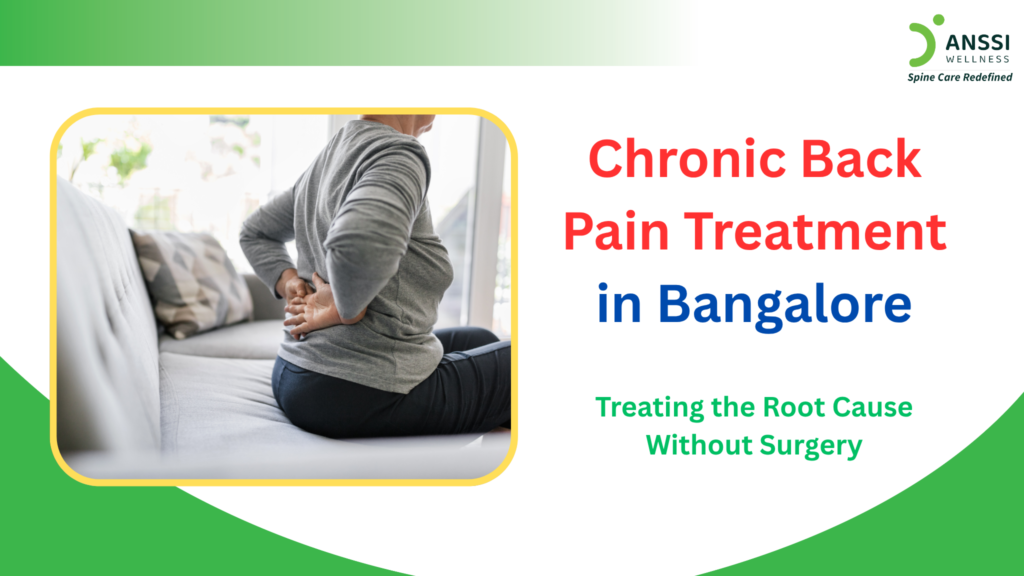
Chronic back pain can gradually become a part of everyday life. For many residents of Bangalore, long hours at a desk, extended commutes, sedentary routines and physically demanding work can place continuous stress on the lower back. What may begin as occasional discomfort can eventually develop into persistent pain that interferes with work, sleep, exercise and routine activities.
Pain medicines can provide temporary relief, but when the pain keeps returning, repeatedly taking medication may not be enough. The important question becomes: What is causing the pain in the first place?
For people searching for chronic back pain treatment in Bangalore, understanding the underlying spinal problem and exploring appropriate non-surgical options can be an important step toward better long-term management.
What Can Cause Chronic Back Pain?
Chronic back pain can have many causes. In some patients, the problem is related to muscles, posture, or physical strain. In others, it originates from structural changes in the spine.
Common spinal causes include:
- Disc bulge or herniated disc: The spinal disc may bulge or herniate and irritate a nearby nerve.
- Degenerative disc disease: Discs can gradually lose water content and elasticity, reducing their ability to absorb mechanical stress.
- Spondylosis: Age-related degeneration can affect discs, vertebral joints, and surrounding structures.
- Spinal stenosis: Narrowing around the spinal canal or nerve pathways can contribute to nerve compression.
- Reduced disc height: Disc degeneration can reduce the normal space between vertebrae and potentially increase mechanical stress around spinal structures.
When a spinal nerve is irritated or compressed, symptoms may extend beyond the lower back. Patients may experience pain travelling into the buttocks or legs, along with tingling, numbness, or weakness.
Bangalore’s lifestyle can add to these challenges.
- Professionals may spend eight or more hours sitting at computers.
- Daily commuting can involve prolonged sitting or awkward postures.
- Road vibrations and repeated travel on two-wheelers may add mechanical stress.
- Workers involved in lifting or physically demanding activities can place additional loads on the lumbar spine.
However, lifestyle factors are not the only explanation. A proper clinical evaluation is necessary to identify the actual source of persistent pain.
Why Treating the Root Cause Matters
Pain is a symptom, not always the underlying problem.
Painkillers and anti-inflammatory medicines can reduce the perception of pain or inflammation. This can make everyday movement easier and may be appropriate for short-term symptom management.
But medication does not necessarily restore a degenerated disc, correct reduced disc height, or remove mechanical pressure affecting a spinal nerve. This is why some patients experience a familiar cycle: pain develops, medication provides relief, the medicine is stopped, and the pain gradually returns.
The answer is not necessarily to stop prescribed medication. Instead, patients should discuss their continuing symptoms with their doctor and determine whether an underlying structural problem is contributing to the pain.
MRI findings, when clinically appropriate, can provide information about discs, nerves, and other spinal structures. Importantly, imaging findings should always be correlated with symptoms and physical examination rather than being considered in isolation.
Why Spine Surgery Makes Many Patients Hesitate
When conservative treatments do not provide sufficient relief, some patients may eventually be advised to consider surgery. Depending on the condition, procedures can include discectomy, laminectomy or spinal fusion.
Spine surgery can be appropriate and necessary in specific circumstances. However, it is still an invasive intervention and carries a few commonly recognised risks.
Potential complications can include infection, bleeding, nerve injury, recurrent disc problems, and persistent pain. Fusion procedures can also alter the movement and mechanical loading of the spine, potentially contributing to degeneration at neighbouring levels over time.
There is also the practical burden to consider. Surgery can involve hospitalisation, postoperative rehabilitation, temporary restrictions on physical activity, and high financial costs.
These concerns understandably make many people look for suitable non-surgical options before committing to an invasive procedure.
That does not mean surgery should be avoided when it is medically necessary. For example, severe or progressive neurological weakness, significant spinal cord compression, or new bladder and bowel dysfunction may require urgent specialist assessment and potentially surgical treatment.
Non-Surgical Spinal Decompression Treatment
For appropriately selected patients with disc-related spinal conditions, Non-Surgical Spinal Decompression Treatment (NSSDT) may be considered as part of a comprehensive non-surgical treatment programme.
NSSDT uses controlled, computer-regulated decompressive forces directed at the affected spinal segment. The objective is to reduce mechanical loading on the affected disc and create a more favourable environment around irritated spinal structures.
The treatment is designed to support several potential objectives, including:
- Reducing mechanical stress on affected spinal discs
- Reducing irritation around compressed nerve roots
- Supporting disc hydration
- Supporting disc height in appropriate disc-related conditions
- Improving spinal mobility and function
The underlying concept is different from simply suppressing pain. Instead of focusing exclusively on the symptom, decompression aims to influence the mechanical environment associated with certain disc-related spinal problems.
However, Non-Surgical Spinal Decompression Treatment should not be presented as a universal solution for every form of back pain. Severe fixed bony narrowing, major instability or serious neurological compression may require other forms of treatment. A qualified professional must determine whether a patient is an appropriate candidate.
Why Complementary Therapies and Rehabilitation Still Matter
Treating chronic back pain is rarely about one treatment alone.
Physiotherapy can complement non-surgical spinal care by addressing muscle weakness, flexibility limitations and poor movement patterns. A rehabilitation programme may include core strengthening, spinal mobility exercises, posture correction and ergonomic guidance.
For Bangalore’s office workers, simple workplace changes can also be valuable. Adjusting chair and monitor height, taking regular movement breaks, and avoiding prolonged static sitting can reduce unnecessary strain.
People who commute for long periods may also benefit from reviewing their sitting posture and taking appropriate breaks during extended journeys.
Patients involved in physical work should learn safe lifting and movement techniques rather than repeatedly placing excessive loads on the lower back.
Choosing Chronic Back Pain Treatment in Bangalore
The most appropriate treatment depends on why the back pain is occurring.
Before choosing a treatment, patients should consider whether the clinic provides:
- A detailed clinical assessment
- Appropriate MRI or imaging review
- Neurological evaluation when indicated
- Individualised treatment planning
- Physiotherapy and rehabilitation support
- Guidance on posture and daily activities
- Regular monitoring of treatment progress
A diagnosis should guide treatment, not simply the presence of pain.
About ANSSI:
ANSSI Wellness focuses on improving the quality of life for patients suffering from spinal issues, aiming to provide relief where other conventional treatments have failed. Through advanced Non-Surgical Spinal Decompression Treatment, ANSSI is committed to helping patients avoid surgery and recover in a safe, effective, and compassionate environment.
Book Consultation:
Call +91 9004726844 | 9920936844
Visit www.anssiwellness.com
Connect with ANSSI Wellness on LinkedIn, Instagram, and Facebook for expert guidance.
Clinical References:
- Ferreira M, de Luca K, Haile L et al. Global, regional, and national burden of low back pain, 1990–2020, its attributable risk factors, and projections to 2050: a systematic analysis of the Global Burden of Disease Study 2021. The Lancet Rheumatology, 5, e316-e329.
- Eijckelhof BH, Huysmans MA, Bruno Garza JL, Blatter BM, van Dieën JH, Dennerlein JT, van der Beek AJ. The effects of workplace stressors on muscle activity in the neck-shoulder and forearm muscles during computer work: a systematic review and meta-analysis. Eur J Appl Physiol. 2013 Dec;113(12):2897-912.
- Urban JP, Roberts S. Degeneration of the intervertebral disc. Arthritis Research & Therapy. 2003;5(3):120-130.
- Zhou, T., Salman, D. & McGregor, A.H. Recent clinical practice guidelines for the management of low back pain: a global comparison. BMC Musculoskelet Disord 25, 344 (2024).
- Ramos G., MD. Efficacy of Vertebral Axial Decompression (VAX-D) on Chronic Low Back Pain: A Study of Dosage Regimen. Journal of Neurological Research, Volume 26, April 2004.