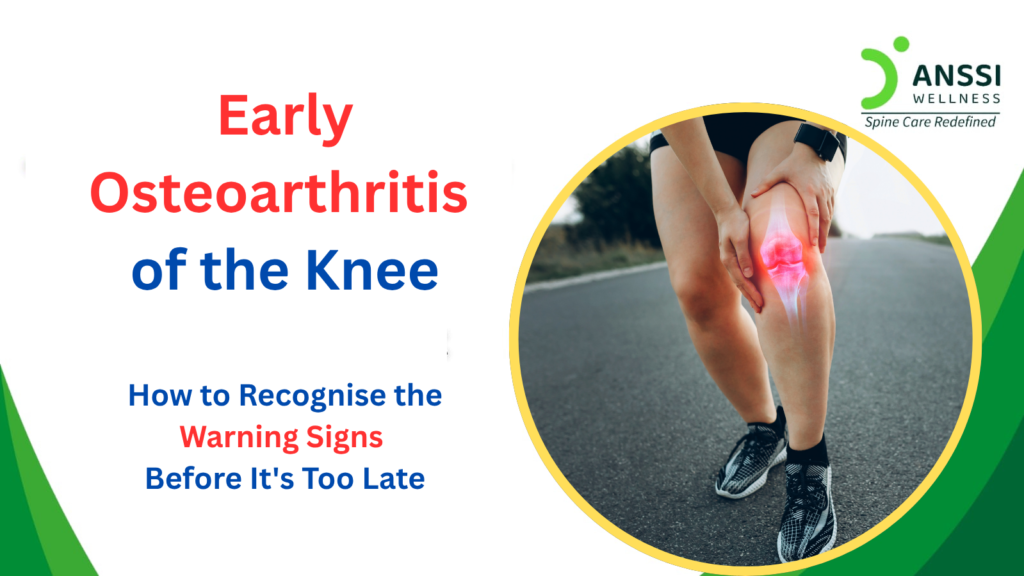
Don’t dismiss your knee pain as “normal ageing.” Learn the early warning signs of knee osteoarthritis, how it is diagnosed, and why ANSSI Wellness’s Advanced Knee Rehabilitation Program is the most effective early knee OA treatment without surgery in India.
It begins so quietly that most people ignore it entirely. A little stiffness when you get out of bed in the morning. A faint clicking sound when you climb the stairs. A dull ache in your knees after a long day on your feet. Nothing dramatic. Nothing that stops you in your tracks.
So you dismiss it. You tell yourself it is just tiredness. Or age. Or the weather. You take a painkiller, apply a hot pack, and carry on.
This is precisely how early osteoarthritis of the knee destroys millions of lives across India; not with a sudden, unmistakable crisis, but with a slow, silent progression that goes unrecognised and untreated until the damage is severe enough to warrant a medical intervention.
Here is the truth that too few doctors communicate clearly enough: osteoarthritis of the knee is not a death sentence for your mobility, but only if you catch it early. The window for effective, non-surgical treatment is real, but it is not open forever. Once cartilage is gone, it does not regenerate on its own. Once the joint reaches bone-on-bone deterioration, surgery becomes almost inevitable.
Let’s learn to recognise the signs, understand the diagnostic process, and discover why early knee OA treatment can halt, and even reverse, the progression of osteoarthritis before it is too late.
What is Early Osteoarthritis of the Knee?
The knee joint is cushioned by a layer of smooth, resilient cartilage that coats the ends of the bones, absorbing shock and enabling fluid, pain-free movement. Osteoarthritis occurs when this cartilage begins to break down and wear away; a degenerative process that, once started, tends to accelerate without intervention.
Clinicians classify knee osteoarthritis into four stages using the Kellgren-Lawrence grading scale:
- Grade 1 (Minor): Microscopic cartilage damage; minimal joint space narrowing
- Grade 2 (Mild): Visible cartilage thinning on imaging; this is the critical early intervention window
- Grade 3 (Moderate): Significant cartilage loss; visible bone changes; chronic pain and swelling
- Grade 4 (Severe): Bone-on-bone contact; severe deformity; surgery typically the only remaining option
The tragedy is that most patients do not seek medical attention until Grade 3 or 4. By then, the opportunities for non-surgical knee cartilage treatment are dramatically reduced.
Who is most at risk? Early osteoarthritis is most prevalent among women over 40, individuals who are overweight, people with physically demanding occupations, those with a history of knee injury, and anyone with a family history of arthritis. Increasingly, however, it is also appearing in younger, urban Indians due to sedentary lifestyles combined with sudden high-impact exercise patterns.
6 Early Warning Signs You Should Never Ignore
The challenge with early osteoarthritis knee symptoms is that they are easy to rationalise away. Here are six signs that should prompt you to seek a professional knee osteoarthritis diagnosis.
1. Morning Stiffness That Eases Within 30 Minutes:
Waking up with stiff, uncomfortable knees that loosen after you move around is a hallmark early signal of OA. Unlike rheumatoid arthritis, where stiffness persists for over an hour, OA-related morning stiffness typically resolves within 30 minutes, which is exactly why people tend to dismiss it.
2. Mild Swelling Around the Knee Joint:
Intermittent puffiness or warmth around the knee, particularly after physical activity, indicates early inflammation within the joint. This is your body signalling that cartilage is under stress.
3. Clicking, Creaking, or Grinding Sounds (Crepitus):
That unsettling crunch or click when you bend or straighten your knee is called crepitus. It occurs when roughened cartilage surfaces rub against each other, a direct acoustic sign that cartilage integrity is already compromised.
4. Pain When Climbing Stairs or Rising From a Chair:
Early OA pain is typically activity-specific rather than constant. If your knees hurt going up or down stairs, or when standing up from a seated position, but feel relatively fine when resting, this pattern is a classic early osteoarthritis symptom that warrants immediate attention.
5. Reduced Range of Motion and Flexibility:
Difficulty fully bending or straightening the knee, or a feeling of tightness that limits your natural gait, suggests early joint space narrowing. It is a structural change that worsens significantly without treatment.
6. Post-Activity Aching That Was Not There Before:
If your knees ache for hours after a walk, a gym session, or even a shopping trip, when they previously had no such reaction, this is your cartilage communicating its distress. Do not wait for this signal to get louder.
How Early Knee Osteoarthritis is Diagnosed
Accurate knee osteoarthritis diagnosis requires a combination of clinical assessment and imaging. Crucially, it requires a doctor who takes early symptoms seriously rather than attributing them reflexively to age.
Physical Examination
A thorough clinical assessment includes evaluation of joint tenderness, swelling, range of motion, gait analysis, and muscle strength around the knee. A skilled clinician can detect early OA with reasonable accuracy through examination alone.
X-Ray Grading
Standing weight-bearing X-rays of the knee allow the physician to assess joint space width, which is the gap between the femur and tibia that reflects cartilage thickness. Using the Kellgren-Lawrence scale, early-stage narrowing can be identified and graded, providing a baseline to monitor disease progression over time.
MRI Scanning
Where X-rays show bone structure, MRI reveals soft tissue detail, such as cartilage thickness, early cartilage lesions, meniscal tears, ligament integrity, and bone marrow changes that precede visible X-ray findings. MRI is the gold standard for detecting Grade 1 and Grade 2 OA, making it invaluable for early intervention planning.
Why Early OA Is Frequently Missed
The uncomfortable reality is that early osteoarthritis is routinely misdiagnosed or dismissed at the primary care level. Patients are told their X-rays look “normal for their age,” given a prescription for anti-inflammatory medication, and sent home. Without a proper MRI or a specialist who understands the significance of early cartilage changes, the condition continues to progress undetected, untreated, and increasingly irreversible.
Why Acting Early is Critical
Cartilage has no blood supply of its own. Unlike bone or muscle, it cannot heal itself once significantly damaged. Every month that early osteoarthritis goes untreated is a month in which the cartilage continues to degrade, silently, irreversibly.
The progression from Grade 2 to Grade 4 OA can take anywhere from two to ten years, depending on individual factors. But the critical point is this: the transition from treatable to surgical is not gradual; it is a threshold. Once the joint reaches bone-on-bone deterioration, no amount of rehabilitation or conservative treatment can restore what has been lost.
Total Knee Replacement surgery in India costs between ₹2 to ₹5 lakhs per knee, involves weeks of hospitalisation, months of physiotherapy, and significant surgical risks such as infection, implant failure, blood clots, and nerve damage. With a prosthetic lifespan of 15-20 years, many patients face revision surgery in their lifetime.
The financial, physical, and emotional cost of delayed treatment is enormous. The cost of early intervention, by comparison, is a fraction, and the outcomes are immeasurably better.
The Best Early Knee OA Treatment Without Surgery
ANSSI Wellness’s Advanced Knee Rehabilitation Program is India’s most comprehensive non-surgical treatment protocol specifically designed for early to moderate knee osteoarthritis. It is changing the trajectory of thousands of patients who were told their only option was to wait for surgery.
The centrepiece of the program is advanced Knee Decompression Treatment. It is a technology-driven, non-invasive procedure that applies precise, controlled decompression forces to the knee joint. This creates negative pressure within the joint space, promoting the natural influx of synovial fluid, oxygen, and nutrients into the damaged cartilage, stimulating regeneration, reducing inflammation, and restoring the joint’s natural cushioning capacity.
Unlike painkillers that merely suppress symptoms, or physiotherapy that strengthens muscles without addressing cartilage damage, ANSSI’s program targets the structural pathology of osteoarthritis directly. It does so by halting degeneration and supporting genuine biological recovery.
The program delivers:
- Cartilage regeneration support through enhanced nutrient delivery to damaged joint tissue
- Reduction in joint inflammation, associated pain, and swelling
- Restoration of joint space by reversing early-stage narrowing visible on X-ray
- Strengthening of the supporting musculature to reduce mechanical load on the knee
- Improved range of motion and functional mobility
And it achieves all of this with zero surgery, zero hospitalisation, zero medicines, and zero side effects and at a fraction of the cost of knee replacement.
ANSSI Wellness operates 16 clinics across India, including Mumbai, Pune, Bangalore, Hyderabad, Nagpur, and Patna, making expert knee pain treatment accessible to patients across the country. Every patient begins with a comprehensive diagnostic assessment, including review of imaging, clinical examination, and a personalised treatment plan, so that the program is precisely calibrated to the stage and severity of their condition.
Book Consultation
Call +91 9004726844 | 9920936844
Visit www.anssiwellness.com
References:
- Vos T, Lim S, Abbafati C et al., Global burden of 369 diseases and injuries in 204 countries and territories, 1990–2019: a systematic analysis for the Global Burden of Disease Study 2019, The Lancet, 396, 1204-1222.
- Heidari B. Knee osteoarthritis prevalence, risk factors, pathogenesis and features: Part I. Caspian J Intern Med. 2011 Spring;2(2):205-12. PMID: 24024017; PMCID: PMC3766936.
- Hunter D, March L, Chew M, Osteoarthritis in 2020 and beyond: a Lancet Commission, The Lancet, 2020; 396, 1711-1712.
- Felson DT. Clinical practice. Osteoarthritis of the knee. N Engl J Med. 2006 Feb 23;354(8):841-8. doi: 10.1056/NEJMcp051726. Erratum in: N Engl J Med. 2006 Jun 8;354(23):2520. PMID: 16495396.
- Fransen M, McConnell S, Harmer AR, Van der Esch M, Simic M, Bennell KL. Exercise for osteoarthritis of the knee: a Cochrane systematic review. Br J Sports Med. 2015 Dec;49(24):1554-7. doi: 10.1136/bjsports-2015-095424. Epub 2015 Sep 24. PMID: 26405113.
About ANSSI:
ANSSI Wellness focuses on improving the quality of life for patients suffering from knee issues, aiming to provide relief where other conventional treatments have failed. Through Advanced Knee Rehabilitation Treatment, ANSSI is committed to helping patients avoid surgery and recover in a safe, effective, and compassionate environment.
Connect with ANSSI Wellness on LinkedIn, Instagram, and Facebook for expert guidance.