A herniated disc can be a frustrating and painful condition. What may begin as occasional lower back or neck discomfort can progress to shooting pain, tingling, numbness or weakness in an arm or leg. For many people in Hyderabad, persistent symptoms eventually lead to an MRI scan and a diagnosis of a herniated disc.
At that point, an important question often arises: Should you undergo surgery, or are there effective non-surgical treatment options?
The answer depends on the cause and severity of the condition, the presence of neurological symptoms and the individual’s overall health. For appropriately selected patients, Non-Surgical Spinal Decompression Treatment (NSSDT) is one option that can be explored before considering surgery.
What is a Herniated Disc?
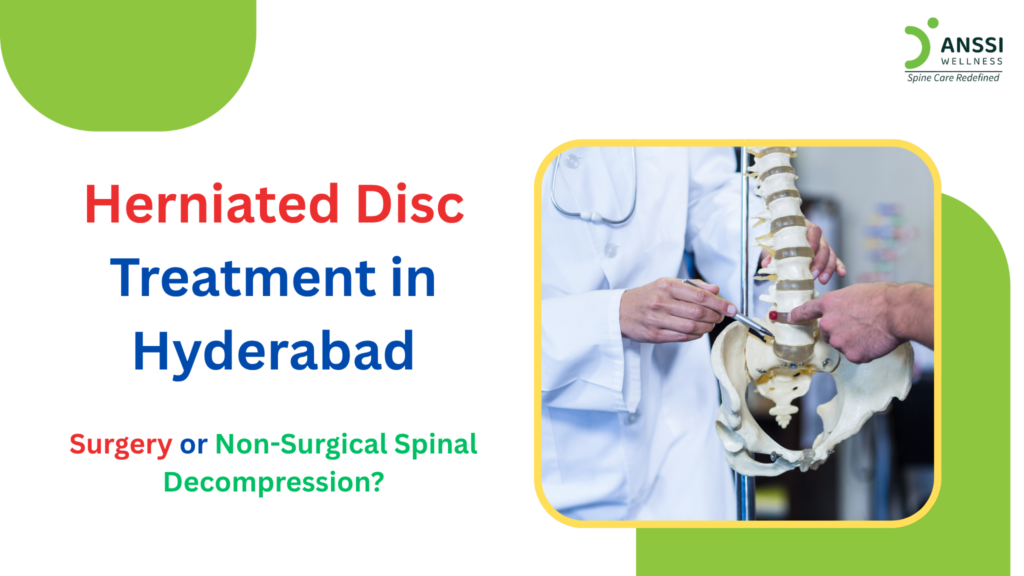
The spine contains a series of vertebrae separated by flexible intervertebral discs. These discs act as cushions, helping absorb mechanical forces and allowing the spine to move.
Each disc has a relatively strong outer layer surrounding a softer inner material. When the outer portion becomes weakened or develops a tear, the inner material can protrude through it. This is commonly referred to as a herniated or slipped disc.
The herniation becomes particularly problematic when it irritates or compresses a nearby spinal nerve.
A lumbar herniated disc may cause:
- Lower back pain
- Pain travelling into the buttock or leg
- Sciatica
- Tingling or pins-and-needles sensations
- Numbness
- Muscle weakness
A cervical herniated disc may instead cause neck pain accompanied by symptoms travelling into the shoulder, arm or hand.
However, an important point is that not every herniated disc seen on an MRI necessarily causes symptoms. Imaging findings need to be correlated with the patient’s clinical symptoms and examination.
What Causes a Herniated Disc?
Herniated discs can develop for several reasons.
- Age-Related Disc Degeneration: As we age, spinal discs can gradually lose water content and elasticity. A dehydrated or degenerated disc may become less capable of absorbing everyday mechanical loads.
- Prolonged Sitting: Modern work often involves spending several hours at a desk. Poor sitting posture, inadequate lumbar support and insufficient movement breaks can contribute to repeated spinal loading.
- Repetitive Bending and Lifting: Jobs requiring frequent bending, twisting or lifting can place additional stress on the discs, particularly when loads are handled with poor technique.
- Sedentary Lifestyle: Inadequate physical activity can contribute to weak core and postural muscles. These muscles play an important role in supporting the spine during daily activities.
- Excess Weight and Other Lifestyle Factors: Additional body weight can increase mechanical loading on the lumbar spine. Smoking and poor general physical conditioning may also negatively affect spinal health.
For Hyderabad residents, these factors may combine with long commutes, desk-based occupations and physically demanding work, potentially aggravating an already vulnerable spine.
When is Surgery Considered?
Surgery can be an important and effective treatment when there is significant nerve compression that does not respond adequately to appropriate conservative treatment.
Procedures such as microdiscectomy or discectomy remove the portion of disc material compressing a nerve. The objective is to provide more space for the affected nerve and reduce neurological symptoms.
However, surgery is an invasive procedure and can involve potential complications. These may include infection, bleeding, nerve injury, recurrent disc herniation and persistent or recurrent pain.
Recovery can also require restrictions on physical activity and time away from work.
This does not mean surgery should be avoided when it is medically necessary. In particular, progressive neurological weakness, significant neurological deterioration or cauda equina syndrome requires urgent medical evaluation, and surgery may be necessary.
The important question is whether surgery is medically required at the present stage of your condition.
What is Non-Surgical Spinal Decompression Treatment?
For appropriately selected patients, Non-Surgical Spinal Decompression Treatment (NSSDT) provides another treatment approach to discuss with a qualified professional.
NSSDT uses controlled, computer-regulated decompression forces to target the affected spinal segment.
The treatment is designed to modify the mechanical loading environment around the affected disc. In suitable disc-related conditions, the controlled decompression is intended to help reduce mechanical stress around the affected nerve and support disc retraction.
The approach also aims to support disc hydration and improve the mechanical environment around the spinal segment.
Unlike surgery, NSSDT does not involve cutting into the spine or surgically removing disc material.
It is important to understand, however, that NSSDT is not suitable for every patient with a herniated disc. Treatment suitability depends on the patient’s symptoms, neurological status, imaging findings and overall health.
NSSDT is More Than Decompression Alone
A comprehensive non-surgical programme may combine decompression with physiotherapy and rehabilitation.
Depending on the patient’s requirements, treatment may include:
- Core and spinal stabilisation exercises
- Posture correction
- Flexibility exercises
- Ergonomic modifications
- Movement education
- Muscle strengthening
- Guidance on safe lifting and daily activities
This is important because simply reducing pain does not necessarily correct the movement and lifestyle factors that may contribute to recurring symptoms.
For a Hyderabad office worker, for example, treatment may need to address prolonged sitting and workstation posture. Someone involved in physical labour may require guidance regarding lifting techniques and spinal protection.
Surgery vs NSSDT: Which One is Better?
There is no single treatment that is best for every herniated disc patient.
| Surgery | NSSDT |
|---|---|
| Invasive procedure | Non-invasive approach |
| Physically removes compressive disc material | Uses controlled decompression forces |
| May be necessary for serious neurological compression | May be considered for selected disc-related conditions |
| Requires surgical recovery | Generally delivered without hospitalisation |
| Has recognised surgical risks | Does not carry the risks associated with spinal surgery |
| Appropriate when conservative care is insufficient or urgent decompression is required | Appropriate only when clinical assessment indicates suitability |
The comparison should therefore not be viewed simply as “surgery versus decompression.” The correct decision depends on the individual patient’s diagnosis and clinical condition.
A patient with mild-to-moderate disc-related symptoms and no progressive neurological deficit may have different treatment options from someone with severe nerve compression and worsening weakness.
Choosing the Right Treatment in Hyderabad
If you have been diagnosed with a herniated disc, the first step should be a proper evaluation rather than immediately choosing a treatment based solely on an MRI report.
A specialist should consider your symptoms, neurological examination, imaging and medical history before recommending a treatment plan.
For patients who want to explore non-surgical care, NSSDT may be worth discussing where clinically appropriate. A structured programme combining decompression, physiotherapy and rehabilitation can provide a comprehensive approach to managing selected disc-related conditions.
At the same time, patients should not delay urgent medical care simply to avoid surgery. New or worsening muscle weakness, significant loss of sensation or bladder and bowel changes require prompt assessment.
About ANSSI:
ANSSI Wellness focuses on improving the quality of life for patients suffering from spinal issues, aiming to provide relief where other conventional treatments have failed. Through advanced Non-Surgical Spinal Decompression Treatment, ANSSI is committed to helping patients avoid surgery and recover in a safe, effective, and compassionate environment.
Book Consultation:
Call +91 9004726844 | 9920936844
Visit www.anssiwellness.com
Connect with ANSSI Wellness on LinkedIn, Instagram, and Facebook for expert guidance.
Clinical References:
- Yates, Justin P. MSc; McGill, Stuart M. PhD. The Effect of Vibration and Posture on the Progression of Intervertebral Disc Herniation. Spine 36(5):p 386-392, March 1, 2011.
- Kreiner DS et al. North American Spine Society. An evidence-based clinical guideline for the diagnosis and treatment of lumbar disc herniation with radiculopathy. Spine J. 2014 Jan;14(1):180-91.
- North American Spine Society. Evidence-based recommendations for the diagnosis and conservative and surgical management of lumbar disc herniation.
- National Institute for Health and Care Excellence. Clinical guideline covering assessment and non-surgical management of low back pain and sciatica related to disc pathology.
- Gose E., Ph.D, Naguszewski W., MD, Naguszewski R., MD. Vertebral Axial Decompression Therapy for Pain Associated with Herniated or Degenerated Discs or Facet Syndrome: An Outcome Study. Journal of Neurological Research, Volume 20, No 3, April 1998.