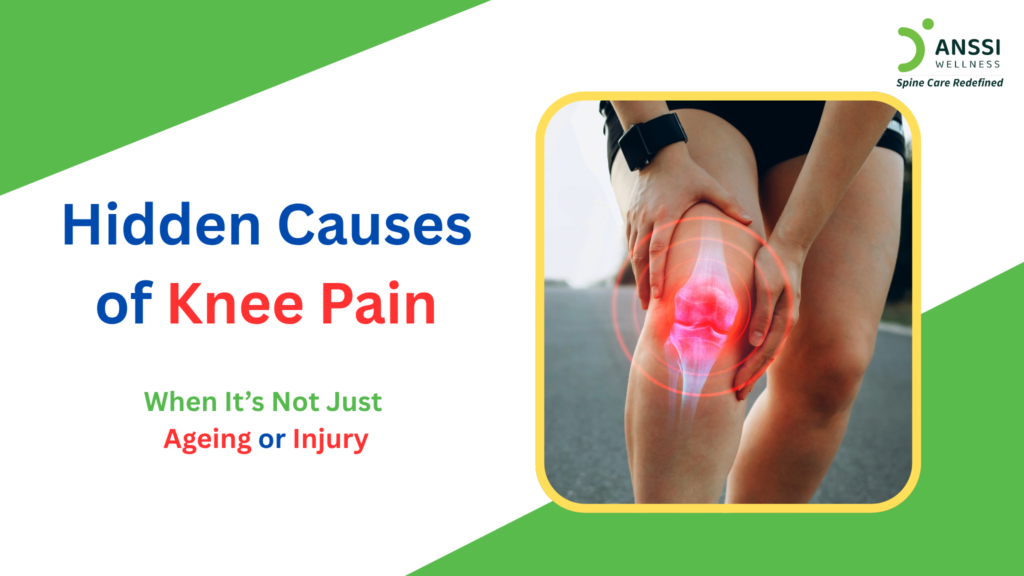
Knee pain is often dismissed as a natural part of ageing or blamed on an old injury. But what if your knee hurts even though you have never experienced a major injury? What if the pain keeps returning despite rest, medication, or changes in activity?
Persistent knee pain does not always have one obvious cause. Everyday factors such as poor posture, muscle imbalance, prolonged sitting, excess weight, and incorrect exercise techniques can gradually change the way forces are distributed through the knee joint.
Understanding these less obvious contributors is important because simply treating pain may not address the factors that are continuing to place stress on your knee. A comprehensive knee rehabilitation programme can help you identify these issues and work towards improving strength, mobility and joint function without immediately turning to surgery.
Why Does Your Knee Hurt Without a Major Injury?
The knee is a weight-bearing joint that constantly adapts to the forces created while walking, standing, climbing stairs, exercising, and performing everyday activities.
When the muscles, joints, and movement patterns around the knee are not working efficiently, some areas may experience greater mechanical stress. Over time, this can contribute to pain and stiffness.
Several hidden factors can play a role.
1. Poor Posture and Body Alignment
The way you stand, walk, or sit can influence how your knees carry weight.
For example, prolonged standing with uneven weight distribution or walking with altered alignment may increase stress on particular areas of the knee. Poor lower-limb alignment can also affect how the kneecap moves during activities such as climbing stairs or squatting.
Posture alone may not explain every case of knee pain, but it can contribute to abnormal loading patterns, particularly when combined with muscle weakness or previous injury.
2. Muscle Imbalance
Your knee does not work in isolation. The quadriceps, hamstrings, calf muscles, gluteal muscles, and core all contribute to lower-limb stability and movement.
If some muscles are weak while others are excessively tight, the knee may not move as efficiently as it should.
Weak quadriceps, for instance, can affect the control of movements such as climbing stairs or getting up from a chair. Weak hip and gluteal muscles can also influence lower-limb alignment during walking, running, or squatting.
A rehabilitation programme can identify these weaknesses and use targeted exercises to improve muscular balance.
3. A Sedentary Lifestyle
Spending much of the day sitting can have consequences beyond back and neck discomfort.
When physical activity is consistently low, muscles supporting the knee can gradually become weaker. Joint mobility may also decrease, making movements feel stiff or uncomfortable.
This can create a cycle: pain leads to less movement, less movement contributes to weakness and stiffness, and reduced strength can make everyday activities more demanding.
Regular, appropriately prescribed movement is therefore an important part of maintaining knee function.
4. Incorrect or Excessive Exercise
Exercise is generally beneficial for joint health, but doing too much too quickly or using incorrect technique can overload the knee.
Repeated high-impact activity, deep squats, jumping or running without adequate conditioning may aggravate an already vulnerable joint.
This is particularly relevant for people who suddenly increase their workout intensity after a long period of inactivity.
The solution is not necessarily to stop exercising completely. Instead, exercise should be adjusted according to the individual’s condition, strength, and functional capacity.
5. Weight Gain
The knees carry much of the body’s weight during standing and movement. Additional body weight can therefore increase the mechanical demands placed on these joints.
Weight management, combined with suitable strengthening and low-impact physical activity, can help reduce unnecessary stress on the knees.
A personalised rehabilitation plan can help people become more physically active without immediately placing excessive loads on painful joints.
6. Previous Minor Injuries and Movement Compensation
Not every injury is dramatic.
A minor sprain, strain, or period of knee pain may cause a person to unconsciously change the way they walk or stand. They may shift their weight to the opposite leg or avoid certain movements.
If this compensation continues for a long time, it can alter the distribution of forces through the lower limbs.
Even when the original injury has healed, the altered movement pattern may remain.
Knee Pain Symptoms You Should Not Ignore
Occasional discomfort after strenuous activity may not necessarily indicate a serious problem. However, persistent symptoms deserve your attention.
Consider professional evaluation if you experience:
- Knee pain that continues or repeatedly returns
- Persistent swelling
- Morning or activity-related stiffness
- Difficulty climbing or descending stairs
- Pain while standing or walking
- Reduced knee movement
- Clicking or instability
- Difficulty getting up from a chair
- Increasing difficulty performing normal activities
Severe pain, significant swelling following an injury, inability to bear weight, or sudden loss of joint function should be assessed promptly.
Why Treating Only the Pain May Not Be Enough
Pain relief can be helpful, but it does not automatically correct the factors contributing to knee problems.
For example, medication may temporarily reduce pain or inflammation, but it cannot strengthen weak muscles, correct poor movement patterns, or improve physical conditioning.
This is why someone may experience temporary improvement and then notice symptoms returning after resuming normal activities.
The goal of effective rehabilitation should be broader: understand what is contributing to the pain and improve the knee’s ability to tolerate everyday loads.
How Knee Rehabilitation Addresses the Root Cause
A comprehensive knee rehabilitation programme begins with an assessment rather than assuming that every knee problem is the same.
Depending on the individual, rehabilitation may include:
Physiotherapy
Targeted physiotherapy can help improve strength, flexibility, balance, and movement control. Exercises may focus on the quadriceps, hamstrings, calf, and hip muscles to provide better support around the knee.
Mobility and Flexibility Exercises
Stiff muscles and restricted joint movement can affect normal movement patterns. Appropriate mobility exercises can help improve flexibility and functional movement.
Posture and Movement Correction
Patients can be taught how to stand, walk, climb stairs, squat, and perform everyday activities with better movement mechanics.
Lifestyle Modification
Increasing appropriate physical activity, managing weight, avoiding prolonged inactivity, and learning how to progress exercise safely can support long-term knee health.
What is Advanced Knee Decompression Treatment?
For appropriately selected patients, advanced knee decompression treatment may be incorporated into a non-surgical rehabilitation programme.
The approach uses controlled unloading and decompressive forces intended to reduce mechanical stress on the knee joint. It may be considered particularly when joint compression contributes to pain and restricted movement.
When combined with physiotherapy and rehabilitation, the objective is not simply to make the knee feel better temporarily but to support improved joint function and mobility.
However, knee decompression is not appropriate for every knee condition. The cause and severity of pain, the patient’s age, joint changes, medical history, and clinical findings should all be considered before treatment.
A Personalised Approach is Essential
Knee pain can result from many different conditions, including osteoarthritis, tendon problems, ligament injuries, meniscus problems, and other joint disorders. Posture, muscle imbalance, and lifestyle factors may contribute to symptoms, but they are not always the primary cause.
That is why self-diagnosis can be misleading.
A proper evaluation can help determine whether the problem is primarily related to joint degeneration, muscular weakness, movement mechanics, or another condition requiring specialised care.
About ANSSI:
ANSSI Wellness focuses on improving the quality of life for patients suffering from knee issues, aiming to provide relief where other conventional treatments have failed. Through Advanced Knee Rehabilitation Treatment, ANSSI is committed to helping patients avoid surgery and recover in a safe, effective, and compassionate environment.
Connect with ANSSI Wellness on LinkedIn, Instagram, and Facebook for expert guidance.