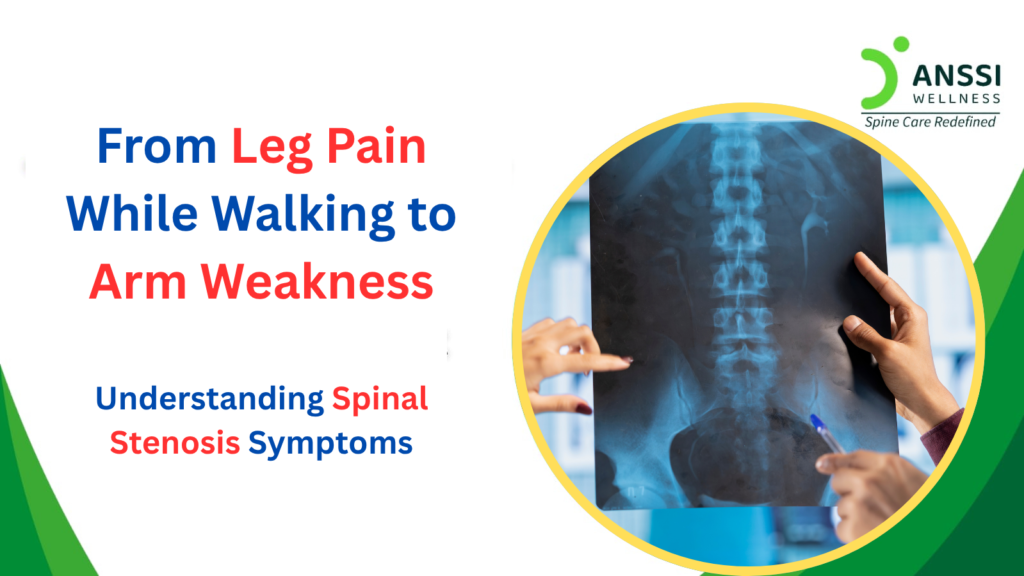
Spinal stenosis is a common age-related spinal condition that can gradually affect mobility, balance, and the overall quality of your life. Many people initially dismiss the symptoms as ordinary ageing, arthritis, or poor circulation. However, spinal stenosis involves narrowing of the spinal canal or the openings through which spinal nerves travel, placing pressure on the spinal cord or nerve roots. If left untreated, this pressure can lead to progressive neurological problems.
The symptoms of spinal stenosis differ depending on whether it affects the lumbar spine (lower back) or the cervical spine (neck). Understanding these symptoms can help patients seek timely medical attention and receive appropriate treatment before permanent nerve damage develops.
What is Spinal Stenosis?
The spinal canal is a protective tunnel through which the spinal cord and nerve roots pass. In spinal stenosis, this space becomes narrower, reducing the room available for these important neural structures.
Several age-related changes contribute to this narrowing, including:
- Degeneration and bulging of spinal discs
- Thickening of spinal ligaments
- Formation of bone spurs (osteophytes)
- Enlargement of the facet joints
- Degenerative changes associated with ageing
As the available space decreases, nerves or the spinal cord may become compressed, producing pain, weakness, numbness, and reduced mobility.
Lumbar Spinal Stenosis: Why Walking Becomes Difficult
Lumbar spinal stenosis affects the lower back and commonly compresses the nerves supplying the legs.
One of its hallmark symptoms is neurogenic claudication, a pattern of symptoms that many patients find confusing.
What is Neurogenic Claudication?
Patients often experience:
- Leg heaviness
- Cramping
- Burning pain
- Tingling or numbness
- Weakness in one or both legs
- Fatigue after walking short distances
These symptoms usually develop while standing or walking and improve after sitting down or leaning forward.
Many patients notice that they can comfortably lean over a shopping trolley while walking through a supermarket but struggle to walk upright for the same distance. This characteristic symptom occurs because bending forward temporarily increases the available space around the nerves.
Why Do These Symptoms Occur?
When standing upright, the spinal canal naturally becomes slightly narrower. In patients with spinal stenosis, this further reduces the already limited space surrounding the nerves.
Walking increases mechanical stress on the compressed nerve roots, producing pain and weakness.
Sitting or bending forward opens the spinal canal slightly, temporarily relieving pressure and reducing symptoms.
Cervical Spinal Stenosis: When the Spinal Cord is Compressed
Cervical spinal stenosis affects the neck and may compress the spinal cord itself, producing a condition known as cervical myelopathy.
Unlike lumbar stenosis, symptoms often involve both the arms and legs because the spinal cord carries nerve signals throughout the body.
Common Symptoms Include
- Persistent neck pain
- Arm weakness
- Hand clumsiness
- Difficulty buttoning clothes
- Problems writing or holding objects
- Tingling or numbness in the hands
- Balance problems
- Unsteady walking
- Progressive weakness in the limbs
These symptoms indicate that spinal cord function may be affected and should never be ignored.
Why Spinal Stenosis is Often Misdiagnosed
One reason spinal stenosis remains undiagnosed for years is that its symptoms resemble several other conditions.
For example:
- Neurogenic claudication is frequently mistaken for peripheral vascular disease, where reduced blood flow causes leg pain during walking.
- Hip arthritis may produce pain that resembles lumbar spinal stenosis.
- Balance problems are often attributed simply to ageing.
- Hand weakness may initially be mistaken for arthritis or nerve entrapment.
Without careful evaluation, patients may receive treatments that address the wrong condition while the underlying spinal problem continues to progress.
Ensuring Accurate Diagnosis
A thorough evaluation by a spine specialist is essential for determining the true cause of symptoms.
Assessment usually includes:
- Detailed medical history
- Physical examination
- Neurological assessment
- Evaluation of walking pattern
- Muscle strength testing
- Reflex examination
- MRI where clinically indicated
MRI is particularly valuable because it allows the specialist to visualise the spinal canal, discs, ligaments, and nerves, helping determine both the location and severity of compression.
Importantly, imaging findings are interpreted alongside the patient’s symptoms and clinical examination rather than in isolation.
Warning Signs That Require Immediate Medical Attention
Certain symptoms suggest progressive neurological deterioration and require urgent specialist assessment.
These include:
- Increasing arm or leg weakness
- Difficulty walking that progressively worsens
- Frequent falls
- Loss of hand coordination
- Bladder or bowel dysfunction
- Severe numbness involving both legs
- Rapid progression of neurological symptoms
These signs may indicate significant spinal cord or nerve compression requiring prompt medical intervention.
Non-Surgical Treatment Options
Many patients with spinal stenosis can initially be managed with conservative treatment, particularly when symptoms are mild to moderate, and there is no evidence of significant neurological deterioration.
Comprehensive management may include:
- Physiotherapy
- Posture correction
- Strengthening exercises
- Flexibility training
- Activity modification
- Weight management
- Lifestyle advice
- Medications for symptom control when clinically appropriate
These treatments aim to improve mobility, strengthen supporting muscles, and reduce mechanical stress on the spine.
The Role of Non-Surgical Spinal Decompression Treatment
For selected patients whose symptoms are associated with disc-related spinal stenosis, Non-Surgical Spinal Decompression Treatment (NSSDT) may be incorporated into a personalised rehabilitation programme.
Using computer-controlled technology, NSSDT is designed to reduce pressure within affected spinal discs and decrease mechanical stress on nearby nerve roots. When combined with physiotherapy, strengthening exercises, posture correction, and lifestyle modification, it may help improve spinal function in appropriately selected patients.
It is important to understand that Non-Surgical Spinal Decompression Treatment does not physically widen the bony spinal canal or reverse fixed bony narrowing caused by advanced arthritis or large bone spurs. Suitability depends on the underlying cause of stenosis and is determined only after a comprehensive clinical evaluation and review of MRI findings by a spine specialist.
When Surgery May Be Necessary
Although many patients benefit from conservative treatment, surgery remains an important option in specific situations.
A spine specialist may recommend surgery when there is:
- Progressive cervical myelopathy
- Significant spinal cord compression
- Severe neurological deficits
- Persistent disabling symptoms despite appropriate conservative treatment
The goal of surgery is to relieve pressure on the spinal cord or nerve roots when non-surgical management is unlikely to provide sufficient benefit.
About ANSSI:
ANSSI Wellness focuses on improving the quality of life for patients suffering from spinal issues, aiming to provide relief where other conventional treatments have failed. Through advanced Non-Surgical Spinal Decompression Treatment, ANSSI is committed to helping patients avoid surgery and recover in a safe, effective, and compassionate environment.
Book Consultation:
Call +91 9004726844 | 9920936844
Visit www.anssiwellness.com
Connect with ANSSI Wellness on LinkedIn, Instagram, and Facebook for expert guidance.
Clinical References:
- Lurie J, Tomkins-Lane C. Management of lumbar spinal stenosis. BMJ. 2016;352:h6234.
- Katz JN, Harris MB. Lumbar spinal stenosis. New England Journal of Medicine. 2008;358(8):818-825.
- Rhee JM, Shamji MF, Erwin WM, et al. Nonoperative management of cervical myelopathy: a systematic review. Spine. 2013;38(22 Suppl 1):S55-S67.
- Ramos G., MD, Martin W., MD. Effects of Vertebral Axial Decompression On Intradiscal Pressure. Journal of Neurosurgery 81: 350-353, 1994.