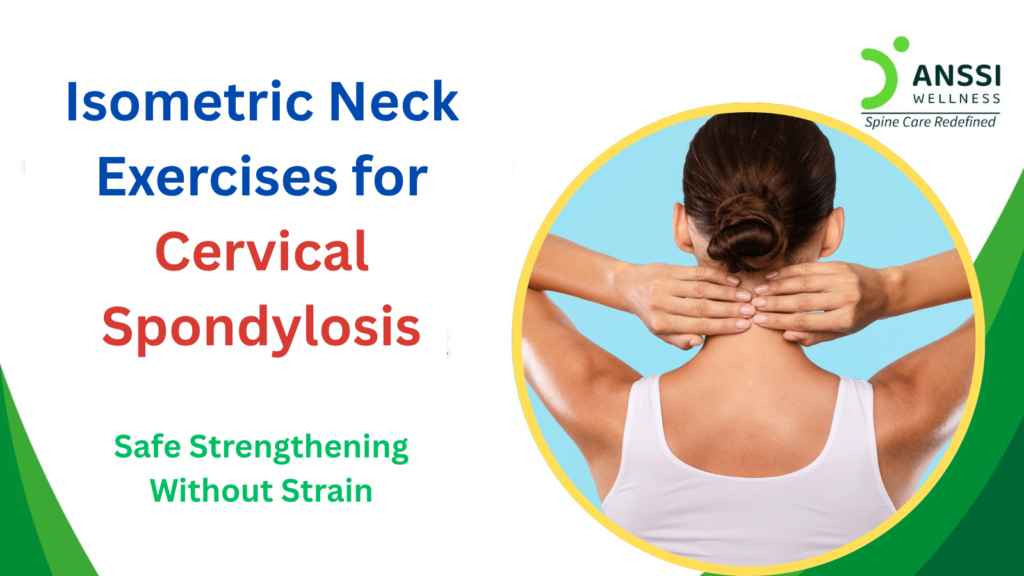
Neck pain, stiffness, and difficulty turning the head have become common problems for many people. Cervical spondylosis is a condition associated with degenerative changes in the cervical spine. Age-related wear and tear, prolonged screen use, poor posture, inadequate physical activity, and repetitive strain can contribute to neck symptoms.
Strengthening the muscles that support the neck can be an important part of rehabilitation. However, not every exercise is suitable for every person. Excessive bending, twisting, or forceful neck movements may aggravate symptoms in some individuals. This is where isometric neck exercises can offer you a controlled way to strengthen your neck muscles without excessive movement.
What Are Isometric Neck Exercises?
Isometric exercises involve contracting a muscle while keeping the associated joint relatively still. For the neck, gentle resistance can be provided using your hand.
The goal is not to repeatedly move the neck forward, backwards, or from side to side. Instead, the muscles are activated against gentle resistance while the head remains relatively stationary.
When performed correctly and at an appropriate intensity, these exercises may help improve muscle activation, strength, and support around the neck.
However, exercise intensity should always be adapted to the individual’s condition and symptoms.
A. Forward Isometric Exercise
The objective is to activate the neck muscles in a controlled manner rather than create strain.
- Sit or stand upright with your shoulders relaxed.
- Place the palm of your hand against your forehead.
- Gently press your forehead against your palm while using your hand to prevent your head from moving forward. Your neck should remain relatively still.
- Hold the gentle pressure for a few seconds and then relax.
Remember, there is no need to push forcefully.
B. Backwards Isometric Exercise
This exercise can activate the muscles at the back of the neck.
- Place both hands behind your head.
- Gently press your head backwards against your hands while using your hands to prevent noticeable movement.
- Hold the contraction for a few seconds and then relax.
Keep the pressure gentle and avoid extending your neck forcefully.
C. Sideways Isometric Exercise
This exercise can help activate the muscles responsible for supporting the neck during side-to-side movement.
- Place your right palm against the right side of your head, above the ear.
- Gently try to move your head toward your right hand while using your hand to resist the movement. Your head should remain relatively still.
- After a few seconds, relax and repeat on the opposite side.
D. Rotation Isometric Exercise
Here, the goal is to create gentle muscle tension without actually rotating the neck significantly.
- Place your palm against the side of your forehead.
- Gently attempt to turn your head toward your hand while using your hand to resist the movement.
- Repeat on the other side if comfortable.
Do not force the movement or hold your breath while performing the exercise.
How Should You Perform These Exercises Safely?
The most important principle is gentle resistance rather than maximum effort.
- Start with short holds and a small number of repetitions.
- Keep your breathing normal and maintain a comfortable upright posture.
- Gradually increasing exercise intensity may be appropriate for some people, but progression should depend on symptoms and professional guidance.
- Stop the exercise if it causes significant or increasing pain, dizziness, headache, numbness, tingling, or weakness.
It is also important to distinguish between mild muscle effort and worsening neurological symptoms. If pain begins travelling further into the shoulder or arm, or if numbness or weakness increases, discontinue the exercise and seek professional advice.
Who Should Be Careful?
Isometric exercises are not automatically suitable for everyone with cervical spondylosis.
People experiencing severe or rapidly worsening neck pain, significant nerve compression, increasing weakness, balance problems, recent spinal injury, or other neurological symptoms should be examined by a doctor or physiotherapist before beginning a new exercise program.
An MRI may show cervical disc degeneration, disc bulging, or other changes, but an imaging finding alone does not determine which exercises are appropriate. The findings should be considered together with symptoms and clinical examination.
Exercises Are Only One Part of Recovery
Although strengthening exercises can be valuable, managing cervical spondylosis usually involves more than exercise alone.
Physiotherapy can help improve neck and upper-body strength, mobility, posture, flexibility, and functional movement. A physiotherapist can also modify exercises according to your symptoms and progress.
Posture correction is particularly important for people who spend many hours using computers or mobile devices. Adjusting screen height, maintaining appropriate sitting posture, taking regular movement breaks, and avoiding prolonged forward-head positioning can help reduce unnecessary strain.
Depending on the symptoms, heat or cold therapy may also be used as part of symptom management. Activity modification and appropriate lifestyle changes can further support rehabilitation.
Can Non-Surgical Spinal Decompression Help?
For selected patients whose cervical symptoms are associated with certain disc-related conditions, Non-Surgical Spinal Decompression Treatment (NSSDT) may be considered as part of a non-surgical treatment plan.
NSSDT uses controlled, computer-regulated decompressive forces directed at selected spinal segments. The approach is intended to reduce mechanical pressure on the targeted area and support the management of appropriate disc-related conditions.
NSSDT may be combined with physiotherapy, strengthening, posture correction, and other supportive rehabilitation measures depending on the patient’s condition.
When Should You See a Doctor?
Do not rely only on home exercises if your symptoms are worsening or affecting your daily activities.
Medical evaluation is particularly important if you experience:
- Increasing weakness in the arm or hand
- Persistent numbness or tingling
- Pain that consistently travels from the neck into the arm
- Difficulty with balance or walking
- Loss of coordination or difficulty using your hands
- Symptoms following a significant injury
Severe neurological symptoms or signs of spinal cord compression may require urgent specialist assessment. Some conditions cannot be safely managed through exercise or other non-surgical approaches and may require surgical treatment.
About ANSSI:
ANSSI Wellness focuses on improving the quality of life for patients suffering from spinal issues, aiming to provide relief where other conventional treatments have failed. Through advanced Non-Surgical Spinal Decompression Treatment, ANSSI is committed to helping patients avoid surgery and recover in a safe, effective, and compassionate environment.
Book Consultation:
Call +91 9004726844 | 9920936844
Visit www.anssiwellness.com
Connect with ANSSI Wellness on LinkedIn, Instagram, and Facebook for expert guidance.