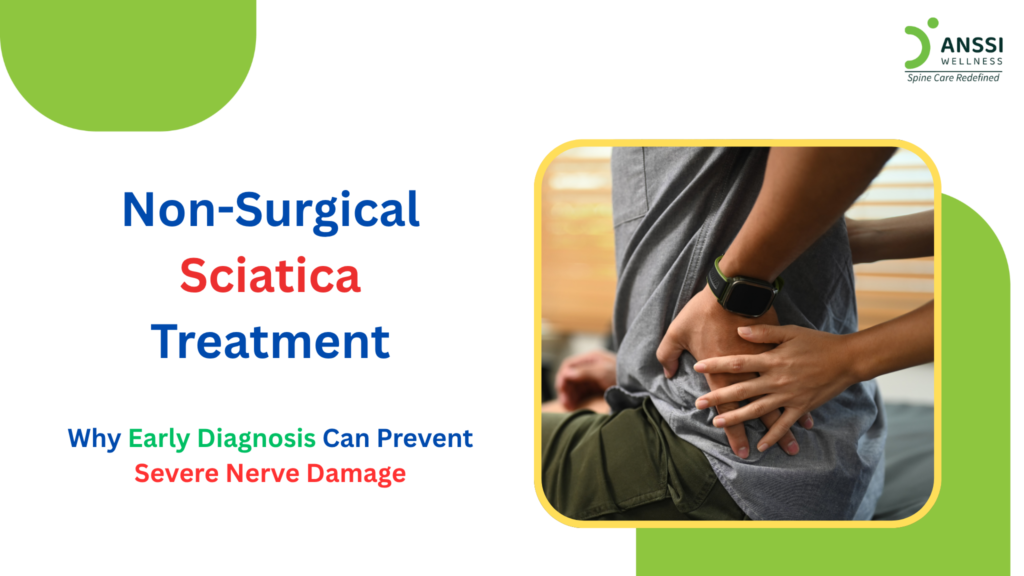
Sciatica is more than just lower back pain. It is a condition caused by irritation or compression of the sciatic nerve, the longest nerve in the human body, which runs from the lower back through the buttocks and down each leg. While some people experience only mild discomfort initially, untreated sciatica can gradually progress, causing persistent pain, muscle weakness, and difficulty performing everyday activities.
Many patients ignore the early warning signs, hoping the pain will resolve on its own. However, delaying treatment can allow nerve compression to worsen over time. Early diagnosis and appropriate treatment can often relieve symptoms, protect nerve function, and reduce the likelihood of requiring surgery in appropriately selected patients.
Understanding Sciatica
Sciatica is not a disease itself but a symptom of an underlying spinal condition that compresses or irritates the sciatic nerve.
The most common causes include:
- Herniated (slipped) disc
- Bulging disc
- Spinal stenosis
- Spondylolisthesis
- Degenerative disc disease
Among these, a herniated lumbar disc is one of the leading causes. When the inner portion of a damaged spinal disc protrudes outward, it can press on nearby nerve roots that form the sciatic nerve. This pressure produces the characteristic pain that travels from the lower back into the buttock and down the leg.
Early Symptoms You Should Not Ignore
Sciatica often begins gradually before becoming more severe.
Early symptoms include:
- Lower back pain
- Pain radiating into the buttock
- Leg pain extending below the knee
- Tingling or “pins and needles”
- Numbness in the leg or foot
- Mild muscle weakness
- Pain while sitting for prolonged periods
- Increased discomfort during coughing, sneezing, or bending
These symptoms indicate that the sciatic nerve may already be under pressure. Seeking medical advice early allows the underlying cause to be identified before further nerve irritation develops.
What Happens If Sciatica is Left Untreated?
Ignoring sciatica can have significant consequences.
Persistent nerve compression may lead to:
- Increasing intensity of leg pain
- Reduced mobility
- Progressive muscle weakness
- Difficulty standing or walking
- Problems performing daily activities
- Reduced workplace productivity
- Poor sleep quality
- Emotional stress caused by chronic pain
In severe cases, prolonged nerve compression may result in permanent neurological deficits.
A particularly serious complication is cauda equina syndrome, a medical emergency characterised by severe nerve compression that may cause bladder or bowel dysfunction, numbness around the groin, and rapidly progressing leg weakness. Immediate surgical treatment is required in such situations.
Why Early Diagnosis Matters
Early diagnosis is essential because successful treatment depends on identifying the precise cause of sciatica.
A comprehensive assessment usually includes:
- Detailed medical history
- Physical examination
- Neurological assessment
- Evaluation of muscle strength and reflexes
- MRI where clinically indicated
MRI helps determine whether the sciatic nerve is being compressed by a herniated disc, spinal stenosis, or another spinal condition. Understanding the location and severity of compression allows the spine specialist to recommend the most appropriate treatment.
Prompt diagnosis also helps prevent worsening neurological symptoms and allows conservative treatment to begin at an earlier stage.
Non-Surgical Treatment Options
For many patients, surgery is not the first treatment option.
Conservative management often includes:
- Activity modification
- Physiotherapy
- Core strengthening exercises
- Posture correction
- Stretching programmes
- Ergonomic improvements
- Pain management under medical supervision
The aim of conservative treatment is to reduce pain, improve spinal function, strengthen supporting muscles, and relieve pressure on irritated nerves.
Non-Surgical Spinal Decompression Treatment
For appropriately selected patients with disc-related sciatica, Non-Surgical Spinal Decompression Treatment (NSSDT) may be incorporated into a personalised rehabilitation programme.
NSSDT uses a computer-controlled decompression system to gently apply controlled distraction forces to the affected spinal segment.
The treatment is designed to:
- Reduce pressure within the intervertebral disc
- Create negative intradiscal pressure
- Encourage partial retraction of herniated disc material
- Relieve compression of affected nerve roots
- Support disc hydration and spinal function
Because every patient is different, suitability for NSSDT is determined only after a thorough clinical evaluation by an orthopaedic specialist and review of imaging findings.
When combined with physiotherapy, posture correction, strengthening exercises, and lifestyle modifications, NSSDT forms part of a comprehensive non-surgical rehabilitation programme aimed at addressing the structural cause of disc-related nerve compression.
When is Surgery Necessary?
Although many patients improve with conservative treatment, surgery remains an important option in certain clinical situations.
A spine specialist may recommend surgery if there is:
- Progressive muscle weakness
- Significant neurological deficit
- Cauda equina syndrome
- Severe spinal instability
- Persistent disabling symptoms despite appropriate conservative treatment
Surgical procedures such as microdiscectomy aim to remove the portion of the disc compressing the nerve.
Like any major operation, spine surgery carries potential risks, including infection, bleeding, nerve injury, scar tissue formation, and a period of postoperative rehabilitation. For this reason, many patients explore conservative treatment options before considering surgery, where clinically appropriate.
Benefits of Early Non-Surgical Treatment
Seeking treatment during the early stages of sciatica offers several advantages.
Early intervention may help:
- Relieve pain before it becomes chronic
- Reduce nerve irritation
- Preserve muscle strength
- Improve mobility
- Restore daily function more quickly
- Reduce dependence on prolonged pain medication
- Increase the opportunity to recover without surgery in appropriately selected patients
Patients who delay treatment often experience more persistent symptoms and may require longer rehabilitation.
About ANSSI:
ANSSI Wellness focuses on improving the quality of life for patients suffering from spinal issues, aiming to provide relief where other conventional treatments have failed. Through advanced Non-Surgical Spinal Decompression Treatment, ANSSI is committed to helping patients avoid surgery and recover in a safe, effective, and compassionate environment.
Book Consultation:
Call +91 9004726844 | 9920936844
Visit www.anssiwellness.com
Connect with ANSSI Wellness on LinkedIn, Instagram, and Facebook for expert guidance.
Clinical References:
- Koes BW, van Tulder MW, Peul WC. Diagnosis and treatment of sciatica. BMJ. 2007;334(7607):1313-1317.
- Vroomen PC, de Krom MC, Slofstra PD, Knottnerus JA. Conservative treatment of sciatica: a systematic review. Journal of Spinal Disorders. 2000;13(6):463-469.
- Peul WC, van Houwelingen HC, van den Hout WB, et al. Surgery versus prolonged conservative treatment for sciatica. New England Journal of Medicine. 2007;356(22):2245-2256.
- Gose E., Ph.D, Naguszewski W., MD, Naguszewski R., MD. Vertebral Axial Decompression Therapy for Pain Associated with Herniated or Degenerated Discs or Facet Syndrome: An Outcome Study. Journal of Neurological Research, Volume 20, No 3, April 1998.
- Tilaro F., MD, Miskovich D. MD. The Effects of Vertebral Axial Decompression On Sensory Nerve Dysfunction In Patients with Low Back Pain and Radiculopathy. Canadian Journal of Clinical Medicine Vol. 6, No 1, January 1999.