Because back pain is so prevalent, many people learn to deal with it. A few days of discomfort after travelling, sitting for long hours, lifting something heavy or doing household work may seem normal. But when back pain keeps returning, starts travelling into the leg or is accompanied by numbness and weakness, it may be more than a simple muscle strain.
A slipped disc, commonly referred to as a herniated or prolapsed disc, can cause a distinctive combination of symptoms. Recognising these warning signs can help you understand when your back pain deserves professional evaluation, and when immediate medical attention is necessary.
What is a Slipped or Herniated Disc?
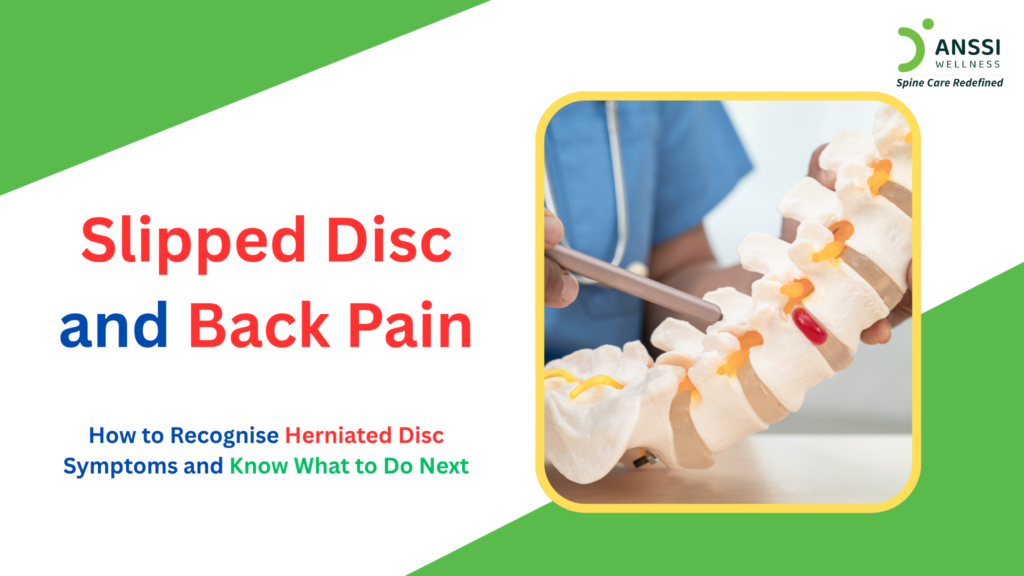
Your spine consists of individual bones called vertebrae, separated by flexible spinal discs that act as cushions and help the spine move.
Each disc has a softer inner portion surrounded by a stronger outer layer. When part of a disc bulges or herniates beyond its normal position, it can sometimes irritate or compress a nearby spinal nerve.
This is why a disc problem may cause symptoms far beyond the lower back. Depending on the location of the affected disc, symptoms may travel into the buttock, thigh, leg or foot. A disc problem in the neck can similarly produce symptoms in the shoulder, arm or hand.
Slipped Disc Symptoms You Should Know
The symptoms of a herniated disc can vary depending on the location and extent of nerve involvement. Some of the most characteristic symptoms include:
Localised Back or Neck Pain
Pain may begin around the lower back when a lumbar disc is involved. Cervical disc problems can instead produce pain around the neck and upper back.
The pain may feel aching, sharp, burning or deep. It may become more noticeable after prolonged sitting, bending or physical activity.
Pain That Travels Into the Leg or Arm
One of the important clues that a disc may be irritating a nerve is radiating pain.
Instead of remaining in the lower back, pain may travel through the buttock and down one leg. It can sometimes extend towards the calf, ankle or foot.
With a cervical disc problem, pain may travel from the neck into the shoulder, arm or hand.
This type of shooting, burning or electric-like pain is often described as nerve-related pain.
Tingling and Numbness
A compressed or irritated nerve may also produce sensations such as pins and needles, tingling or numbness.
You may notice reduced sensation in a particular part of your leg or foot. In cervical disc problems, numbness or tingling may occur in the arm, hand or fingers.
These symptoms should not simply be dismissed as “normal” back pain, particularly when they persist or worsen.
Muscle Weakness
Nerve compression can sometimes affect the muscles supplied by the affected nerve. You may notice difficulty lifting the foot, climbing stairs, gripping objects or performing movements that were previously easy.
Progressive weakness deserves prompt medical evaluation.
How Posture and Movement Can Reveal a Disc Problem
Certain movements and positions can aggravate symptoms associated with disc problems.
- For some people, prolonged sitting increases lower back or leg pain. Bending forward, lifting heavy objects or repeatedly flexing the spine may also worsen symptoms.
- Coughing or sneezing can sometimes temporarily increase pain because of changes in pressure around the spine.
- Standing, walking or changing position may provide relief for some individuals, while others may experience worsening symptoms with prolonged standing or walking.
However, there is no single posture that proves you have a herniated disc. Muscle strain and other spinal conditions can produce overlapping symptoms. A pattern involving radiating pain, altered sensation, or weakness is more concerning for nerve involvement and should be assessed.
When is Back Pain a Medical Emergency?
Most episodes of back pain do not require emergency treatment. However, certain symptoms can indicate serious compression of the nerves supplying the lower body.
Seek immediate medical attention if you develop:
- New loss of bladder or bowel control
- Difficulty starting or controlling urination
- Numbness around the groin, buttocks or inner thighs (saddle-area numbness)
- Rapidly worsening or significant weakness in one or both legs
- Severe symptoms that afflict both legs, especially if there are neurological abnormalities
These symptoms can be associated with serious nerve compression, including cauda equina syndrome, and should not be managed at home or by delaying consultation.
What Should You Do If Symptoms Are Persistent?
If your back pain keeps returning, lasts for several weeks, travels down the leg or is accompanied by persistent tingling or numbness, arrange a consultation with a qualified healthcare professional.
A thorough medical history and physical and neurological examination are typically the first steps in the diagnosis process. An MRI may be recommended when clinically appropriate to examine the discs, nerves and other spinal structures.
Importantly, an MRI finding alone does not always explain someone’s pain. Imaging results need to be considered together with symptoms and examination findings.
Does a Slipped Disc Always Require Surgery?
No. A diagnosis of a slipped or herniated disc does not automatically mean that surgery is necessary.
Many patients can initially be managed with non-surgical approaches, depending on their symptoms and diagnosis. Treatment may include activity modification, physiotherapy, targeted exercises, posture correction and other conservative measures.
For appropriately selected patients with certain disc-related conditions, Non-Surgical Spinal Decompression Treatment (NSSDT) may also be considered. At ANSSI Wellness, NSSDT is presented as a computer-controlled, non-invasive approach intended to apply controlled decompressive forces to targeted areas of the spine.
The suitability of decompression depends on the patient’s specific condition. It should not be considered a substitute for urgent medical or surgical treatment when serious neurological compression is suspected.
About ANSSI:
ANSSI Wellness focuses on improving the quality of life for patients suffering from spinal issues, aiming to provide relief where other conventional treatments have failed. Through advanced Non-Surgical Spinal Decompression Treatment, ANSSI is committed to helping patients avoid surgery and recover in a safe, effective, and compassionate environment.
Book Consultation:
Call +91 9004726844 | 9920936844
Visit www.anssiwellness.com
Connect with ANSSI Wellness on LinkedIn, Instagram, and Facebook for expert guidance.
Clinical References:
- Deyo RA, Weinstein JN. Low back pain. New England Journal of Medicine. 2001;344(5):363-370.
- Koes BW, van Tulder MW, Peul WC. Diagnosis and treatment of sciatica. BMJ. 2007;334(7607):1313-1317.
- Meldon SW, Moettus LN. Thoracolumbar spine fractures: clinical presentation and the effect of altered sensorium. Annals of Emergency Medicine. 1995;26(6):711.
- Boden SD, Davis DO, Dina TS, Patronas NJ, Wiesel SW. Abnormal magnetic-resonance scans of the lumbar spine in asymptomatic subjects. Journal of Bone and Joint Surgery. 1990;72(3):403-408.
- Gose E., Ph.D, Naguszewski W., MD, Naguszewski R., MD. Vertebral Axial Decompression Therapy for Pain Associated with Herniated or Degenerated Discs or Facet Syndrome: An Outcome Study. Journal of Neurological Research, Volume 20, No 3, April 1998.