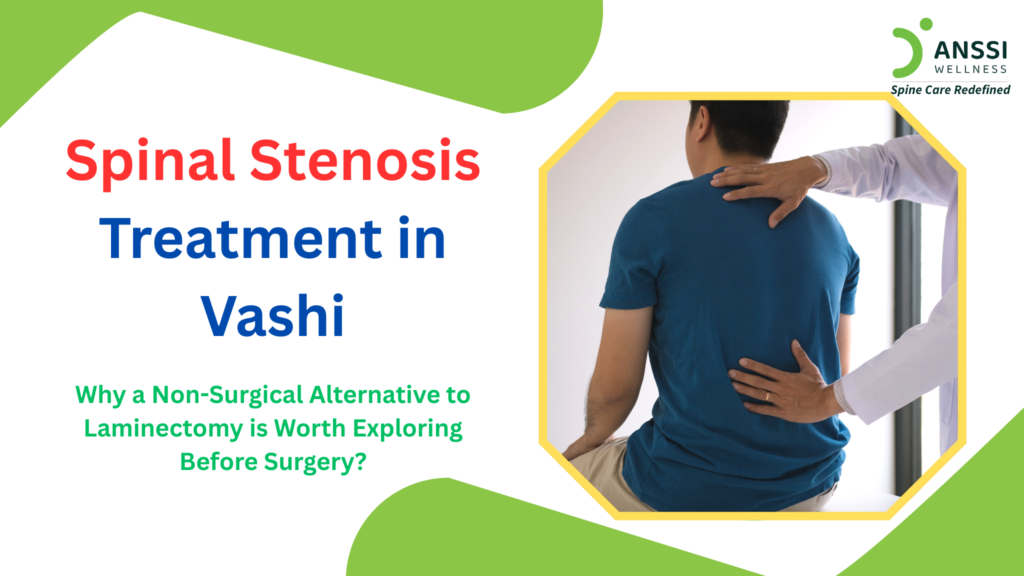
Walking a short distance, standing in a queue or going shopping can become surprisingly difficult when spinal stenosis begins affecting your lower back. Many older adults experience pain, numbness, heaviness or weakness in the legs that improves after sitting down. As symptoms progress, everyday independence can gradually become harder to maintain.
For residents of Vashi and Navi Mumbai who have been diagnosed with lumbar spinal stenosis, being advised to undergo laminectomy or spinal fusion can raise an important question: Is surgery my only option?
The answer is not always yes. Depending on the severity and cause of stenosis, some patients may be able to explore non-surgical treatment before undergoing an elective surgical procedure.
What Happens in Spinal Stenosis?
Spinal stenosis occurs when the spaces available for the spinal nerves become narrower. In the lumbar spine, this narrowing may develop because of age-related disc degeneration, bulging discs, enlargement of the facet joints, thickening of ligaments or a combination of these changes.
As the available space decreases, nearby nerves can become irritated or compressed.
This can produce symptoms such as:
- Lower back pain and stiffness
- Pain spreading into the buttocks or legs
- Numbness or tingling
- Leg heaviness or weakness
- Difficulty standing or walking for extended periods
- Symptoms that improve when sitting or bending forward
The experience is often described as a cycle: walking increases discomfort, the person stops and sits down, symptoms settle, and walking resumes.
Why is Laminectomy Recommended?
A laminectomy is a surgical procedure intended to relieve pressure on neural structures by removing part of the vertebral bone or other tissues contributing to the narrowing.
For appropriately selected patients, decompression surgery can provide meaningful improvement. It can be particularly important when symptoms are severe, neurological function is deteriorating or non-surgical management has failed.
Fusion may be considered in situations involving spinal instability or other structural factors where stabilisation is thought to be necessary.
However, surgery is still surgery. It involves an operation, anaesthesia, recovery and potential complications. The decision should therefore be based on the patient’s symptoms, neurological examination, imaging findings, overall health and the specific cause of stenosis.
Understanding the Risks and Possibility of Recurrence
Laminectomy is not automatically a dangerous procedure, and for the right patient its benefits may outweigh its risks. Nevertheless, potential complications can include infection, bleeding, blood clots, anaesthesia-related problems, dural tears, nerve injury and persistent or recurrent symptoms.
There is also an important long-term consideration: surgery treats the anatomical narrowing that is causing the current problem, but it does not necessarily stop the underlying degenerative process of the spine.
A systematic review and meta-analysis of long-term laminectomy outcomes reported a pooled reoperation rate of about 14% among the studies included, although the evidence quality was considered low.
Recurrence does not necessarily mean that the original surgery failed. Degenerative changes can continue, and problems can develop at the same or another spinal level. Research examining reoperation after lumbar decompression has found that repeat surgery can occur for different reasons, including same-level disease after decompression and adjacent-segment disease following fusion.
This is one reason patients considering elective surgery may reasonably want to understand their non-surgical options first.
How Can Non-Surgical Spinal Decompression Help?
Non-Surgical Spinal Decompression Treatment takes a fundamentally different approach.
Instead of surgically removing bone or tissue from the spinal canal, NSSDT uses controlled, computer-regulated decompressive forces applied to the spine.
The proposed mechanism is particularly relevant when disc degeneration and reduced disc height contribute to narrowing. By applying controlled decompressive forces, the treatment aims to reduce loading on affected spinal segments and potentially improve disc height.
The intended concept is that restoring or improving disc height may increase the available space around nearby neural structures, potentially reducing mechanical stress on the nerves.
Importantly, this is not the same as surgically enlarging the spinal canal. NSSDT does not remove the lamina, thickened ligament or arthritic bone. Therefore, it should not be presented as an equivalent replacement for laminectomy in every form of spinal stenosis.
Instead, it may be an option worth discussing for appropriately selected patients whose stenosis has a significant disc-related or degenerative component.
Why Consider a Non-Surgical Approach Before Surgery?
For suitable patients, exploring non-surgical care can have several potential advantages.
No Surgical Incision
NSSDT does not require cutting into the spine or removing vertebral bone.
No Surgical Anaesthesia
Because it is a non-surgical treatment, it does not involve the anaesthesia required for an operation.
No Surgical Hospital Recovery
Patients receiving non-surgical treatment avoid the inpatient surgical recovery associated with many operative procedures.
Conservative Treatment Approach
NSSDT can be considered as part of a broader conservative programme that may include physiotherapy, strengthening, posture correction and lifestyle modifications.
Personalised Care
Treatment can be planned according to the individual’s symptoms, diagnosis and response to therapy rather than assuming that every patient requires the same intervention.
When is Surgery Necessary?
Patients with severe or progressive neurological deficits, significant spinal instability, certain fractures, tumours, severe spinal cord or nerve compression, or other serious conditions may require specialist surgical evaluation.
If you develop rapidly worsening weakness, significant difficulty walking, new bladder or bowel dysfunction, or numbness around the groin or saddle area, seek urgent medical attention rather than delaying care to try a non-surgical treatment.
For elective cases, however, patients who have been advised to undergo surgery can reasonably ask whether there are appropriate conservative alternatives and whether obtaining a second opinion would be beneficial.
About ANSSI:
ANSSI Wellness focuses on improving the quality of life for patients suffering from spinal issues, aiming to provide relief where other conventional treatments have failed. Through advanced Non-Surgical Spinal Decompression Treatment, ANSSI is committed to helping patients avoid surgery and recover in a safe, effective, and compassionate environment.
Book Consultation:
Call +91 9004726844 | 9920936844
Visit www.anssiwellness.com
Connect with ANSSI Wellness on LinkedIn, Instagram, and Facebook for expert guidance.
Clinical References:
- Sajadi K, Azarhomayoun A, Jazayeri SB, Baigi V, Ranjbar Hameghavandi MH, Rostamkhani S, Atlasi R, Faghih Jooybari M, Ghodsi Z, Vaccaro AR, Khorasanizadeh M, Rahimi-Movaghar V. Long-Term Outcomes of Laminectomy in Lumbar Spinal Stenosis: A Systematic Review and Meta-Analysis. Asian J Neurosurg. 2022 Aug 29;17(2):141-155.
- Lang Z, Li JS, Yang F, Yu Y, Khan K, Jenis LG, Cha TD, Kang JD, Li G. Reoperation of decompression alone or decompression plus fusion surgeries for degenerative lumbar diseases: a systematic review. Eur Spine J. 2019 Jun;28(6):1371-1385.
- de Graaf I, Prak A, Bierma-Zeinstra S, Thomas S, Peul W, Koes B. Diagnosis of lumbar spinal stenosis: a systematic review of the accuracy of diagnostic tests. Spine. 2006;31(10):1168-1176.
- Kreiner DS et al. North American Spine Society. An evidence-based clinical guideline for the diagnosis and treatment of lumbar disc herniation with radiculopathy. Spine J. 2014 Jan;14(1):180-91.
- Tilaro F., MD, Miskovich D. MD. The Effects of Vertebral Axial Decompression On Sensory Nerve Dysfunction In Patients with Low Back Pain and Radiculopathy. Canadian Journal of Clinical Medicine Vol. 6, No 1, January 1999.