Spondylosis is a degenerative condition of the spine that can affect your neck, lower back or other spinal regions. It is commonly associated with age-related changes in the intervertebral discs and spinal joints. For many patients, symptoms begin gradually with occasional pain and stiffness. Over time, however, discomfort may become more frequent and can interfere with your sleep, work, walking and everyday activities.
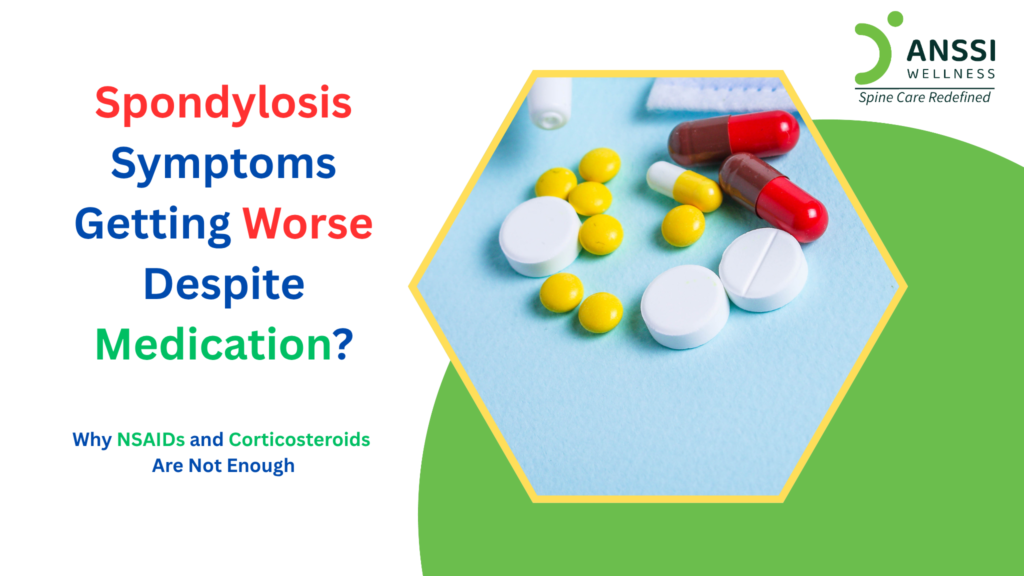
Medication is often one of the first approaches used to manage spondylosis symptoms. Non-steroidal anti-inflammatory drugs (NSAIDs) may reduce pain and inflammation, while corticosteroids may be prescribed in selected situations to control significant inflammatory symptoms.
But what happens when the symptoms continue or worsen despite taking these medicines as prescribed?
One possibility is that the underlying structural changes in the spine are continuing to contribute to the symptoms. Medication can help control the body’s pain and inflammatory response, but it does not necessarily correct disc degeneration, loss of disc height or mechanical irritation of a spinal nerve.
Understanding What Happens to the Spine in Spondylosis
To understand why symptoms can persist, it is important to understand what happens inside the spine.
Between the vertebrae are intervertebral discs that act as cushions and help the spine move. With degeneration, these discs can gradually lose water content and elasticity. Their height may decrease, reducing their ability to absorb mechanical forces effectively.
Degenerative changes can also include disc bulging, development of bone spurs known as osteophytes and changes in the facet joints. Together, these changes may reduce the space available for nearby nerves.
When a nerve root becomes irritated or compressed, symptoms may extend beyond the spine.
- Cervical spondylosis, for example, may cause neck pain and stiffness accompanied by pain, tingling or numbness extending into the shoulder, arm or hand.
- Lumbar spondylosis may cause lower back pain and, when nerves are affected, symptoms extending into the buttock or leg.
Not every degenerative change seen on an X-ray or MRI causes symptoms. MRI reports should therefore always be interpreted alongside the patient’s symptoms and clinical examination.
Why NSAIDs May Not Address the Whole Problem
NSAIDs work primarily by reducing chemicals involved in inflammation and pain. This can make them useful for short-term symptom management.
However, an NSAID does not physically restore a disc that has lost height. It does not remove a disc bulge or osteophyte, nor does it directly widen a narrowed space around a compressed nerve.
This creates an important distinction:
Reducing pain and inflammation does not necessarily mean correcting the mechanical cause of pain.
A patient may feel considerably better while taking an NSAID, but symptoms can return when the medicine is discontinued if the underlying structural problem remains.
Long-term NSAID use also requires medical supervision. Depending on the specific medicine and individual health factors, prolonged use can increase the risk of gastrointestinal problems, kidney complications and cardiovascular events.
Therefore, patients should not continue taking these medicines indefinitely without reviewing their treatment plan with their doctor.
What About Corticosteroids?
Corticosteroids are powerful anti-inflammatory medicines. In certain situations, they can provide significant relief when inflammation is contributing to spinal symptoms.
However, corticosteroids also have limitations similar to NSAIDs. They reduce inflammation but do not necessarily correct the structural changes associated with spondylosis.
Repeated or prolonged corticosteroid exposure can also be associated with complications such as increased blood glucose, weakened bones, increased susceptibility to infections, changes in blood pressure and other systemic effects. The risks depend on factors such as the type of corticosteroid, dose, duration and route of administration.
This does not mean corticosteroids should never be used. They can have an important role when appropriately prescribed. The key is recognising that they may be one component of symptom management rather than a structural solution for degenerative spinal changes.
When Structural Problems Need a Structural Approach
If persistent symptoms are associated with disc degeneration, reduced disc height, disc bulging or nerve-root irritation, treatment may need to address the mechanical component as well.
This is where Non-Surgical Spinal Decompression Treatment (NSSDT) may be considered for appropriately selected patients.
NSSDT uses controlled decompressive forces directed toward specific spinal segments. The objective is to reduce mechanical loading on the affected disc and create a more favourable environment around the affected spinal structures.
In selected disc-related cases, the treatment is intended to support:
- Reduction of mechanical stress on the affected disc
- Reduction of irritation around affected nerve roots
- Support for disc hydration
- Improvement or preservation of disc height
- Better spinal mobility and function
Unlike a painkiller, decompression is not primarily intended to suppress the perception of pain. Its purpose is to influence the mechanical environment contributing to disc-related symptoms.
However, patients should have realistic expectations. NSSDT cannot reverse every structural consequence of advanced spondylosis. Severe bony outgrowths, large osteophytes, significant spinal instability, or serious neurological compression may require other forms of treatment.
A thorough clinical evaluation is therefore essential before considering decompression.
Why Complementary Therapies Still Matter
Non-Surgical Spinal Decompression Treatment can be incorporated into a broader rehabilitation programme rather than being viewed as an isolated treatment.
Physiotherapy can help address muscular weakness, reduced flexibility, and poor movement patterns that may contribute to excessive spinal loading.
A personalised programme may include:
- Strengthening exercises
- Spinal mobility exercises
- Posture correction
- Core strengthening
- Ergonomic modifications
- Flexibility training
- Guidance on safe lifting and movement
For people who spend many hours sitting at a desk, driving, or performing physically demanding work, correcting daily movement and posture habits can be particularly important.
A Comprehensive Approach to Spondylosis
Spondylosis management does not necessarily have to involve choosing between medication and non-surgical rehabilitation. Different treatments can serve different purposes.
- Medication may help control pain and inflammation.
- Physiotherapy can improve strength and movement.
- Lifestyle changes can reduce unnecessary spinal loading.
For appropriately selected disc-related cases, NSSDT may provide an additional structural approach aimed at reducing mechanical stress and supporting spinal mobility.
The right combination depends on the patient’s symptoms, examination findings, MRI reports, age, overall health, and the severity of degeneration.
When Should You Seek Reassessment?
If your spondylosis symptoms are worsening despite medication, it is worth discussing the situation with a qualified healthcare professional rather than simply increasing or prolonging medication.
Seek medical evaluation if you develop persistent or increasing:
- Neck or back pain
- Stiffness and restricted movement
- Arm or leg pain
- Tingling or numbness
- Muscle weakness
- Difficulty walking or performing everyday activities
Rapidly progressive weakness, significant problems with coordination or walking, or new bladder or bowel problems require urgent medical assessment.
About ANSSI:
ANSSI Wellness focuses on improving the quality of life for patients suffering from spinal issues, aiming to provide relief where other conventional treatments have failed. Through advanced Non-Surgical Spinal Decompression Treatment, ANSSI is committed to helping patients avoid surgery and recover in a safe, effective, and compassionate environment.
Book Consultation:
Call +91 9004726844 | 9920936844
Visit www.anssiwellness.com
Connect with ANSSI Wellness on LinkedIn, Instagram, and Facebook for expert guidance.
Clinical References:
- Binder AI. Cervical spondylosis and neck pain. BMJ. 2007;334(7592):527-531.
- Wehling M. Non-steroidal anti-inflammatory drug use in chronic pain conditions with special emphasis on the elderly and patients with relevant comorbidities: management and mitigation of risks and adverse effects. European Journal of Clinical Pharmacology. 2014;70(10):1159-1172.
- Liu D, Ahmet A, Ward L, et al. A practical guide to the monitoring and management of the complications of systemic corticosteroid therapy.
- Manchikanti L, Abdi S, Atluri S, et al. An update of comprehensive evidence-based guidelines for interventional techniques in chronic spinal pain. Pain Physician. 2013;16(2 Suppl):S49-S283.
- Naguszewski W., MD, Naguszewski R., MD, Gose E., Ph.D. Dermatosomal Somatosensory Evoked Potential Demonstration of Nerve Root Decompression After VAX-D Therapy. Journal of Neurological Research Vol 23 , No 7, October 2001.
- Tilaro F., MD. An Overview of Vertebral Axial Decompression. Canadian Journal of Clinical Medicine Vol. 5, No 1, January 1998.