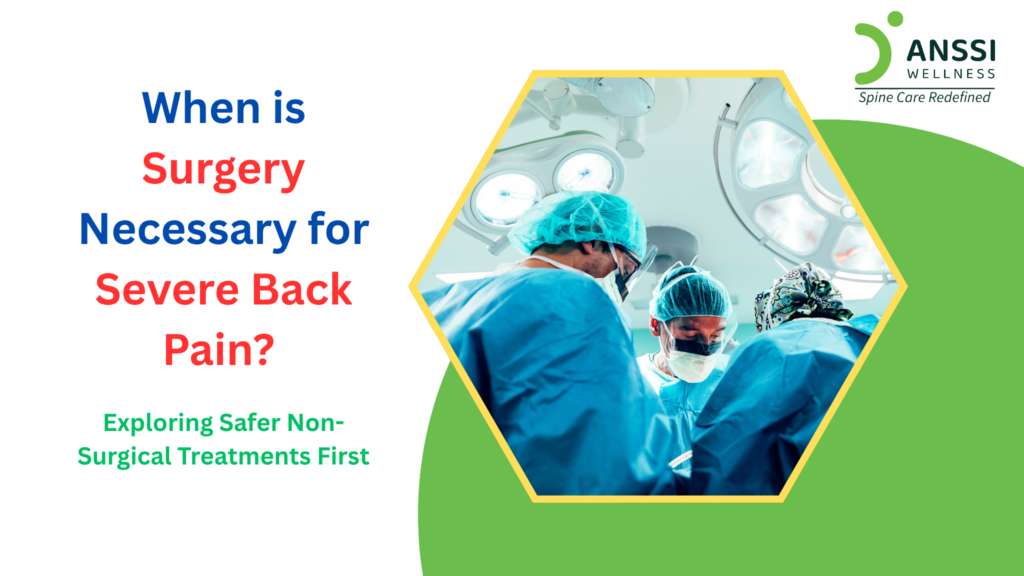
Been told you need back surgery for severe chronic pain? Discover the medical conditions that truly require surgery, the ones that don’t, and why Non-Surgical Spinal Decompression Treatment (NSSDT) at ANSSI Wellness is the safer, more effective alternative for most spinal disc conditions in India.
The conversation is one that thousands of Indians have every week. You have been living with severe back pain, the kind that makes every movement an ordeal, that disrupts your sleep, your work, and your relationships. You have tried painkillers, physiotherapy, and injections. Nothing has provided lasting relief. So you sit across from a spine surgeon who reviews your MRI, points to the screen, and says the words you have been dreading: “You need surgery.”
At that moment, it is easy to feel that surgery is inevitable. That your spine has deteriorated beyond the reach of any other option. That the operating table is simply the next logical step.
But here is what that conversation rarely includes: a significant proportion of the spinal surgeries performed in India every year are carried out on conditions that are treatable, equally effectively, and far more safely, without any surgical intervention at all.
Understanding Severe Chronic Back Pain: What is Actually Happening in the Spine
Severe chronic back pain is almost always structural in origin. The most common underlying culprits are disc herniation, spinal stenosis, spondylosis, spondylolisthesis, degenerative disc disease, and nerve root compression, conditions in which the architecture of the spine has changed in ways that generate pain, restrict movement, and, in some cases, compromise neurological function.
The critical distinction that most patients are never clearly explained is this: severity of pain does not automatically equal necessity of surgery.
Pain is a neurological signal. It can be excruciating even when the underlying structural problem is entirely amenable to non-surgical correction. Conversely, significant structural changes visible on an MRI, a large disc herniation, for instance, can sometimes produce minimal symptoms and resolve entirely with appropriate non-surgical treatment.
The question that should guide every treatment decision is not “how bad is the pain?” but rather “is the underlying structural problem one that genuinely requires surgical repair, or is it one that can be resolved through targeted, structural non-surgical intervention?”
For disc herniation, nerve compression, canal narrowing, and degenerative disc pathology, the answer to that question is more often non-surgical.
When is Back Surgery Genuinely Necessary? The Real Medical Indications
There are specific, well-defined medical situations in which spinal surgery is genuinely necessary and should not be delayed:
- Cauda Equina Syndrome: This is the one true spinal emergency. When a massive disc herniation compresses the entire bundle of nerve roots at the base of the spinal cord, it causes loss of bladder and bowel control, numbness in the inner thighs and groin, along with bilateral leg weakness. This condition requires an emergency surgical procedure, as permanent paralysis and incontinence are the consequences of delay.
- Progressive Neurological Deficit: When leg weakness is rapidly worsening, particularly the inability to lift the front of the foot, and this progression is not halted by immediate conservative treatment, a surgical procedure may be necessary to prevent permanent nerve damage.
- Structural Spinal Instability: Fractures caused by trauma or tumour invasion, severe high-grade spondylolisthesis where one vertebra has slipped significantly over another, or spinal tumours causing cord compression represent structural instability that cannot be managed conservatively and typically requires surgical stabilisation.
- Genuine Failure of Appropriate Conservative Treatment: When a patient has genuinely undergone a full, adequate course of well-executed, evidence-based non-surgical treatment, without meaningful improvement, surgical consultation is a reasonable next step.
These are serious, specific indications. What they are not is a description of the average patient who walks into a surgical consultation with an MRI showing a herniated disc and debilitating back pain. That patient, in the overwhelming majority of cases, is not yet a surgical candidate; they are a non-surgical treatment candidate who has not yet received the right intervention.
When Surgery is NOT Necessary, The Conditions Most Often Over-Prescribed
The following conditions represent the vast majority of spinal surgeries performed in India, and the vast majority of cases in which non-surgical treatment should be the first, and often the only, line of care:
Disc Herniation and Disc Bulge
This is the single most over-operated condition in spinal surgery globally. Multiple high-quality studies demonstrate that the majority of lumbar disc herniations, including large, symptomatic ones, resolve or significantly reduce in size over time with appropriate conservative management.
The disc material is gradually reabsorbed by the body, and nerve compression resolves. Surgical removal of disc material achieves faster initial relief but produces equivalent long-term outcomes to non-surgical treatment in most patients, at vastly greater risk and cost.
Lumbar Spinal Stenosis
Canal narrowing that produces leg pain and neurogenic claudication is frequently managed with the surgical removal of bone or ligament (laminectomy). However, non-surgical treatment, particularly spinal decompression treatment, produces outcomes comparable to surgery in the majority of stenosis patients, without the risks of failed back surgery syndrome, adjacent segment degeneration, or post-operative instability.
Degenerative Disc Disease
Spinal fusion surgery for DDD permanently eliminates movement at the fused segment, transferring increased stress to adjacent discs and dramatically accelerating their degeneration, a well-documented phenomenon known as adjacent segment disease.
For a condition that is fundamentally about disc dehydration and height loss, a treatment that directly reverses these changes non-surgically is clinically preferable to one that fuses and immobilises the affected segment permanently.
Spondylosis and Bone Spurs
Surgical removal of bone spurs is rarely necessary when the nerve compression they produce can be relieved by restoring disc height and foraminal space through targeted non-surgical decompression.
Sciatica from Nerve Root Compression
The overwhelming majority of sciatica cases, even severe, debilitating ones, are caused by disc herniation or foraminal narrowing that is directly addressable through non-surgical decompression. Surgery should be considered only after a genuine course of structural non-surgical treatment has been completed.
The Safer Non-Surgical Treatments to Explore First
For patients with disc herniation, spinal stenosis, degenerative disc disease, spondylosis, and nerve root compression, the following non-surgical treatments should be explored, in the correct sequence and with appropriate clinical oversight, before any surgical decision is made:
Non-Surgical Spinal Decompression Treatment (NSSDT)
NSSDT is the most structurally significant non-surgical treatment available for spinal disc conditions.
Using a precisely engineered, computer-controlled decompression system, it applies a carefully calibrated decompression mechanism to the affected spinal segments, creating negative intradiscal pressure that draws herniated disc material back towards its natural position, restores disc height, widens the foraminal space occupied by compressed nerve roots, and rehydrates degenerated discs by promoting the influx of oxygen, water, and nutrients.
This is not symptomatic management. Non-surgical spinal decompression treatment is a genuine structural correction, achieving the same decompression of nerve roots that surgery aims to deliver, through the body’s own biological mechanisms, without incision, anaesthesia, hospitalisation, or recovery downtime.
Targeted Physiotherapy and Rehabilitation
Structured physiotherapy that addresses muscular imbalances, postural dysfunction, and spinal loading mechanics plays a valuable supporting role in recovery. However, for disc-related and nerve compression conditions, physiotherapy alone cannot retract a herniated disc or widen a narrowed foramen, as it must be combined with structural decompression treatment for optimal outcomes.
Anti-Inflammatory Management
Appropriate short-term application of manual therapy or cold packs can reduce the acute inflammatory component of nerve compression pain, making it easier for the patient to participate actively in decompression treatment.
Lifestyle and Postural Modification
Correcting the postural habits, ergonomic environment, and movement patterns that are perpetuating mechanical load on damaged spinal structures is essential for preventing recurrence and maintaining the structural improvements achieved through NSSDT.
References:
- Ronald J. Feise, Stephanie Mathieson, Rodger S. Kessler, Corey Witenko, Fabio Zaina, Benjamin T. Brown. Benefits and harms of treatments for chronic nonspecific low back pain without radiculopathy: systematic review and meta-analysis. The Spine Journal, Volume 23, Issue 5, 2023, Pages 629-641, ISSN 1529-9430. https://doi.org/10.1016/j.spinee.2022.11.003.
- Yaman O, Guchkha A, Vaishya S, Zileli M, Zygourakis C, Oertel J. The role of conservative treatment in lumbar disc herniations: WFNS spine committee recommendations. World Neurosurg X. 2024 Feb 13;22:100277. doi: 10.1016/j.wnsx.2024.100277. PMID: 38389961; PMCID: PMC10882128.
- Berry J A, Elia C, Saini H S, et al. (October 17, 2019) A Review of Lumbar Radiculopathy, Diagnosis, and Treatment. Cureus 11(10): e5934. DOI 10.7759/cureus.5934.
Efficacy of Vertebral Axial Decompression (VAX-D) on Chronic Low Back Pain: A Study of Dosage Regimen. Ramos G., MD. Journal of Neurological Research, Volume 26, April 2004. - Ramos G., MD, Martin W., MD. Effects of Vertebral Axial Decompression On Intradiscal Pressure. Journal of Neurosurgery 81: 350-353, 1994.
- David C. Duncan, MD, Don Keenan, SPHR, Ph.D. An Industry Based, Retrospective, Cost Analysis of Vertebral Axial Decompression (VAX-D) VS. Surgery For Lumbar Disc Disease: 10 Case Studies. Sinclair Oil Corporation Study, Tulsa Oklahoma.
About ANSSI:
ANSSI Wellness focuses on improving the quality of life for patients suffering from spinal issues, aiming to provide relief where other conventional treatments have failed. Through advanced Non-Surgical Spinal Decompression Treatment, ANSSI is committed to helping patients avoid surgery and recover in a safe, effective, and compassionate environment.
Book Consultation:
Call +91 9004726844 | 9920936844
Visit www.anssiwellness.com
Connect with ANSSI Wellness on LinkedIn, Instagram, and Facebook for expert guidance.