Lower back pain is one of the most common health problems worldwide. It affects people of all ages and can result from poor posture, muscle strain, prolonged sitting, heavy lifting, or age-related changes in the spine. In most cases, lower back pain improves with conservative treatment such as activity modification, physiotherapy, and time.
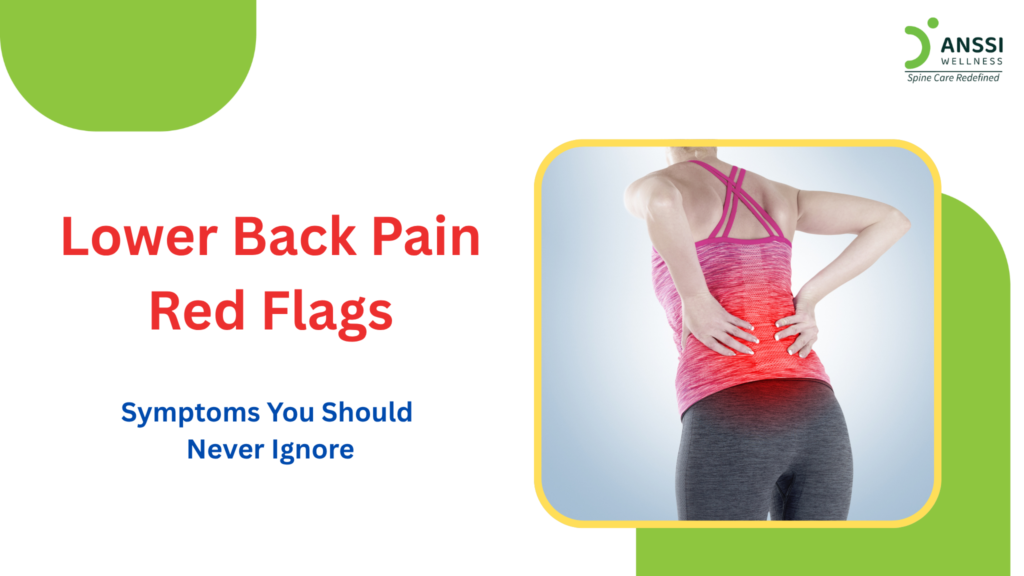
However, not every episode of back pain is harmless. Certain symptoms, known as red flags, may indicate serious spinal or medical conditions that require immediate specialist assessment. Recognising these warning signs can help prevent permanent nerve damage and ensure timely treatment.
Common Causes of Lower Back Pain
The lower back, or lumbar spine, supports much of the body’s weight while allowing flexibility and movement. Because it is constantly under mechanical stress, it is particularly vulnerable to injury and degeneration.
Common causes of lower back pain include:
- Muscle or ligament strain
- Bulging or herniated lumbar disc
- Degenerative disc disease
- Lumbar spinal stenosis
- Spondylolisthesis
- Facet joint arthritis
Many of these conditions respond well to structured conservative treatment, especially when diagnosed early. However, some symptoms suggest that the underlying problem may be more serious and should never be ignored.
Lower Back Pain Red Flags You Should Never Ignore
Progressive Leg Weakness
One of the most important warning signs is increasing weakness in one or both legs.
You may notice:
- Difficulty lifting the front of the foot (foot drop)
- Trouble climbing stairs
- Difficulty standing from a seated position
- Increasing instability while walking
Progressive muscle weakness may indicate worsening nerve compression and requires prompt evaluation by a spine specialist.
Bladder or Bowel Dysfunction
Loss of bladder or bowel control is a medical emergency.
Warning signs include:
- Difficulty passing urine
- Loss of bladder control
- Loss of bowel control
- Numbness around the groin or buttocks (saddle numbness)
These symptoms may indicate cauda equina syndrome, a rare but serious condition caused by severe compression of the nerves at the lower end of the spinal cord. Immediate hospital assessment is essential because delayed treatment can lead to permanent neurological damage.
Bilateral Leg Symptoms
Pain affecting both legs simultaneously is less common than typical sciatica and may indicate more significant spinal canal narrowing or nerve compression.
Symptoms may include:
- Pain radiating into both legs
- Numbness in both feet
- Weakness affecting both lower limbs
- Difficulty walking long distances
- Poor balance
In order to identify the underlying reason, these symptoms should be assessed as soon as possible.
Persistent Numbness or Progressive Neurological Changes
Occasional tingling may occur with several spinal conditions. However, numbness that continues to worsen or spreads over time should not be ignored.
Seek medical attention if you develop:
- Increasing numbness
- Loss of sensation
- Worsening coordination
- Balance problems
Progressive neurological symptoms may indicate ongoing nerve compression requiring specialist assessment.
Systemic Warning Signs
Lower back pain accompanied by general illness may suggest causes unrelated to routine mechanical back pain.
These warning signs include:
- Unexplained weight loss
- Fever associated with back pain
- Persistent night pain that does not improve with rest
- Previous history of cancer
- Recent significant trauma
These symptoms may indicate infection, fracture, inflammatory disease, or malignancy and require urgent medical evaluation.
Why Early Specialist Evaluation Matters
Persistent lower back pain should not be treated solely with repeated courses of pain medication without identifying the underlying cause.
A spine specialist typically performs:
- A detailed medical history
- Physical examination
- Neurological assessment
- MRI or other imaging where clinically indicated
Accurate diagnosis helps distinguish routine mechanical back pain from more serious spinal disorders and ensures that treatment is tailored to the patient’s condition.
Early assessment also reduces the risk of permanent neurological complications when urgent intervention is required.
Standard Non-Surgical Care for Appropriate Patients
Fortunately, most patients with lower back pain do not require surgery.
Depending on the diagnosis, conservative treatment may include:
- Physiotherapy
- Core strengthening exercises
- Posture correction
- Ergonomic advice
- Activity modification
- Weight management
- Medications when clinically appropriate
These treatments aim to improve spinal stability, restore movement, reduce pain, and support long-term recovery.
The Role of Non-Surgical Spinal Decompression Treatment
For appropriately selected patients with disc-related chronic lower back pain or lumbar radiculopathy, Non-Surgical Spinal Decompression Treatment (NSSDT) may be incorporated into a personalised rehabilitation programme.
Using computer-controlled technology, NSSDT is designed to gently reduce pressure within affected spinal discs, decrease mechanical stress on compressed nerve roots, and support spinal function. It is typically combined with physiotherapy, posture correction, strengthening exercises, and lifestyle modification to optimise recovery.
However, it is important to understand that Non-Surgical Spinal Decompression Treatment is not appropriate for emergency conditions such as cauda equina syndrome, spinal fractures, infections, tumours, or rapidly progressive neurological deficits. These situations require immediate medical or surgical management.
About ANSSI:
ANSSI Wellness focuses on improving the quality of life for patients suffering from spinal issues, aiming to provide relief where other conventional treatments have failed. Through advanced Non-Surgical Spinal Decompression Treatment, ANSSI is committed to helping patients avoid surgery and recover in a safe, effective, and compassionate environment.
Book Consultation:
Call +91 9004726844 | 9920936844
Visit www.anssiwellness.com
Connect with ANSSI Wellness on LinkedIn, Instagram, and Facebook for expert guidance.
Clinical References:
- Zhou, T., Salman, D. & McGregor, A.H. Recent clinical practice guidelines for the management of low back pain: a global comparison. BMC Musculoskelet Disord 25, 344 (2024).
- Ferreira M, de Luca K, Haile L et al. Global, regional, and national burden of low back pain, 1990–2020, its attributable risk factors, and projections to 2050: a systematic analysis of the Global Burden of Disease Study 2021. The Lancet Rheumatology, 5, e316-e329.
- Ramos G., MD, Martin W., MD. Effects of Vertebral Axial Decompression On Intradiscal Pressure. Journal of Neurosurgery 81: 350-353, 1994.
- Ramos G., MD. Efficacy of Vertebral Axial Decompression (VAX-D) on Chronic Low Back Pain: A Study of Dosage Regimen. Journal of Neurological Research, Volume 26, April 2004. Effects of Vertebral Axial Decompression On Intradiscal Pressure.