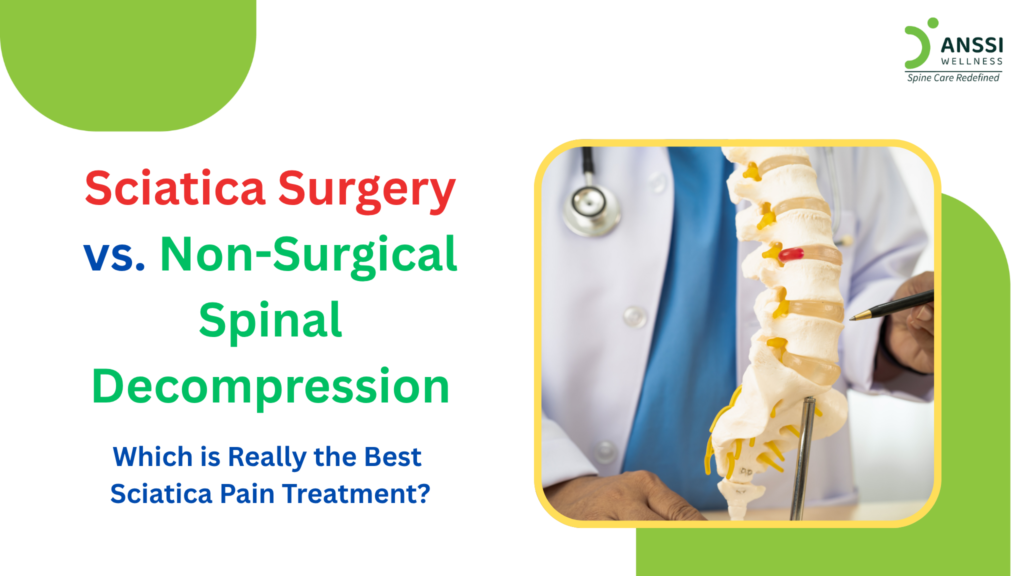
Been told you need surgery for sciatica? Discover the real risks of discectomy and laminectomy and why Non-Surgical Spinal Decompression Treatment (NSSDT) is the safer, more effective sciatica pain treatment without surgery in India.
The conversation often goes something like this. You have been suffering from debilitating sciatica for months with pain shooting down your leg, numbness in your foot, and the inability to sit, stand, or sleep comfortably. You finally see a specialist, undergo an MRI, and then come the words that make your stomach drop: “You need surgery.”
For millions of Indians dealing with chronic sciatica, this moment is both frightening and pivotal. Surgery feels drastic. But the pain feels unbearable. And so, trapped between fear and desperation, many patients agree to go under the knife. And, patients often do so without fully understanding what that decision entails, or whether a safer, equally effective alternative exists.
A growing number of sciatica patients in India are achieving full, lasting pain relief without a single incision. Before you book that operation, read this. It could change everything.
Understanding Sciatica: What’s Actually Happening in Your Spine
The sciatic nerve is the longest and widest nerve in the human body, running from the lower back through the buttocks and all the way down each leg to the feet. When this nerve is compressed, irritated, or inflamed, typically due to a herniated disc, bone spur, or spinal stenosis in the lumbar region, the result is sciatica.
The pain can range from a mild, persistent ache to a sharp, electric shock-like sensation that radiates along the entire nerve pathway. Accompanying symptoms often include numbness, tingling, and muscle weakness in the affected leg.
The critical point here is this: sciatica is fundamentally a structural problem. The nerve is being physically compressed by a disc, bone, or a narrowed spinal canal. Which means that any effective, lasting sciatica pain treatment must address that structural compression, not merely mask the pain with drugs or temporarily cut away tissue.
This is where the choice between surgery and spinal decompression becomes decisive.
The Surgical Route: Discectomy and Laminectomy Explained
The two most common surgical procedures prescribed for sciatica are discectomy and laminectomy.
A discectomy involves removing the portion of a herniated disc that is pressing on the sciatic nerve. A laminectomy removes part of the vertebral bone (the lamina) to widen the spinal canal and relieve nerve compression caused by spinal stenosis. In some cases, both procedures are performed together.
On paper, this sounds straightforward. In reality, the picture is considerably more complex.
The Real Risks of Spinal Surgery
Spinal surgery, like any surgery, carries inherent risks that patients are not always fully aware of:
- Infection: Post-surgical spinal infections, though relatively rare, can be severe and require prolonged antibiotic treatment or further surgery.
- Nerve damage: Operating in close proximity to delicate nerve structures carries the risk of accidental injury, potentially leading to permanent weakness, numbness, or even paralysis.
- Dural tears: Inadvertent tears in the protective membrane surrounding the spinal cord can cause cerebrospinal fluid leakage and chronic headaches.
- Anaesthesia complications: General anaesthesia always carries its own set of risks, particularly for older patients or those with underlying health conditions.
- Failed Back Surgery Syndrome (FBSS): This is perhaps the most sobering reality of spinal surgery. FBSS is a well-documented condition in which patients continue to experience chronic pain or develop new pain, even after a technically successful surgery. Studies suggest that a significant proportion of patients who undergo spinal surgery report unsatisfactory long-term outcomes.
The Recurrence Problem
Even when sciatica surgery appears to succeed initially, recurrence is a major concern.
Removing part of a disc does not stop the underlying degenerative process in the spine. Over time, the same or adjacent discs can re-herniate, and the pain returns, often worse than before. Many patients find themselves facing a second or even third surgery within a few years, each carrying the same risks and an increasingly diminished chance of success.
Add to this the financial burden, spinal surgeries in India can cost anywhere from ₹2 to ₹6 lakhs or more, plus weeks of hospitalisation, months of restricted activity, and the psychological toll of a major operation, and it becomes clear why so many patients are now asking: is there a better way?
The Non-Surgical Alternative: Spinal Decompression for Sciatica
Non-Surgical Spinal Decompression Treatment (NSSDT) is an advanced, technology-driven procedure that has been used in the United States for over 30 years to treat the exact conditions that cause sciatica, without drugs, without injections, and without surgery.
Here is how it works.
- The patient lies on a specially engineered decompression table.
- A carefully calibrated, computer-controlled decompression force is applied to the lumbar spine, gently stretching and decompressing the vertebral segments.
- This creates a negative intradiscal pressure, essentially a vacuum effect inside the affected disc that draws the herniated or bulging disc material back towards its natural position, away from the compressed sciatic nerve.
- As the pressure on the nerve is relieved, so is the pain.
- Simultaneously, the negative pressure promotes the flow of oxygen, water, and nutrients back into the damaged disc, supporting its natural healing and regeneration.
The result is not a temporary fix. It is a genuine structural correction, addressing the root cause of sciatica at its source.
Why NSSDT is the Smarter Sciatica Surgery Alternative
Compared to surgery, NSSDT offers a compelling set of advantages:
- No hospitalisation: Sessions are conducted at an outpatient clinic
- No general anaesthesia or surgical risks: The procedure is entirely non-invasive
- No recovery downtime: Patients can resume normal activities between sessions
- No medicines or injections: Zero pharmacological side effects
- No recurrence cycle: By healing the disc rather than removing it, the treatment addresses the source of compression
- Fraction of the cost: A full NSSDT treatment course costs significantly less than spinal surgery
For patients who have been told they need a discectomy or laminectomy, NSSDT represents a clinically credible, evidence-backed sciatica pain treatment without surgery; one that is now available in India.
ANSSI Wellness: India’s Leading NSSDT Provider
ANSSI Wellness introduced Non-Surgical Spinal Decompression Treatment to India in 2012, pioneering a new standard of spine care that prioritises healing over hospitalisation. Co-founded by American spine specialist Dr. Joseph Cammarata, who has over 30 years of experience delivering NSSDT in the United States, ANSSI brings world-class, US-proven technology to Indian patients at an accessible cost.
Today, ANSSI Wellness operates 16 clinics across India, including Mumbai, Pune, Bangalore, Hyderabad, Nagpur, Nashik, and Patna, making it the country’s most widespread provider of non-surgical spinal decompression. Their multidisciplinary team has successfully treated thousands of sciatica patients, many of whom were previously advised surgery and came to
ANSSI as a last resort, leaving as walking proof that surgery is rarely the only option.
What does treatment at ANSSI look like?
After a thorough diagnostic assessment reviewing your MRI reports and clinical history, a personalised NSSDT treatment plan is designed for you. Most patients begin experiencing significant pain relief within the first few sessions. A full course of treatment typically spans several weeks, with each session lasting under an hour. There is no need to take leave from work, and no hospital stays are needed.
For patients who have been living in fear of the operating table, ANSSI Wellness offers something profoundly reassuring: a genuine, proven path to sciatica relief that does not require you to risk your health to regain it.
Book Consultation
Call +91 9004726844 | 9920936844
Visit www.anssiwellness.com
References:
- Bombieri FF, Shafafy R, Elsayed S. Complications associated with lumbar discectomy surgical techniques: a systematic review. J Spine Surg. 2022 Sep;8(3):377-389. doi: 10.21037/jss-21-59. PMID: 36285095; PMCID: PMC9547702.
- Bydon M, Macki M, Abt NB, Sciubba DM, Wolinsky JP, Witham TF, Gokaslan ZL, Bydon A. Clinical and surgical outcomes after lumbar laminectomy: An analysis of 500 patients. Surg Neurol Int. 2015 May 7;6(Suppl 4):S190-3. doi: 10.4103/2152-7806.156578. PMID: 26005583; PMCID: PMC4431053.
- The Effects of Vertebral Axial Decompression On Sensory Nerve Dysfunction In Patients with Low Back Pain and Radiculopathy. Tilaro F., MD, Miskovich D. MD. Canadian Journal of Clinical Medicine Vol. 6, No 1, January 1999.
- VAX-D Reduces Chronic Discogenic Low Back Pain – 4 year Study. Odell R., MD, Ph.D, Boudreau D. DO. Anesthesiology News, Volume 29, Number 3 , March 2003.
About ANSSI:
ANSSI Wellness focuses on improving the quality of life for patients suffering from spinal issues, aiming to provide relief where other conventional treatments have failed. Through advanced Non-Surgical Spinal Decompression Treatment, ANSSI is committed to helping patients avoid surgery and recover in a safe, effective, and compassionate environment.
Connect with ANSSI Wellness on LinkedIn, Instagram, and Facebook for expert guidance.