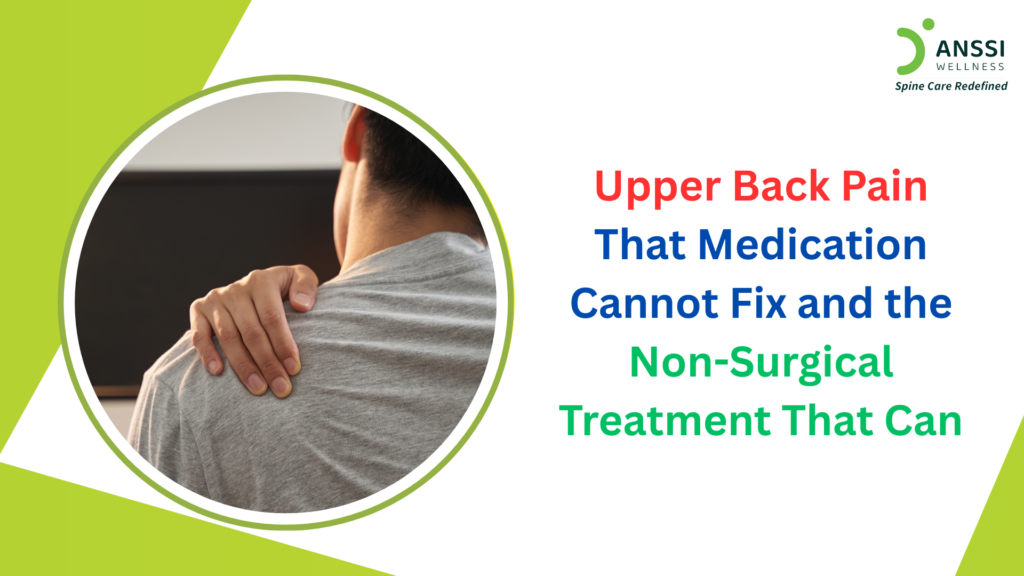
Chronic upper back pain can become frustrating when the same treatment cycle keeps repeating: pain appears, medication provides temporary relief, normal activities resume, and the pain eventually returns. Many patients rely on NSAIDs, muscle relaxants or steroid injections for months while trying to manage their symptoms.
But what happens when the pain is being driven by a structural problem in the spine?
When upper back pain is associated with disc degeneration, disc bulging, nerve irritation, or facet joint overload, reducing pain and inflammation may not address the mechanical problem responsible for it. This is why some patients continue experiencing symptoms despite repeated medication.
For appropriately selected patients, Non-Surgical Spinal Decompression Treatment (NSSDT) offers another treatment approach that focuses on the mechanical environment of the affected spinal segment rather than pain suppression alone.
What Causes Structural Upper Back Pain?
The upper and middle portions of the spine, known as the thoracic spine, provide stability while allowing the body to rotate and bend. The region contains intervertebral discs and facet joints that absorb and distribute mechanical forces.
Several factors can contribute to structural upper back pain, including:
- Thoracic disc bulge or herniation
- Disc degeneration
- Reduced disc hydration and disc height
- Facet joint dysfunction or overload
- Poor posture
- Repetitive spinal loading
- Prolonged sitting or standing
- Previous injuries
When a disc degenerates or protrudes, it can alter the normal distribution of forces through the spinal segment. In some cases, nearby neural structures may become irritated or compressed.
Facet joints can also become overloaded when disc height or spinal alignment changes. The resulting combination of mechanical stress, inflammation, and muscular guarding can contribute to persistent pain.
Patients may experience localised upper back pain, stiffness, restricted movement or, depending on the structures involved, symptoms extending toward other areas.
Importantly, an abnormality seen on an MRI does not automatically prove that it is the source of pain. MRI reports should be interpreted alongside symptoms and a clinical examination.
Why Medication May Not Fix the Problem
Medication can be useful in managing pain. NSAIDs, for example, can reduce inflammatory activity and may help patients remain functional during painful episodes.
However, medication does not necessarily correct the structural cause of pain.
If a disc is protruding and mechanically irritating a nearby structure, an anti-inflammatory medicine may reduce the inflammatory response around it, but it does not physically reposition the disc. Similarly, if altered disc mechanics are increasing stress on the facet joints, medication does not restore normal spinal loading.
Muscle relaxants can help reduce muscle spasms and guarding, but they do not repair disc degeneration or correct an underlying mechanical abnormality.
This distinction is important: symptom reduction and structural correction are not necessarily the same thing.
Repeatedly treating the symptoms without investigating why they keep returning can leave patients caught in a cycle of temporary improvement and recurrence.
The Risks of Long-Term Medication
Long-term medication should never be undertaken without appropriate medical supervision.
- Depending on the specific medicine, prolonged NSAID use can be associated with gastrointestinal complications, kidney-related problems and cardiovascular risks. Individual risk varies according to the drug, dosage, duration of treatment, and the patient’s existing health conditions.
- Muscle relaxants can also have side effects such as drowsiness and impaired alertness, which may affect driving and daily activities.
These risks do not mean that such medicines should never be used. They can have an important role when prescribed appropriately. The concern arises when patients depend on repeated medication indefinitely without addressing an underlying structural condition.
Why Steroid Injections May Provide Only Temporary Relief
Steroid injections are sometimes used when inflammation contributes significantly to spinal pain. They can reduce inflammatory activity around affected tissues and may provide relief for certain patients.
However, an injection does not necessarily eliminate the underlying disc herniation, degeneration, or altered spinal mechanics.
Consequently, some patients experience a familiar pattern: significant improvement after an injection followed by the gradual return of symptoms as its effect diminishes.
Repeated injections also require careful consideration because potential risks depend on the injection site, medication, frequency, and individual health factors.
For structural disc-related pain, temporary suppression of inflammation may therefore be only one component of treatment rather than a definitive solution.
How Non-Surgical Spinal Decompression Treatment Works
Non-Surgical Spinal Decompression Treatment (NSSDT) takes a different approach.
The treatment uses computer-controlled decompression forces to target specific spinal segments. The objective is to modify the mechanical loading environment around an affected disc. Controlled decompression is intended to reduce mechanical stress within the affected spinal segment and, in appropriately selected disc-related cases, may support disc retraction and reduce mechanical irritation around nearby nerve structures.
The treatment is also designed to encourage a more favourable environment for disc hydration.
This makes NSSDT fundamentally different from a painkiller. Instead of primarily changing how the brain perceives pain or reducing inflammatory signalling, the treatment attempts to influence the mechanical conditions contributing to disc-related symptoms.
However, it is important to maintain realistic expectations. Non-Surgical Spinal Decompression Treatment is not suitable for every cause of upper back pain. Fixed bony abnormalities, severe neurological compression and certain serious spinal conditions may require other forms of medical treatment.
A detailed clinical evaluation is therefore essential before treatment is recommended.
Comprehensive Non-Surgical Rehabilitation
NSSDT may be combined with physiotherapy and rehabilitation to address the factors that continue to place stress on the spine.
A personalised programme may include:
- Posture correction
- Thoracic mobility exercises
- Core and spinal stabilisation
- Shoulder and upper-back strengthening
- Flexibility exercises
- Ergonomic modifications
- Education about safe movement and lifting
This is particularly relevant for people who spend long hours sitting at a desk, working on computers, driving or performing repetitive physical tasks.
Correcting these contributing factors can help reduce unnecessary spinal loading and support the patient’s progress.
When Should You Seek Professional Evaluation?
Upper back pain that persists despite medication should not simply be ignored.
Professional assessment is particularly important when pain continues for several weeks, repeatedly returns after temporary treatment, interferes with sleep or daily activities, or is accompanied by neurological symptoms such as numbness, tingling or weakness.
Severe or rapidly progressive neurological symptoms require prompt medical assessment. Non-surgical treatment should never delay necessary emergency care.
About ANSSI:
ANSSI Wellness focuses on improving the quality of life for patients suffering from spinal issues, aiming to provide relief where other conventional treatments have failed. Through advanced Non-Surgical Spinal Decompression Treatment, ANSSI is committed to helping patients avoid surgery and recover in a safe, effective, and compassionate environment.
Book Consultation:
Call +91 9004726844 | 9920936844
Visit www.anssiwellness.com
Connect with ANSSI Wellness on LinkedIn, Instagram, and Facebook for expert guidance.
Clinical References:
- Briggs AM, Smith AJ, Straker LM, Bragge P. Thoracic spine pain in the general population: prevalence, incidence and associated factors in children, adolescents and adults. A systematic review. BMC Musculoskeletal Disorders. 2009;10:77.
- Manchikanti L, Abdi S, Atluri S, et al. An update of comprehensive evidence-based guidelines for interventional techniques in chronic spinal pain. Pain Physician. 2013;16(2 Suppl):S49-S283.
- Wehling M. Non-steroidal anti-inflammatory drug use in chronic pain conditions with special emphasis on the elderly and patients with relevant comorbidities: management and mitigation of risks and adverse effects. European Journal of Clinical Pharmacology. 2014;70(10):1159-1172.
- Ramos G., MD, Martin W., MD. Effects of Vertebral Axial Decompression On Intradiscal Pressure. Journal of Neurosurgery 81: 350-353, 1994.
- Gose E., Ph.D, Naguszewski W., MD, Naguszewski R., MD. Vertebral Axial Decompression Therapy for Pain Associated with Herniated or Degenerated Discs or Facet Syndrome: An Outcome Study. Journal of Neurological Research, Volume 20, No 3, April 1998.