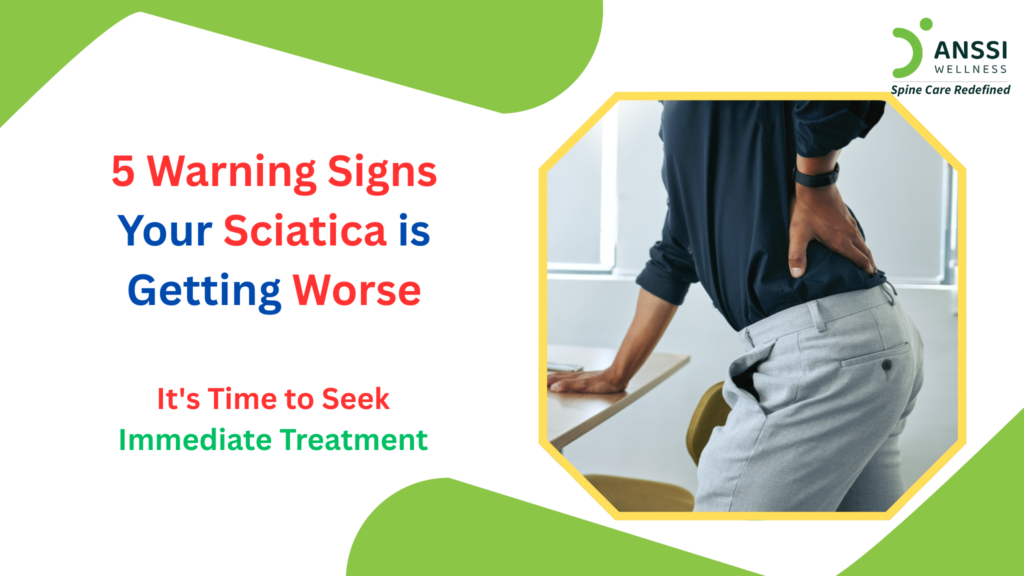
Sciatica is far more than ordinary lower back pain. It is a condition caused by irritation or compression of the sciatic nerve, the largest nerve in the human body, which travels from the lower back through the buttocks and down each leg.
While many people experience mild episodes that improve with rest or conservative care, persistent or worsening symptoms should never be ignored. Progressive sciatica may indicate increasing nerve compression that can significantly affect mobility, work performance, and overall quality of life.
Recognising the warning signs early allows timely treatment before permanent nerve damage develops. Understanding what causes sciatica and knowing when to seek medical attention can make a significant difference in long-term recovery.
What Causes Sciatica?
Sciatica is not a disease itself but a symptom of an underlying spinal problem. It develops when one or more nerve roots in the lumbar spine become compressed or irritated.
The most common structural causes include:
Slipped (Herniated) Disc
A herniated or slipped disc occurs when the soft inner portion of an intervertebral disc pushes through its outer layer and presses against nearby nerve roots.
Disc Bulge
A bulging disc may gradually narrow the space available for spinal nerves, resulting in irritation and inflammation.
Lumbar Spinal Stenosis
Degenerative narrowing of the spinal canal can compress multiple nerve roots, particularly in older adults.
Degenerative Disc Disease
As spinal discs lose hydration and height with age, they may contribute to nerve compression and spinal instability.
Spondylolisthesis
When one vertebra slips forward over another, the spinal nerves may become compressed, leading to sciatic pain.
Although the causes differ, the result is often the same: compression of the sciatic nerve that produces pain travelling from the lower back into the leg.
Five Warning Signs Your Sciatica is Getting Worse
1. Increasing Leg Pain That Travels Below the Knee
One of the earliest signs of worsening sciatica is pain that extends further down the leg.
Instead of remaining in the lower back or buttocks, the pain may spread into the calf or foot. Many patients describe it as burning, electric shock-like, or stabbing pain.
As nerve compression increases, the pain often becomes more frequent and intense, making it difficult to:
- Sit for extended periods
- Walk comfortably
- Drive
- Sleep through the night
Persistent radiating pain should be evaluated by a spine specialist.
2. Progressive Numbness and Tingling
Occasional tingling may initially seem harmless, but worsening numbness can indicate increasing nerve dysfunction.
Patients may notice:
- Tingling in the calf
- Numbness in the foot
- Reduced sensation in the toes
- Difficulty recognising hot or cold surfaces
When numbness spreads or becomes constant, it suggests that the affected nerve is no longer functioning normally. Early medical assessment can help prevent further neurological deterioration.
3. Muscle Weakness in the Leg or Foot
Muscle weakness is one of the most important warning signs of worsening sciatica.
Patients may experience:
- Difficulty climbing stairs
- Trouble standing on their toes
- Weakness while walking
- Foot drop (difficulty lifting the front of the foot)
- Frequent tripping
These symptoms suggest that the compressed nerve is beginning to lose its ability to control the muscles it supplies. Progressive weakness requires prompt medical evaluation because prolonged nerve compression may reduce the likelihood of complete recovery.
4. Difficulty Walking or Standing for Long Periods
As sciatica progresses, patients often find it increasingly difficult to remain active. Walking even short distances may trigger severe leg pain, numbness, or weakness.
This can affect:
- Daily commuting
- Office work
- Household activities
- Shopping
- Exercise
- Social activities
Reduced mobility often leads to decreased physical fitness, weight gain, and further stress on the spine.
Ignoring these symptoms may allow the underlying spinal condition to worsen.
5. Loss of Bladder or Bowel Control: A Medical Emergency
The most serious warning sign is the sudden loss of bladder or bowel control, especially when accompanied by numbness around the groin, buttocks, or inner thighs (known as saddle numbness).
These symptoms may indicate severe compression of the nerves at the base of the spinal canal, a condition known as cauda equina syndrome. This is a medical emergency that requires immediate hospital evaluation and urgent treatment to reduce the risk of permanent neurological damage.
Patients experiencing these symptoms should seek emergency medical care without delay.
The Impact of Advanced Sciatica on Daily Life
As sciatica worsens, it can affect nearly every aspect of life.
Patients frequently report:
- Difficulty performing household tasks
- Reduced productivity at work
- Interrupted sleep
- Loss of independence
- Anxiety about movement
- Reduced participation in hobbies and exercise
Persistent pain may also contribute to emotional stress, frustration, and reduced overall quality of life. Seeking treatment early often leads to better outcomes than waiting until symptoms become severe.
Is Surgery Always Necessary?
Many patients assume that surgery is inevitable once sciatica becomes chronic. However, surgery is generally reserved for specific situations.
When Surgery May Be Recommended
Spinal surgery may be considered when:
- Progressive neurological weakness develops
- Severe nerve compression is confirmed on imaging
- Bladder or bowel dysfunction occurs
- Symptoms fail to improve despite appropriate conservative treatment
In these situations, surgical decompression may help relieve pressure on the affected nerves.
Risks and Limitations of Surgery
Although surgery can benefit selected patients, it also carries potential risks.
These may include:
- Infection
- Bleeding
- Nerve injury
- Scar tissue formation
- Recurrent disc herniation
- Recovery and rehabilitation periods
- Persistent or recurrent pain despite surgery
For many patients without severe neurological deficits, non-surgical treatment options may be considered before surgery.
Non-Surgical Spinal Decompression Treatment: A Safe Alternative
For many patients, Non-Surgical Spinal Decompression Treatment (NSSDT) offers a modern, non-invasive approach to managing sciatica caused by structural spinal conditions.
How NSSDT Works
Using computer-controlled technology, NSSDT applies gentle, precise decompression forces to the affected spinal segments.
The treatment aims to:
- Reduce intradiscal pressure
- Encourage retraction of bulging or herniated disc material
- Reduce pressure on compressed nerve roots
- Improve nutrient exchange within spinal discs
- Support healthier spinal mechanics
Rather than simply masking pain, NSSDT is designed to address the structural factors contributing to sciatic nerve irritation.
Comprehensive Rehabilitation for Long-Term Recovery
NSSDT is often integrated into personalised spinal rehabilitation programs that may include:
- Physiotherapy
- Core strengthening exercises
- Flexibility and mobility training
- Posture correction
- Ergonomic advice
- Lifestyle modification
This multidisciplinary approach helps improve spinal stability while reducing the risk of symptom recurrence.
Benefits of Early Non-Surgical Treatment
Patients receiving timely treatment may experience:
- Reduced leg and back pain
- Improved walking tolerance
- Better mobility
- Reduced dependence on pain medication
- Improved quality of life
- Potential avoidance of surgery
Early intervention also helps prevent the progression of structural spinal problems.
About ANSSI:
ANSSI Wellness focuses on improving the quality of life for patients suffering from spinal issues, aiming to provide relief where other conventional treatments have failed. Through advanced Non-Surgical Spinal Decompression Treatment, ANSSI is committed to helping patients avoid surgery and recover in a safe, effective, and compassionate environment.
Book Consultation:
Call +91 9004726844 | 9920936844
Visit www.anssiwellness.com
Connect with ANSSI Wellness on LinkedIn, Instagram, and Facebook for expert guidance.
Clinical References:
- Kreiner DS et al. North American Spine Society. An evidence-based clinical guideline for the diagnosis and treatment of lumbar disc herniation with radiculopathy. Spine J. 2014 Jan;14(1):180-91.
- El Melhat AM, Youssef ASA, Zebdawi MR, Hafez MA, Khalil LH, Harrison DE. Non-Surgical Approaches to the Management of Lumbar Disc Herniation Associated with Radiculopathy: A Narrative Review. J Clin Med. 2024 Feb 8;13(4):974.
- Gose E., Ph.D, Naguszewski W., MD, Naguszewski R., MD. Vertebral Axial Decompression Therapy for Pain Associated with Herniated or Degenerated Discs or Facet Syndrome: An Outcome Study. Journal of Neurological Research, Volume 20, No 3, April 1998.
- Tilaro F., MD, Miskovich D. MD. The Effects of Vertebral Axial Decompression On Sensory Nerve Dysfunction In Patients with Low Back Pain and Radiculopathy. Canadian Journal of Clinical Medicine Vol. 6, No 1, January 1999.
- Gugliotta M, da Costa BR, Dabis E, Theiler R, Jüni P, Reichenbach S, Landolt H, Hasler P. Surgical versus conservative treatment for lumbar disc herniation: a prospective cohort study. BMJ Open. 2016 Dec 21;6(12):e012938.