Receiving a PIVD (Prolapsed Intervertebral Disc) diagnosis after an MRI can be confusing and worrying. Medical terms such as “disc prolapse,” “nerve compression,” or “disc bulge” can make patients immediately think about surgery. However, a PIVD diagnosis does not automatically mean that an operation is necessary.
For residents of Vashi and surrounding areas, understanding what PIVD means, why it causes pain and nerve-related symptoms, and what treatment options are available can help in making informed decisions about spine health.
What is a Prolapsed Intervertebral Disc?
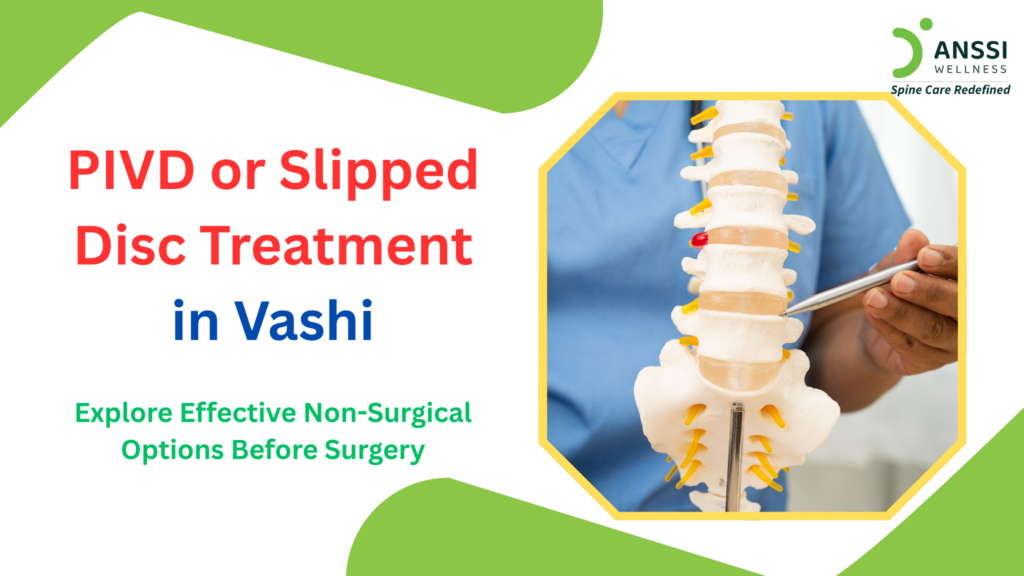
The spine is made up of multiple vertebrae separated by soft structures called intervertebral discs. These discs act as cushions, absorbing shock and allowing the spine to move comfortably.
Each disc has a strong outer layer and a softer inner portion. With ageing, repetitive stress, poor posture, injury, or excessive spinal loading, the outer layer may weaken. The inner disc material can then push outward, producing what is commonly called a prolapsed or herniated disc.
The problem becomes more significant when the protruding disc irritates or compresses a nearby spinal nerve.
- A lumbar PIVD may cause lower back pain accompanied by pain travelling into the buttock or leg. Patients may experience sciatica, tingling, numbness, or weakness.
- A cervical PIVD, on the other hand, may cause neck pain that extends towards the shoulder, arm, or hand. Tingling, numbness, and weakness in the upper limb can also occur when a nerve is affected.
Importantly, an MRI finding should not be interpreted in isolation. Some people have disc bulges or degenerative changes without experiencing any symptoms. An appropriate diagnosis therefore requires correlation between MRI findings, symptoms, physical examination, and neurological assessment.
Lumbar and Cervical PIVD in Working Adults
Modern working lifestyles can place considerable stress on the spine.
Vashi is home to a large population of office professionals, commuters, students, and physically active workers. Long hours sitting at a desk, prolonged laptop use, poor sitting posture, extended smartphone use, and daily commuting can contribute to repetitive spinal loading.
- For lumbar PIVD, prolonged sitting may increase stress on the lower back, particularly when the individual maintains a slouched posture for several hours.
- Cervical PIVD may be associated with prolonged forward-head posture while working on laptops or looking down at smartphones.
Physically demanding activities, incorrect lifting techniques, and sudden increases in workload can also contribute to disc injury.
This does not mean that these activities automatically cause PIVD, but they can contribute to mechanical stress in people who are already vulnerable to disc degeneration or injury.
Does Every PIVD Require Surgery?
One of the most important things patients should understand after receiving a PIVD diagnosis is that surgery is not automatically required.
Treatment depends on several factors, including the severity and location of the prolapse, the duration of symptoms, neurological findings, and how the patient responds to conservative treatment.
- Many patients are initially managed using non-surgical approaches such as activity modification, physiotherapy, posture correction, and appropriate rehabilitation.
- Painkillers and other medicines may help control symptoms temporarily, but they do not necessarily address the underlying disc problem.
- Similarly, physiotherapy can help improve strength, flexibility, movement patterns, and posture, but treatment should be tailored to the structural cause of the patient’s symptoms.
- Surgery may become necessary in specific circumstances. Progressive neurological weakness, significant spinal cord compression, or symptoms associated with cauda equina syndrome, such as bladder or bowel dysfunction, require urgent specialist assessment.
Therefore, the right approach is not to fear surgery or avoid it at all costs, but to determine whether surgery is actually necessary for the individual patient.
Exploring Non-Surgical Spinal Decompression Treatment
For appropriately selected patients with disc-related spinal problems, Non-Surgical Spinal Decompression Treatment (NSSDT) is one treatment option that can be explored.
- NSSDT uses computer-controlled technology to apply carefully regulated decompressive forces to the affected spinal segment. The objective is to reduce mechanical pressure within the affected disc and decrease stress on nearby nerve structures.
- The treatment is designed to create controlled negative pressure within the disc. This can support disc retraction and improve the mechanical environment around a compressed nerve in suitable cases.
- NSSDT can also support disc hydration and spinal mobility as part of a comprehensive rehabilitation programme.
- Unlike conventional spinal surgery, NSSDT does not involve an incision, anaesthesia, or surgical removal of spinal tissue.
However, it is important to maintain realistic expectations. NSSDT is not suitable for every PIVD patient and should not be presented as a universal replacement for surgery. Treatment suitability depends on the specific structural problem and the patient’s clinical condition.
NSSDT as Part of Comprehensive Spine Care
NSSDT is generally more effective when incorporated into a broader rehabilitation strategy.
A treatment programme may include:
- Physiotherapy
- Posture correction
- Core and spinal stabilisation exercises
- Ergonomic modifications
- Education about safe movement and lifting
- Lifestyle recommendations
This comprehensive approach is particularly relevant for working adults who need to address not only their existing symptoms but also the daily habits that may contribute to repeated spinal stress.
For example, an office worker may need guidance on monitor height, chair support, sitting posture, movement breaks, and appropriate exercises. A physically active worker may require education about lifting techniques and spinal mechanics.
Who May Be Suitable for Non-Surgical Treatment?
NSSDT may be considered for appropriately assessed patients with conditions such as:
- Lumbar PIVD
- Cervical PIVD
- Disc bulges
- Disc-related sciatica
- Nerve-related arm or leg pain
- Certain degenerative disc conditions
Before treatment begins, the patient’s MRI should be reviewed alongside their symptoms and clinical examination. Neurological findings, overall health, severity of nerve compression, and duration of symptoms all play a role in determining the appropriate treatment plan.
Making the Right Decision
A PIVD diagnosis can sound alarming, especially when it appears on an MRI report. But the report is only one part of the clinical picture.
The more important questions are:
- What is causing your symptoms?
- How severe is the nerve compression?
- Is there progressive neurological damage?
- And can your condition be managed effectively without surgery?
Getting these questions answered by an appropriately qualified spine or orthopaedic professional can help you understand your choices.
For residents of Vashi experiencing persistent back or neck pain, radiating limb pain, numbness, tingling, or weakness, early evaluation can help identify the underlying problem and determine an appropriate treatment pathway.
About ANSSI:
ANSSI Wellness focuses on improving the quality of life for patients suffering from spinal issues, aiming to provide relief where other conventional treatments have failed. Through advanced Non-Surgical Spinal Decompression Treatment, ANSSI is committed to helping patients avoid surgery and recover in a safe, effective, and compassionate environment.
Book Consultation:
Call +91 9004726844 | 9920936844
Visit www.anssiwellness.com
Connect with ANSSI Wellness on LinkedIn, Instagram, and Facebook for expert guidance.
Clinical References:
- Kreiner DS et al. North American Spine Society. An evidence-based clinical guideline for the diagnosis and treatment of lumbar disc herniation with radiculopathy. Spine J. 2014 Jan;14(1):180-91.
- Yasuma, T; Koh, S; Okamura, T; Yamauchi, Y. Histological changes in aging lumbar intervertebral discs. Their role in protrusions and prolapses.. The Journal of Bone & Joint Surgery 72(2):p 220-229, Feb 1990.
- Naguszewski W., MD, Naguszewski R., MD, Gose E., Ph.D. Dermatosomal Somatosensory Evoked Potential Demonstration of Nerve Root Decompression After VAX-D Therapy. Journal of Neurological Research Vol 23 , No 7, October 2001.
- Ramos G., MD. Efficacy of Vertebral Axial Decompression (VAX-D) on Chronic Low Back Pain: A Study of Dosage Regimen. Journal of Neurological Research, Volume 26, April 2004.