A significant and growing number of Indian patients are receiving disc bulge diagnoses from lumbar MRI, and the majority are being told the same thing: take painkillers, rest, and see how things develop. Some are told their bulge is mild and no treatment is necessary at this stage.
This is one of the most clinically costly responses to a disc bulge diagnosis. A disc bulge is not a condition to wait out. It is a structural warning, and the stage at which intervention is most effective, most straightforward, and most likely to prevent the significantly more complex clinical problem that follows if it is ignored.
Let’s understand what a disc bulge is, why it progresses without structural treatment, which early symptoms indicate that intervention is warranted, and why Non-Surgical Spinal
Decompression is the optimal early-intervention treatment for patients with a disc bulge.
What is a Disc Bulge? Understanding the Early Stage of Disc Pathology
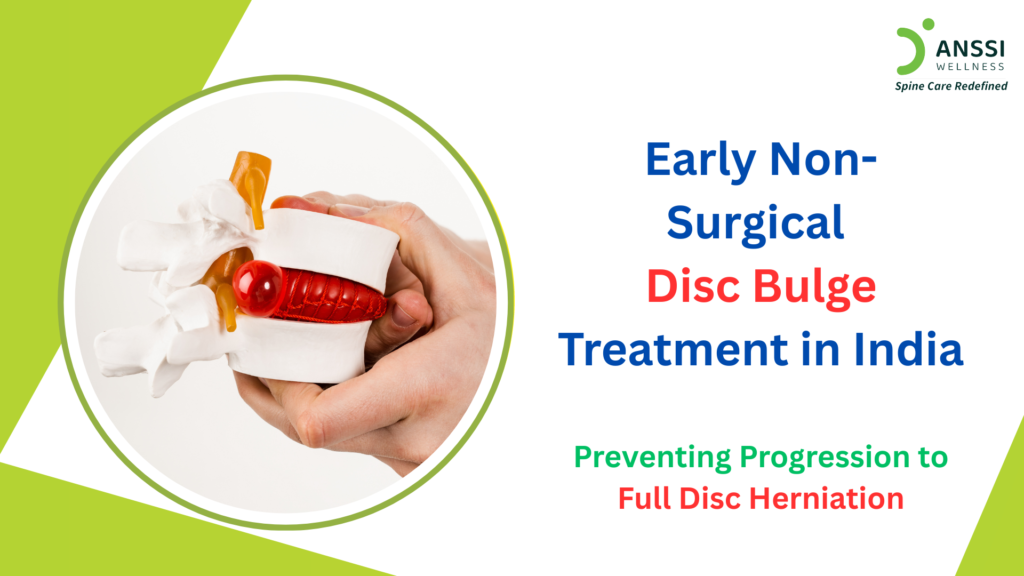
Each intervertebral disc consists of a soft inner nucleus pulposus enclosed within a tough fibrous outer wall called the annulus fibrosus. In a healthy disc, the nucleus remains centralised, and the annular wall maintains its structural integrity under compressive load.
A disc bulge occurs when the nucleus begins to push outward against the annular wall, typically due to disc dehydration, sustained compressive pressure, or both, causing the disc to protrude beyond the normal boundary of the vertebral endplate. Critically, at the disc bulge stage, the annular wall remains intact. The nucleus has not yet broken through.
This distinguishes a disc bulge from a disc herniation, in which the annular wall tears and the nucleus protrudes or extrudes through it, and from sequestration, in which disc material separates and migrates freely within the spinal canal. The full disc pathology spectrum runs: disc degeneration → disc bulge → disc prolapse → disc extrusion → disc sequestration.
The L4-L5 and L5-S1 levels are most commonly affected because they bear the greatest mechanical load in the lumbar spine, concentrated at the lumbosacral junction where spinal loading is highest during both sitting and lifting activities.
The most important clinical point: a disc bulge is the last stage at which the annular wall is still intact and genuine disc retraction is most achievable through non-surgical treatment. Every stage beyond this point increases the structural complexity of the condition and reduces the range of effective non-surgical options available.
Why a Disc Bulge Progresses Without Structural Treatment
A disc bulge does not stabilise on its own. Without structural intervention, three processes drive its progression:
- Ongoing compressive loading: This continues to stress the already weakened annular fibres, driving the nucleus further outward with each day of unaddressed disc loading
- The dehydration cycle: A bulging disc loses its capacity to rehydrate normally during rest, accelerating the disc height loss and annular weakening that drive further bulge progression
- Progressive inflammation: The biochemical environment around a stressed disc degrades the annular collagen fibres, reducing their resistance to rupture under compressive load
India’s sedentary working population and physically active patient groups both accelerate this progression, through sustained lumbar flexion at desks, dynamic loading during two-wheeler commuting, and repetitive lumbar loading in manual occupations.
The clinical trajectory without intervention is consistent: from disc bulge to disc prolapse, nerve root contact, and established radiculopathy; the point at which treatment becomes significantly more complex and recovery significantly less predictable.
Early Symptoms That Indicate Structural Treatment is Warranted
The following symptom pattern at the disc bulge stage is a clear clinical signal that the annular wall is under escalating stress and structural treatment is needed:
- Intermittent lower back pain that has become more frequent, more severe, or triggered by previously tolerated activities
- Morning stiffness and pain that takes longer than 30 minutes to ease
- A pulling or aching sensation extending toward the buttock or upper thigh; early referral before established sciatica develops
- Discomfort that increases with prolonged sitting, forward bending, coughing, or sneezing
- Mild tingling or a heavy sensation in the leg; early neurological involvement before numbness develops
These symptoms at the disc bulge stage are the clearest possible clinical signal that the annular wall is under stress and that the window for effective structural intervention is open, but closing.
Why Medication is Insufficient for Disc Bulge Management
NSAIDs and muscle relaxants reduce the inflammatory pain signal generated by a stressed disc. They do not correct the structural outward displacement of the disc, strengthen the weakened annular fibres, or restore the disc height that progressive bulge is reducing.
The most clinically significant consequence of effective medication at the disc bulge stage is the masking effect: patients whose pain is adequately controlled by medication have reduced awareness of the ongoing structural progression occurring beneath their pharmacological symptom suppression. The disc continues to bulge and degenerate; the patient, feeling better, delays the structural treatment that could halt it.
Long-term NSAID use also carries well-documented systemic risks, such as gastrointestinal ulceration, cardiovascular complications, and progressive renal stress, that make prolonged medication dependency a particularly poor management strategy for what is fundamentally a structural, not pharmacological, problem.
Non-Surgical Spinal Decompression Treatment: The Optimal Early Intervention for Disc Bulge
Non-Surgical Spinal Decompression Treatment (NSSDT) is the only non-surgical method that applies a direct corrective force to the bulging disc itself, making it uniquely positioned as the optimal early-intervention treatment at the disc bulge stage.
Using a computer-controlled decompression table, NSSDT applies a precisely calibrated decompression force to the affected lumbar segment, generating negative intradiscal pressure within the bulging disc. This produces three simultaneous structural effects:
- Disc retraction: Negative pressure draws the bulging nucleus back toward the centre of the disc, reducing the outward displacement of the annular wall
- Disc rehydration: The influx of fluid, oxygen, and nutrients restores disc height and supports biological repair of the weakened annular fibres, addressing the dehydration cycle driving progressive bulge
- Foraminal protection: Restored disc height maintains the foraminal space that progressive bulge and eventual herniation would compromise, protecting the adjacent nerve root from future compression
At the disc bulge stage, before annular rupture, before nucleus extrusion, before nerve root contact, these mechanisms are at their most effective. The annular fibres are weakened but intact. The nucleus is displaced but retractable. The disc height is reduced but restorable. NSSDT applied at this stage delivers outcomes that become progressively harder to achieve as the pathology advances.
Non-Surgical Spinal Decompression Treatment is delivered entirely on an outpatient basis, with no hospitalisation, no medicines, no injections, no side effects, and is compatible with the working and commuting schedules of India’s active patient population.
Complementary Interventions
Physiotherapy and core stabilisation strengthen the deep spinal stabilising muscles, the multifidus and transversus abdominis, reducing the mechanical load on the recovering disc and significantly lowering the risk of bulge recurrence. Postural correction eliminates the forward-flexed sitting postures that concentrate compressive load at L4-L5 and L5-S1.
Ergonomic modification, such as workstation setup, lifting technique, and commuting posture adjustment, reduces the disc loading that perpetuates bulge progression during and after treatment.
Weight management reduces the compressive lumbar disc load that accelerates dehydration and annular weakening in overweight patients.
When to Seek Assessment
Seek specialist assessment if:
- A disc bulge has been confirmed on MRI; regardless of current symptom severity
- Lower back pain has changed in character, frequency, or severity in recent weeks
- Any early neurological symptom is present; buttock pain, leg heaviness, or mild tingling
- Disc bulge is currently being managed with medication without structural assessment or treatment
About ANSSI:
ANSSI Wellness focuses on improving the quality of life for patients suffering from spinal issues, aiming to provide relief where other conventional treatments have failed. Through advanced Non-Surgical Spinal Decompression Treatment, ANSSI is committed to helping patients avoid surgery and recover in a safe, effective, and compassionate environment.
Book Consultation:
Call +91 9004726844 | 9920936844
Visit www.anssiwellness.com
Connect with ANSSI Wellness on LinkedIn, Instagram, and Facebook for expert guidance.
Clinical References:
- Adams MA, Hutton WC. Prolapsed intervertebral disc: a hyperflexion injury. Spine. 1982;7(3):184-191.
- Urban JP, Roberts S. Degeneration of the intervertebral disc. Arthritis Research & Therapy. 2003;5(3):120-130.
- Machado GC, Maher CG, Ferreira PH, et al. Efficacy and safety of paracetamol for spinal pain and osteoarthritis: systematic review and meta-analysis of randomised placebo controlled trials. BMJ. 2015;350:h1225.
- Ramos G., MD, Martin W., MD. Effects of Vertebral Axial Decompression On Intradiscal Pressure. Journal of Neurosurgery 81: 350-353, 1994.
- Naguszewski W., MD, Naguszewski R., MD, Gose E., Ph.D. Dermatosomal Somatosensory Evoked Potential Demonstration of Nerve Root Decompression After VAX-D Therapy. Journal of Neurological Research Vol 23 , No 7, October 2001.