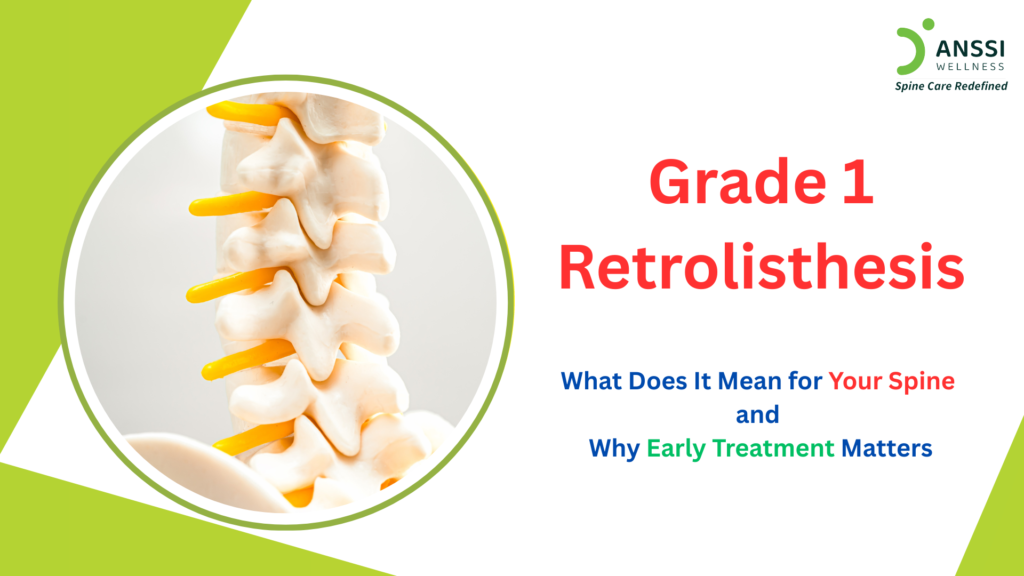
A retrolisthesis diagnosis on an MRI or X-ray report leaves many patients uncertain about what it means and whether treatment is urgently needed. For Grade 1 retrolisthesis specifically, the most common response of monitoring the condition with medication and periodic imaging is also the most clinically costly one.
Grade 1 retrolisthesis is not the least important grade. It is the most treatable. Understanding what it means, what drives its progression, and why early non-surgical intervention changes the long-term outcome is the most important clinical knowledge a patient at this stage can have.
What is Grade 1 Retrolisthesis?
Retrolisthesis refers to the posterior displacement of one vertebra relative to the vertebra below it. It is a backward slip, as distinct from spondylolisthesis, in which displacement is forward. The severity of retrolisthesis is graded according to the percentage of posterior displacement:
- Grade 1: Up to 25% displacement; mild slip
- Grade 2: 25-50% displacement
- Grade 3: 50-75% displacement
- Grade 4: 75-100% displacement
Grade 1 is the earliest and mildest presentation. It is also the stage at which structural intervention is most effective and surgical progression is most preventable.
The lumbar spine, particularly L4-L5 and L5-S1, is the most commonly affected region, though Grade 1 retrolisthesis also occurs in the cervical spine at C3-C4 and C4-C5 in patients with cervical disc degeneration.
What Causes Grade 1 Retrolisthesis?
The primary structural driver of Grade 1 retrolisthesis is disc degeneration. As the intervertebral disc loses hydration and height, the spatial relationship between adjacent vertebrae changes. The posterior vertebral body drifts backwards into the narrowed disc space, producing the posterior displacement visible on weight-bearing X-ray.
Contributing factors include:
- Age-related disc dehydration and height loss
- Ligament laxity reducing segmental stability
- Trauma and injury altering vertebral alignment
- Osteoporosis weakening vertebral bone structure
- Chronic postural loading accelerating disc degeneration
Symptoms of Grade 1 Retrolisthesis
Because Grade 1 displacement is mild, symptoms are frequently intermittent, which is precisely why patients underestimate the condition and delay treatment:
- Deep, aching localised back or neck pain at the level of displacement, typically activity-related
- Intermittent radiating pain into the arm or leg corresponding to the affected nerve root level
- Mild numbness or tingling along the nerve root pathway
- Morning stiffness and reduced spinal flexibility
- Pain that worsens with spinal extension, prolonged standing, or weight-bearing activity
Intermittent symptoms do not indicate a mild structural problem. They indicate an early-stage structural problem; one that is still within the window of effective non-surgical correction.
Why Grade 1 Retrolisthesis Progresses Without Structural Treatment
The disc degeneration driving Grade 1 retrolisthesis does not stabilise without intervention. Three processes continue in parallel:
- Progressive disc height loss increases the degree of posterior vertebral drift
- Deepening foraminal narrowing worsens nerve root compression
- Increasing segmental instability accelerates facet joint loading and adjacent disc degeneration
The clinical trajectory without structural treatment is consistent: Grade 1 advances to Grade 2 as disc degeneration deepens, the treatment options available narrow, and the structural complexity of the condition increases.`
Non-Surgical Treatment for Grade 1 Retrolisthesis
The treatment window is widest at Grade 1. Every month of delayed structural treatment narrows it.
Non-Surgical Spinal Decompression Treatment (NSSDT)
Non-Surgical Spinal Decompression Treatment is the most structurally targeted non-surgical intervention for Grade 1 retrolisthesis. By applying computer-controlled decompression forces to the affected spinal segment, NSSDT generates negative intradiscal pressure that produces three clinically relevant effects:
- Disc rehydration: Fluid, oxygen, and nutrients are drawn back into the degenerated disc, partially restoring disc height
- Posterior drift reduction: Restored disc height reduces the posterior shear force acting on the displaced vertebra
- Foraminal widening: Increased disc height expands the intervertebral foramen, reducing nerve root compression
Non-Surgical Spinal Decompression Treatment is most effective at Grade 1 because the disc retains partial hydration, the annular fibres are weakened but not fully failed, and the degree of posterior displacement is still within the range addressable through achievable disc height restoration.
Treatment suitability is determined after specialist evaluation including MRI review and clinical examination. NSSDT is delivered entirely on an outpatient basis, with no hospitalisation, no medicines, and no side effects.
Physiotherapy and Spinal Stabilisation
Strengthening the deep spinal stabilisers, the multifidus and transversus abdominis, reduces the segmental instability that allows posterior vertebral drift. Postural correction and proprioceptive training address the movement patterns and alignment faults that perpetuate abnormal loading of the affected segment.
Lifestyle and Ergonomic Modification
Weight management reduces compressive spinal loading. Activity modification, such as avoiding movements that increase posterior shear forces, protects the affected segment during recovery. Ergonomic correction of sitting, standing, and lifting mechanics reduces the dynamic forces that perpetuate disc degeneration.
When to Seek Assessment
Seek specialist assessment if:
- Grade 1 retrolisthesis has been confirmed on MRI or weight-bearing X-ray, regardless of current symptom severity.
- Back or neck pain has changed in character, frequency, or severity.
- Any early neurological symptom is present, such as mild tingling, limb heaviness, or radiating pain.
- The condition is currently being managed with medication without structural assessment or treatment.
About ANSSI:
ANSSI Wellness focuses on improving the quality of life for patients suffering from spinal issues, aiming to provide relief where other conventional treatments have failed. Through advanced Non-Surgical Spinal Decompression Treatment, ANSSI is committed to helping patients avoid surgery and recover in a safe, effective, and compassionate environment.
Book Consultation:
Call +91 9004726844 | 9920936844
Visit www.anssiwellness.com
Connect with ANSSI Wellness on LinkedIn, Instagram, and Facebook for expert guidance.
Clinical References:
- Virk SS, Niedermeier S, Yu E, Khan SN. Retrolisthesis. Orthopaedics. 2015;38(6):373-382.
- Denard PJ, Holton KF, Miller J, et al. Lumbar spondylolisthesis and retrolisthesis in older men: prevalence, risk factors, and associations with spinal pathology. Spine. 2010;35(10):1070-1079.
- Beattie PF, Nelson R, Michener L, Cammarata J, Donely J. Outcomes after a prone lumbar traction protocol for patients with activity-limiting low back pain: a prospective case cohort study with long-term follow-up. Journal of Orthopaedic & Sports Physical Therapy. 2008;38(1):3-11.
- Urban JP, Roberts S. Degeneration of the intervertebral disc. Arthritis Research & Therapy. 2003;5(3):120-130.