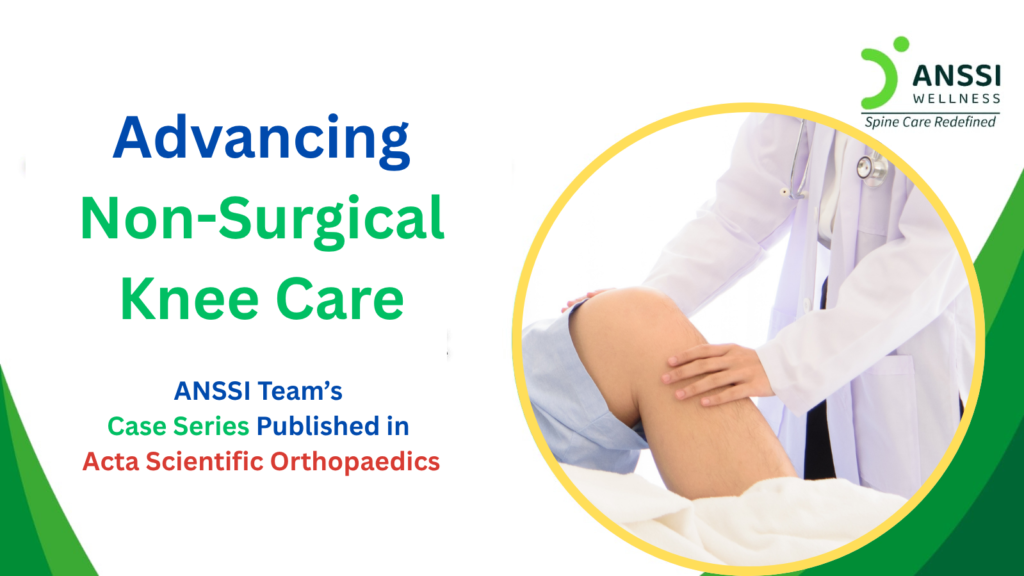
The ANSSI Team has achieved an important milestone in the field of modern, rehabilitative orthopaedic care with the publication of its article, “Non-Surgical Management of Chronic Knee Pain: Evaluating the Role of Advanced Knee Rehabilitation and Decompression Treatment in Early Osteoarthritis,” in the March 2026 issue of Acta Scientific Orthopaedics.
Published as part of the journal’s Case Series component, the article explores the growing need for structured, non-surgical approaches to managing chronic knee pain, particularly in patients with early osteoarthritis (OA).
Addressing a Growing Orthopaedic Challenge
Chronic knee pain is a significant contributor to disability worldwide. Persistent knee pain can affect much more than physical comfort. It can restrict walking, reduce independence, interfere with everyday activities and ultimately affect a person’s overall quality of life.
Among the various causes of chronic knee pain, osteoarthritis is one of the most common, particularly among ageing populations. Progressive changes within the joint can lead to pain, stiffness, swelling and reduced mobility.
The increasing burden of knee osteoarthritis has also highlighted the limitations of conventional treatment approaches. Long-term medication may be associated with adverse effects and may not address the underlying functional limitations. Surgical procedures such as total knee replacement can provide an important solution for appropriately selected patients, but surgery can involve substantial costs, hospitalisation, rehabilitation and recovery time.
These challenges have created increasing interest in effective non-surgical approaches that can be considered earlier in the disease progression.
Exploring a Multimodal Rehabilitation Approach
The article developed by the ANSSI Team examines an advanced, structured rehabilitation approach combining physiotherapy with knee decompression treatment.
Rather than viewing knee pain management simply as pain suppression, the approach discussed in the article focuses on rehabilitation, functional improvement and continuous patient monitoring.
The publication reviews the aetiology, clinical presentation and diagnostic evaluation of chronic knee pain, with particular emphasis on osteoarthritis. It also examines how physiotherapy protocols and knee decompression can be incorporated into a structured treatment workflow.
Knee decompression is discussed as a non-invasive approach designed to reduce mechanical loading across the affected knee joint. When combined with appropriately prescribed physiotherapy and rehabilitation, such an approach may support improved mobility and functional outcomes in selected patients.
The Importance of Early Intervention
One of the important themes explored in the publication is the potential value of early intervention.
When early-stage osteoarthritis is identified, patients may have an opportunity to address pain, mobility limitations, muscle weakness and functional problems before the condition progresses to a stage where surgical intervention becomes necessary.
The article therefore highlights the importance of structured rehabilitation rather than waiting until knee pain becomes severely disabling.
However, treatment suitability must always depend on proper clinical assessment. The severity of osteoarthritis, the patient’s symptoms, functional limitations and overall health need to be considered before selecting an appropriate treatment programme.
Patient Compliance and Continuous Monitoring
The publication also highlights two factors that can significantly influence rehabilitation outcomes: patient compliance and continuous monitoring.
A rehabilitation programme is not limited to treatment sessions at a clinic. Patients may need to follow prescribed exercises, posture and activity recommendations and lifestyle modifications consistently.
Regular monitoring allows healthcare professionals to assess progress, modify rehabilitation protocols and ensure that treatment remains appropriate as the patient’s condition changes.
The role of specialised clinical infrastructure is also discussed, particularly its importance in providing standardised, organised and rehabilitative care.
A Milestone for ANSSI Wellness
The publication in Acta Scientific Orthopaedics represents an important achievement for the ANSSI Team and reflects its continued focus on developing structured approaches to modern orthopaedic rehabilitation.
The research brings together key areas including chronic knee pain, osteoarthritis, knee decompression, physiotherapy, non-surgical treatment and rehabilitation.
Most importantly, it contributes to the broader discussion about how patients with early knee degeneration can be supported through structured non-surgical care.
The publication also reinforces the importance of evidence-informed rehabilitation, patient participation and early clinical intervention in managing chronic knee problems.
For patients, the message is encouraging: knee osteoarthritis does not necessarily mean that surgery is the only option from the outset. Depending on the individual’s condition, early assessment and an appropriately designed rehabilitation programme may help improve function, manage symptoms and potentially delay the need for surgical intervention.
The ANSSI Team’s publication in the March 2026 issue of Acta Scientific Orthopaedics marks a significant step in bringing greater attention to the possibilities of structured, non-surgical knee care.
To read the article, click here.
About ANSSI:
ANSSI Wellness focuses on improving the quality of life for patients suffering from knee issues, aiming to provide relief where other conventional treatments have failed. Through Advanced Knee Rehabilitation Treatment, ANSSI is committed to helping patients avoid surgery and recover in a safe, effective, and compassionate environment.
Connect with ANSSI Wellness on LinkedIn, Instagram, and Facebook for expert guidance.