
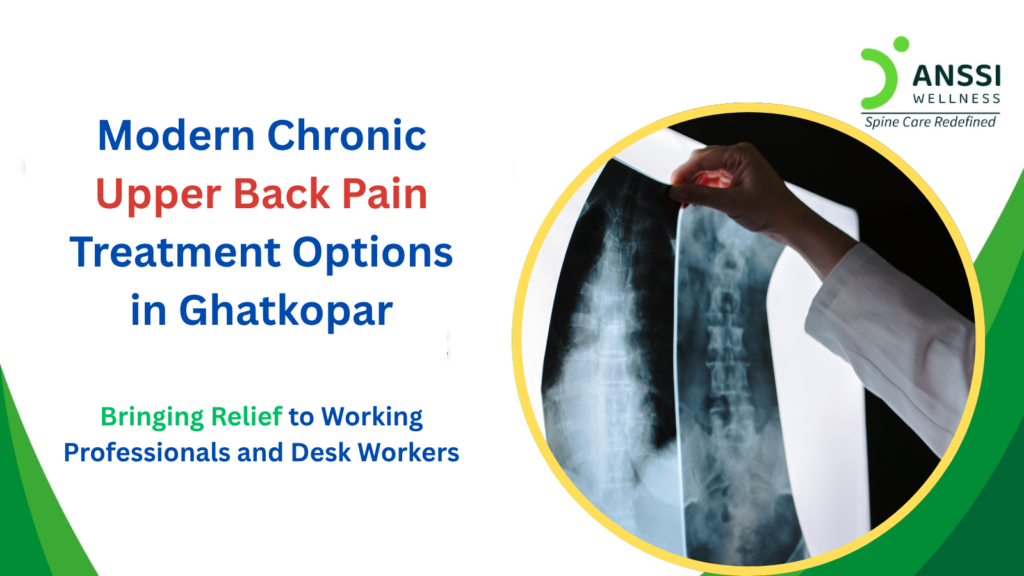
Upper back pain has become an increasingly common complaint among working professionals and desk workers in Ghatkopar and across Mumbai. Long hours spent in front of computers, extended commuting times, smartphone use, and poor workplace ergonomics are placing unprecedented strain on the spine. What often begins as mild discomfort between the shoulder blades can gradually develop into persistent pain, stiffness, and reduced mobility that interferes with work and daily life.
Unfortunately, many people dismiss upper back pain as a temporary muscular problem caused by stress or fatigue. While muscle strain can contribute to discomfort, chronic upper back pain is often linked to underlying structural issues within the spine that require proper diagnosis and targeted treatment.
Modern spinal rehabilitation programs are helping patients move beyond temporary symptom relief by addressing the root causes of upper back pain and promoting long-term recovery.
Understanding Chronic Upper Back Pain
The upper back, also known as the thoracic spine, consists of twelve vertebrae that connect the cervical spine (neck) to the lumbar spine (lower back). This region plays a critical role in maintaining posture, supporting the rib cage, and allowing coordinated movement throughout the upper body.
Although the thoracic spine is generally more stable than other regions of the spine, prolonged postural stress and degenerative changes can still lead to chronic pain and dysfunction.
Common Causes of Upper Back Pain in Working Professionals
Poor Sitting Posture
Many office workers spend hours sitting with rounded shoulders and a slouched back. This posture places continuous stress on the thoracic spine and surrounding muscles.
Forward Head Posture
Constant use of computers and mobile devices often causes the head to shift forward. This increases mechanical loading throughout the neck and upper back.
Prolonged Computer Work
Remaining in a fixed position for long periods reduces movement and increases pressure on spinal structures.
Thoracic Disc Degeneration
Like discs elsewhere in the spine, thoracic discs can gradually lose hydration and elasticity, contributing to pain and stiffness.
Facet Joint Irritation
The small joints connecting spinal vertebrae can become irritated due to repetitive stress and poor posture.
Muscle Fatigue and Imbalance
Weak postural muscles combined with prolonged sitting can create chronic tension and discomfort.
Nerve Irritation and Compression
Structural changes in the spine may irritate nearby nerves, causing persistent symptoms that extend beyond simple muscle pain.
Common Symptoms of Chronic Upper Back Pain
The symptoms of upper back pain can vary significantly depending on the underlying cause.
Common complaints include:
- Persistent aching between the shoulder blades
- Upper back stiffness
- Neck and shoulder discomfort
- Pain during prolonged sitting
- Reduced spinal flexibility
- Fatigue while working
- Difficulty maintaining posture
- Pain that worsens by the end of the day
Some patients also experience headaches, reduced concentration, and difficulty sleeping due to persistent discomfort.
Why Conventional Treatments Often Fail to Deliver Lasting Relief
Many individuals initially seek relief through painkillers, topical treatments, massage therapy, or general physiotherapy. While these approaches may provide temporary comfort, they
often fail to address the underlying structural causes of pain.
Limitations of Painkillers
Painkillers and anti-inflammatory medications can temporarily reduce discomfort and inflammation.
However, they do not:
- Correct poor spinal mechanics
- Reverse disc degeneration
- Address nerve compression
- Improve spinal stability
As a result, symptoms frequently return once the medication wears off.
Long-term dependence on painkillers may also increase the risk of unwanted side effects.
Limitations of General Physiotherapy
Physiotherapy plays an important role in rehabilitation and can improve flexibility, muscle strength, and posture.
However, physiotherapy alone may not adequately address:
- Increased pressure within spinal discs
- Structural degeneration
- Mechanical nerve irritation
- Chronic spinal loading patterns
This is why some patients experience temporary improvement but continue to suffer recurring pain.
Why Pain Keeps Returning
One of the most common reasons upper back pain becomes chronic is that treatment focuses primarily on symptoms rather than causes.
The real problem may involve:
- Thoracic disc degeneration
- Postural overload
- Joint dysfunction
- Nerve compression
- Reduced spinal mobility
Unless these factors are properly identified and addressed, pain is likely to recur.
The Importance of Root-Cause Diagnosis
Before effective treatment can begin, it is essential to determine the precise source of the pain.
Comprehensive Clinical Assessment
A detailed evaluation may include:
- Medical history review
- Postural assessment
- Physical examination
- Movement analysis
- Neurological evaluation
These assessments help clinicians understand how the patient’s spine is functioning and identify contributing factors.
Advanced Imaging Studies
When necessary, MRI or other imaging studies may be used to identify:
- Disc degeneration
- Disc bulges
- Joint abnormalities
- Nerve compression
- Structural changes affecting the thoracic spine
Accurate diagnosis allows treatment to be tailored to the individual’s condition.
Modern Non-Surgical Treatment Options
Modern spinal rehabilitation focuses on restoring function rather than simply reducing symptoms.
Personalised Spinal Rehabilitation Programs
Effective treatment programs are designed around each patient’s specific diagnosis and lifestyle requirements.
These programs may include:
- Postural Correction: Improving posture reduces abnormal stress on the spine and helps prevent future problems.
- Ergonomic Education: Patients learn how to optimise their workstation setup, monitor height, sitting position, and daily movement habits.
- Strengthening Exercises: Targeted exercises improve spinal stability and support healthier posture.
- Mobility Training: Restoring normal movement patterns helps reduce stiffness and improve function.
Non-Surgical Spinal Decompression Treatment (NSSDT)
One of the advanced technologies increasingly incorporated into modern rehabilitation programs is Non-Surgical Spinal Decompression Treatment (NSSDT).
How NSSDT Works
NSSDT uses computer-controlled technology to apply precise decompression forces to the spine.
The treatment aims to:
- Reduce Intradiscal Pressure: Reducing pressure inside the spinal discs helps decrease mechanical stress on surrounding structures.
- Promote Disc Hydration: Improved nutrient exchange supports healthier disc function and may help slow degenerative changes.
- Reduce Nerve Irritation: Decompression may help reduce pressure affecting spinal nerves and surrounding tissues.
- Improve Spinal Mechanics: By reducing abnormal loading, NSSDT supports healthier spinal movement patterns.
Because the treatment is non-invasive, many patients can continue their normal daily activities while undergoing care.
Benefits of NSSDT for Upper Back Pain
Patients undergoing comprehensive rehabilitation programs that incorporate NSSDT may experience several benefits.
- Reduced Pain and Stiffness: Addressing mechanical stress can help reduce chronic discomfort.
- Improved Posture: As pain decreases and mobility improves, patients often find it easier to maintain healthy posture.
- Better Mobility: Improved spinal flexibility can make everyday movements more comfortable.
- Enhanced Work Productivity: Reduced pain often improves concentration, efficiency, and workplace performance.
- Reduced Dependence on Medication: Patients may be less reliant on temporary symptom-management strategies.
- Long-Term Symptom Management: By targeting underlying structural contributors, treatment focuses on sustainable improvement rather than short-term relief.
ANSSI Wellness Ghatkopar: Advanced Care for Working Professionals
At ANSSI Wellness Ghatkopar, treatment programs are designed to address the unique challenges faced by working professionals and desk workers.
Personalised Treatment Approach
Each patient undergoes a detailed evaluation to identify the precise source of pain.
Based on the findings, customised treatment programs may integrate:
- Non-Surgical Spinal Decompression Treatment
- Physiotherapy
- Postural rehabilitation
- Strengthening exercises
- Ergonomic correction
- Lifestyle guidance
The goal is to improve spinal health, reduce pain, and help patients return to productive, active lives.
About ANSSI:
ANSSI Wellness focuses on improving the quality of life for patients suffering from spinal issues, aiming to provide relief where other conventional treatments have failed. Through advanced Non-Surgical Spinal Decompression Treatment, ANSSI is committed to helping patients avoid surgery and recover in a safe, effective, and compassionate environment.
Book Consultation:
Call +91 9004726844 | 9920936844
Visit www.anssiwellness.com
Connect with ANSSI Wellness on LinkedIn, Instagram, and Facebook for expert guidance.
Clinical References:
- Ruiz Santiago F, Láinez Ramos-Bossini AJ, Wáng YXJ, Martínez Barbero JP, García Espinosa J, Martínez Martínez A. The value of magnetic resonance imaging and computed tomography in the study of spinal disorders.
- Ramos G., MD, Martin W., MD. Effects of Vertebral Axial Decompression On Intradiscal Pressure. Journal of Neurosurgery 81: 350-353, 1994
- Gose E., Ph.D, Naguszewski W., MD, Naguszewski R., MD. Vertebral Axial Decompression Therapy for Pain Associated with Herniated or Degenerated Discs or Facet Syndrome: An Outcome Study. Journal of Neurological Research, Volume 20, No 3, April 1998.
- Tilaro F., MD. An Overview of Vertebral Axial Decompression. Canadian Journal of Clinical Medicine Vol. 5, No 1, January 1998.