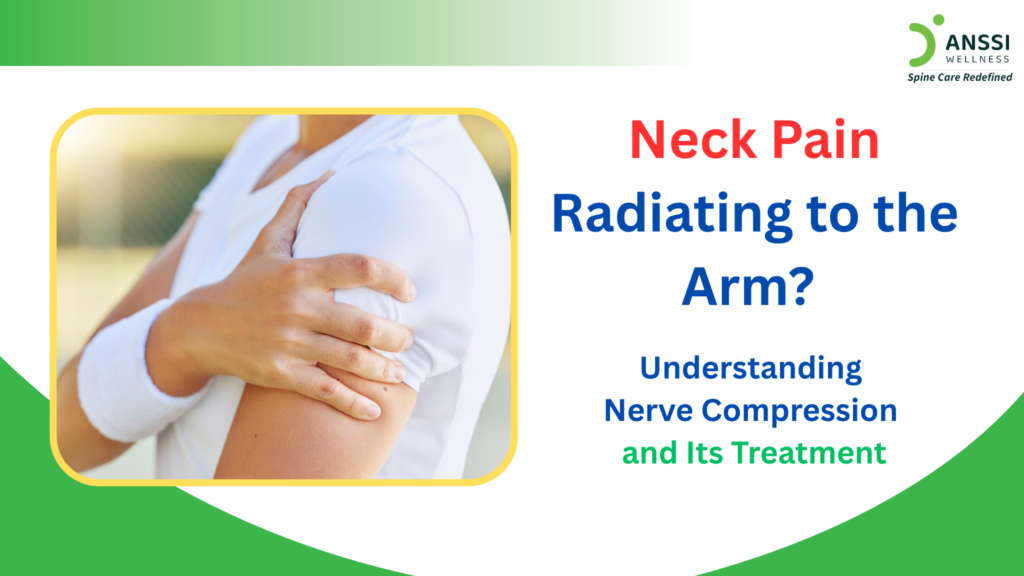
Neck pain that shoots into your arm, shoulder, or fingers is not just muscle tension; it could be cervical nerve compression. Discover the causes, symptoms, and why Non-Surgical Spinal Decompression Treatment (NSSDT) at ANSSI Wellness is the most effective neck pain treatment in India without surgery.
Most people have experienced a stiff neck at some point; the kind that makes turning your head feel like an effort, usually after a bad night’s sleep or a long day hunched over a screen. Uncomfortable, yes. Concerning, not usually.
But there is a very different kind of neck pain; one that does not stay in the neck. It travels. It shoots down your shoulder, burns along your upper arm, or sends electric tingling into your fingers. It may be accompanied by weakness in your hand or a numbing sensation that makes you drop things without warning.
When neck pain radiates into the arm, it is no longer a muscular inconvenience. It is a neurological signal, which is your body’s way of telling you that a nerve is being compressed in your cervical spine, and that something structural needs to be addressed urgently.
Understanding what is happening inside your spine, why it is happening, and what the most effective treatment options are could be the difference between full recovery and permanent nerve damage. This article explains everything you need to know.
What is Cervical Nerve Compression?
The cervical spine, the seven vertebrae that form your neck, is one of the most complex and vulnerable regions of the entire spinal column. It supports the full weight of the head, enables an extraordinary range of motion, and crucially, houses the spinal cord and the nerve roots that branch outward into the shoulders, arms, and hands.
Between each pair of vertebrae sits an intervertebral disc, a soft, gel-filled cushion that absorbs shock and maintains the spacing between the bones. On either side of each vertebral level, nerve roots exit the spinal canal through narrow bony channels called foramina, carrying motor and sensory signals between the brain and the upper limbs.
When any of these structures; a disc, a bone spur, or the walls of the spinal canal; encroaches on these nerve roots, the result is cervical radiculopathy: compressed nerve roots that generate pain, numbness, tingling, or weakness not just at the site of compression, but along the entire pathway of the affected nerve; from the neck all the way into the arm and fingers.
This is what distinguishes radiculopathy from ordinary neck pain. It is not a local muscular problem. It is a structural one, with neurological consequences that can reach far beyond the cervical spine itself.
The Most Common Causes of Cervical Nerve Compression
Several conditions can trigger cervical nerve compression, and in many patients, more than one is present simultaneously:
- Cervical Disc Herniation: When the soft inner material of a cervical disc bulges or ruptures outward, it can press directly onto an adjacent nerve root. This is one of the most common causes of acute, severe neck-to-arm pain and is particularly prevalent in adults between 30 and 50 years of age.
- Cervical Spondylosis: Age-related degeneration of the cervical discs and joints leads to the formation of bone spurs, which are the bony outgrowths that protrude into the foramina and narrow the space available for nerve roots to exit. This gradual process is the leading cause of chronic cervical radiculopathy in patients over 50.
- Cervical Spinal Stenosis: When the spinal canal itself narrows, due to degenerative changes, thickened ligaments, or disc bulging, pressure builds not just on individual nerve roots but on the spinal cord itself, a more serious condition called cervical myelopathy.
- Poor Posture and Tech Neck: Prolonged forward head posture, the hallmark of desk workers, IT professionals, and smartphone users, dramatically increases the load on cervical discs, accelerating degeneration and increasing the risk of disc herniation at a far younger age than previous generations experienced.
- Whiplash and Trauma: Sudden impact injuries, from road accidents, sports, or falls, can cause immediate disc damage and vertebral misalignment that compresses nerve roots, sometimes producing symptoms that only become apparent weeks or months after the original injury.
Symptoms: More Than Just Neck Pain
The symptom profile of cervical nerve compression is distinctive and, once recognised, should prompt immediate medical attention:
- Sharp, burning, or electric-shock pain radiating from the neck into the shoulder, upper arm, forearm, or fingers
- Numbness or tingling in specific fingers; the exact fingers affected correspond to the specific cervical nerve level being compressed
- Weakness in the arm or hand; difficulty gripping, lifting, or performing fine motor tasks
- Persistent headaches originating at the base of the skull, often radiating forward to the temples or behind the eyes
- Symptoms that worsen with specific neck positions, particularly looking upward or rotating the head to the affected side
- Disrupted sleep due to positional pain that intensifies when lying down
How Cervical Nerve Compression Impacts Daily Life
The impact of untreated cervical radiculopathy extends far beyond physical discomfort. Chronic, radiating neck-to-arm pain disrupts sleep quality, which in turn affects concentration, mood, and cognitive performance. For India’s vast population of desk-based professionals, IT engineers, finance workers, teachers, and executives, the inability to sit comfortably at a workstation for extended periods has serious professional consequences.
Simple daily activities, such as driving, cooking, dressing, and carrying a bag, become painful ordeals. The persistent nature of nerve pain generates a significant psychological burden, with many chronic sufferers developing anxiety and depression as their condition goes unresolved.
Most critically, delayed treatment carries the risk of permanent nerve damage. Prolonged compression of a cervical nerve root can cause irreversible changes to nerve function; persistent numbness, lasting weakness, or chronic pain that no treatment can fully resolve. This is why early diagnosis and effective non-surgical treatment are not merely preferable; they are urgent.
Diagnosis: Getting to the Root Cause
Accurate diagnosis of cervical nerve compression requires a structured, multi-modal approach:
- Clinical Neurological Examination: A specialist will assess deep tendon reflexes, dermatome sensation patterns, and motor strength in the arms and hands. Specific tests, such as Spurling’s manoeuvre, in which the neck is tilted and compressed toward the affected side, can reproduce radicular symptoms and help confirm the diagnosis clinically.
- MRI of the Cervical Spine: MRI provides detailed visualisation of disc herniations, nerve root impingement, spinal canal dimensions, and spinal cord involvement, making it the gold standard for imaging cervical nerve compression. No radiation is involved, and it is the single most important investigation in planning the correct course of treatment.
- X-Ray and CT Scan: While less detailed than MRI for soft tissue assessment, X-rays reveal bony changes; disc space narrowing, bone spurs, and vertebral alignment, while CT scans provide precise detail of foraminal narrowing and calcified disc herniations.
One of the most damaging patterns seen in clinical practice is the cycle of self-diagnosis and painkiller dependency; patients who manage their symptoms with over-the-counter anti-inflammatories for months or years without ever obtaining an MRI or a specialist opinion. During this time, the underlying compression continues, nerve damage accumulates, and the window for effective non-surgical intervention gradually closes.
Why Conventional Treatments Fall Short
The standard medical response to cervical radiculopathy typically involves a prescription for painkillers, muscle relaxants, or nerve pain medications. While these may reduce symptom intensity in the short term, they do nothing whatsoever to address the disc herniation, bone spur, or stenosis causing the nerve compression. The pain reliably returns, often with greater intensity, as soon as the medication is discontinued.
Physiotherapy can meaningfully improve posture, neck muscle strength, and range of motion, and plays a valuable supporting role in recovery. However, for conditions involving structural disc pathology or significant foraminal narrowing, physiotherapy alone is rarely sufficient to decompress the affected nerve root.
Cervical surgery, most commonly Anterior Cervical Discectomy and Fusion (ACDF) or cervical laminectomy, carries serious risks: infection, hardware failure, damage to the oesophagus or vocal cords, and a condition known as adjacent segment disease, in which the spinal levels above and below the fused segment degenerate more rapidly due to altered biomechanics.
Recovery is lengthy, mobility is permanently reduced at the fused level, and a significant proportion of patients continue to experience residual pain despite technically successful surgery.
The Best Non-Surgical Treatment: Spinal Decompression
Non-Surgical Spinal Decompression Treatment (NSSDT) offers what neither painkillers nor physiotherapy can deliver, which is the genuine, structural decompression of the cervical nerve roots, without a single incision.
Using a precisely calibrated, computer-controlled decompression system, NSSDT applies gentle traction forces to the cervical spine in a carefully sequenced pattern that creates negative intradiscal pressure within the affected disc. This vacuum effect draws herniated disc material back towards its natural position, widens the foraminal opening through which the compressed nerve exits, and restores healthy disc height; directly relieving the source of nerve compression.
Simultaneously, the negative pressure promotes the flow of oxygen, water, and nutrients back into the dehydrated, damaged disc, supporting natural tissue healing and reducing the inflammatory environment around the compressed nerve root.
The results are not temporary symptomatic relief. They are measurable structural improvements, such as reduced herniation, restored foraminal space, and decompressed nerve roots, that translate into lasting resolution of radiating arm pain, numbness, and weakness.
ANSSI Wellness has been delivering NSSDT across India since 2012, pioneering non-surgical cervical spine care based on over 30 years of clinical experience developed by co-founder Dr. Joseph Cammarata in the United States. With 16 clinics spanning Mumbai, Pune, Bangalore, Hyderabad, Nagpur, Nashik, and Patna, ANSSI has successfully treated thousands of patients with cervical radiculopathy, many of whom arrived having been advised surgery and left having avoided it entirely.
Every patient receives a comprehensive diagnostic consultation, personalised treatment planning based on their MRI findings, and a structured NSSDT program delivered entirely on an outpatient basis, with no hospitalisation, no medicines, no injections, no side effects, and no disruption to daily life.
References:
- Lee MK, Oh J. The relationship between sleep quality, neck pain, shoulder pain and disability, physical activity, and health perception among middle-aged women: a cross-sectional study. BMC Womens Health. 2022 May 21;22(1):186. doi: 10.1186/s12905-022-01773-3. PMID: 35597981; PMCID: PMC9124008.
- Effects of Vertebral Axial Decompression On Intradiscal Pressure. Ramos G., MD, Martin W., MD. Journal of Neurosurgery 81: 350-353, 1994.
- Dermatosomal Somatosensory Evoked Potential Demonstration of Nerve Root Decompression After VAX-D Therapy. Naguszewski W., MD, Naguszewski R., MD, Gose E., Ph.D. Journal of Neurological Research Vol 23 , No 7, October 2001.
Book Consultation:
Call +91 9004726844 | 9920936844
Visit www.anssiwellness.com