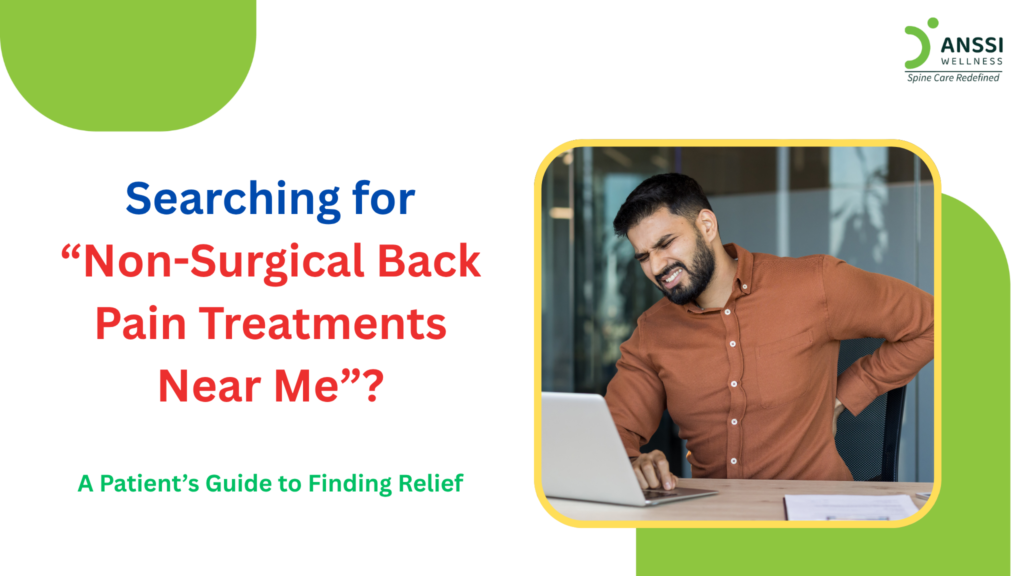
If you have been living with chronic back pain, chances are you have searched online for “non-surgical back pain treatments near me.” The search often comes after months of trying painkillers, physiotherapy, home remedies, or repeated periods of rest without achieving lasting relief.
For many patients, the reason behind this search is straightforward: they want effective treatment without undergoing spine surgery. They may also be concerned about depending on medication for a long period or taking prolonged time away from work and daily responsibilities.
But when choosing a treatment centre, simply finding the closest clinic is not enough. Your search should consider several important factors, including spine expertise, accurate diagnosis, modern non-surgical treatment options and comprehensive rehabilitation.
What Does “Near Me” Really Mean for Back Pain Treatment?
When searching for treatment locally, convenience matters. A nearby clinic can make it easier to attend regular appointments and follow a structured treatment programme.
However, back pain is not a single condition. It can result from muscular strain, spinal joints, disc degeneration, disc bulges, herniated discs, sciatica or spinal stenosis. Therefore, the clinic you choose should have the expertise and facilities to treat the specific cause of your symptoms.
The right question is not only:
“Which back pain clinic is closest to me?”
It should also be:
“Which nearby clinic can accurately diagnose my condition and offer an appropriate non-surgical treatment plan?”
1. Look for Spine Expertise
Chronic back pain can sometimes involve complex structures such as intervertebral discs and spinal nerves. If your pain is persistent, recurrent or associated with symptoms such as leg pain, tingling or numbness, you may need more specialised evaluation than routine pain management.
When comparing local clinics, consider whether they have qualified orthopaedic professionals and trained physiotherapy teams experienced in managing spinal conditions.
It can also be useful to check whether the clinic regularly manages conditions such as:
- Slipped or herniated discs
- Disc bulges
- Sciatica
- Degenerative disc disease
- Spondylosis
- Spinal stenosis
- Chronic neck and back pain
A clinic experienced with disc-related conditions may be better positioned to determine whether your symptoms are related to mechanical pressure on a spinal nerve or another cause.
2. Accurate Diagnosis Should Come Before Treatment
One of the most important criteria when choosing a non-surgical treatment centre is its approach to diagnosis.
Back pain should not automatically be treated based only on where the patient feels pain. A detailed assessment may include your medical history, symptoms, physical examination and neurological evaluation.
If an MRI has already been performed, the report and images may also provide important information about the condition of the spinal discs and surrounding structures.
However, an important point is that an MRI abnormality does not necessarily mean it is the source of your pain. Disc bulges and degenerative changes can sometimes be present in people without significant symptoms.
Therefore, imaging findings should be considered alongside your symptoms and clinical examination.
An accurate diagnosis helps determine whether you are dealing primarily with a muscular problem, disc-related condition, nerve compression or another spinal issue. It also helps prevent inappropriate treatment.
3. Ask About Modern Non-Surgical Treatment Options
Patients searching for “non-surgical back pain treatments near me” are often looking for alternatives to surgery that address more than temporary pain.
One treatment option that may be considered for appropriately selected disc-related conditions is Non-Surgical Spinal Decompression Treatment (NSSDT).
NSSDT uses controlled, computer-regulated decompression forces to place targeted stretching on the affected spinal segment. The objective is to reduce mechanical stress on the affected disc and surrounding structures.
In suitable patients, decompression is designed to create changes in disc loading that can support disc retraction and reduce mechanical irritation around an affected nerve. It can also support disc hydration and improve the environment around the affected spinal segment.
However, Non-Surgical Spinal Decompression Treatment is not a universal treatment for every type of back pain. Its suitability depends on the underlying diagnosis, severity of the condition and individual patient factors.
That is why diagnosis should always come before treatment.
4. Look for Complementary Therapies
An effective non-surgical programme may involve more than one treatment approach.
Physiotherapy can complement spinal care by addressing muscle weakness, restricted mobility and poor movement patterns. Depending on the patient’s condition, rehabilitation may include:
- Core strengthening
- Spinal stabilisation exercises
- Flexibility training
- Posture correction
- Ergonomic guidance
- Movement retraining
- Lifestyle modifications
This comprehensive approach is particularly relevant for people whose back pain is aggravated by long hours of sitting, poor workstation ergonomics, repetitive physical work, or inadequate physical activity.
The goal is not simply to make the patient feel better temporarily but to help them develop healthier movement and activity patterns.
5. Evaluate the Clinic, Not Just Its Location
Once you have shortlisted clinics in your locality, look beyond their distance from your home.
Consider whether the clinic provides:
- Personalised assessment: Your treatment should be based on your specific condition rather than a standard protocol applied to everyone.
- Qualified professionals: Check the qualifications and experience of the doctors and physiotherapists involved in your care.
- Appropriate infrastructure: Modern equipment can be useful, but it should be combined with trained professionals and appropriate treatment protocols.
- Progress monitoring: Your response to treatment should be assessed regularly so that the programme can be modified when necessary.
- Transparent communication: The clinic should explain your diagnosis, treatment options, expected course, and limitations clearly.
Be cautious about clinics promising guaranteed cures or claiming that one treatment can resolve every type of back pain.
When Should You Seek Immediate Medical Attention?
Although many chronic back pain conditions can be managed non-surgically, certain symptoms should never be ignored.
Seek urgent medical evaluation if back pain is accompanied by rapidly progressive weakness, significant loss of sensation, new bladder or bowel dysfunction, or numbness around the groin or saddle area.
These symptoms can indicate serious nerve compression and require prompt medical assessment.
Likewise, persistent or worsening pain should not be managed indefinitely through self-medication.
About ANSSI:
ANSSI Wellness focuses on improving the quality of life for patients suffering from spinal issues, aiming to provide relief where other conventional treatments have failed. Through advanced Non-Surgical Spinal Decompression Treatment, ANSSI is committed to helping patients avoid surgery and recover in a safe, effective, and compassionate environment.
Book Consultation:
Call +91 9004726844 | 9920936844
Visit www.anssiwellness.com
Connect with ANSSI Wellness on LinkedIn, Instagram, and Facebook for expert guidance.
Clinical References:
- Hoy D, Bain C, Williams G, et al. A systematic review of the global prevalence of low back pain. Arthritis & Rheumatism. 2012;64(6):2028-2037.
- Koes BW, van Tulder M, Lin CW, Macedo LG, McAuley J, Maher C. An updated overview of clinical guidelines for the management of non-specific low back pain in primary care. European Spine Journal. 2010;19(12):2075-2094.
- BD 2021 Low Back Pain Collaborators. Global, regional, and national burden of low back pain, 1990-2020, its attributable risk factors, and projections to 2050: a systematic analysis of the Global Burden of Disease Study 2021. Lancet Rheumatol 2023: 5: e316-29.
- Beattie PF., Nelson R., Michener L., Cammarata J., Donely J. Short And Long-Term Outcomes Following Treatment with the VAX-D Protocol for Patients with Chronic, Activity Limiting Low Back Pain. Journal of Orthopaedic & Sports Physical Therapy, Volume 35, Number 1, January 2005.