A slipped disc can turn ordinary movements into painful challenges. Bending, sitting, standing, walking or even sleeping may become difficult when a spinal disc starts irritating a nearby nerve. For residents of Kolhapur, physically demanding work, long two-wheeler commutes, desk-based jobs and age-related spinal changes can all contribute to disc-related problems.
If you have recently been diagnosed with a slipped disc and are currently depending on medication, or have already been advised to undergo surgery, you may be wondering whether there is another option.
For appropriately selected patients, Non-Surgical Spinal Decompression Treatment (NSSDT) is one non-surgical approach worth discussing with a qualified spine professional.
Why Are Slipped Disc Problems Increasing?
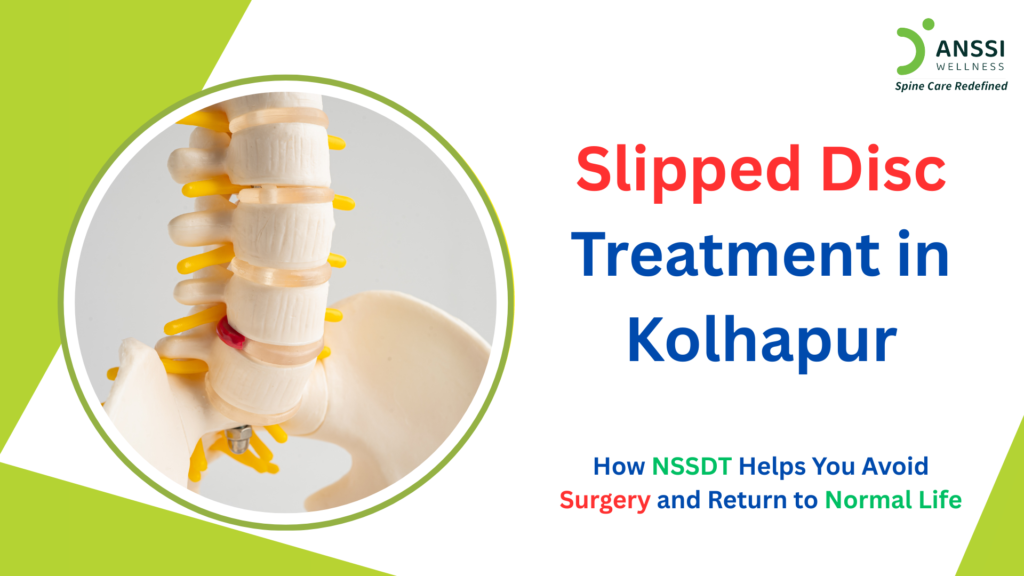
A slipped disc, also called a herniated disc, can develop when the outer portion of an intervertebral disc becomes weakened or damaged, allowing its inner material to protrude.
Several everyday factors may increase stress on the spine.
Physically Demanding Work
Kolhapur has a diverse working population, including people involved in manufacturing, agriculture, construction, transportation and other physically demanding occupations.
Repeated lifting, bending, twisting and carrying heavy loads can place significant stress on spinal discs.
Using incorrect lifting techniques or repeatedly lifting loads beyond one’s capacity may further aggravate an already vulnerable disc.
Two-Wheeler Commuting
Two-wheelers are an important part of daily transportation for many people. Long periods of riding can keep the spine in a sustained posture. Repeated exposure to road vibrations, particularly when combined with poor posture, may aggravate existing back problems.
For someone already experiencing disc degeneration or nerve irritation, prolonged commuting may make symptoms more noticeable.
Desk-Based Work
The problem is not limited to physical labour. Professionals who spend several hours sitting at a desk can also experience spinal stress.
Poor chair support, prolonged sitting, inadequate movement breaks and incorrect screen positioning may contribute to poor spinal alignment. Over time, these factors can aggravate existing cervical or lumbar disc problems.
Age-related disc degeneration, excess weight, weak core muscles and inadequate physical activity can add further stress.
How Does a Slipped Disc Cause Pain?
The spine contains flexible discs between individual vertebrae. These discs act as cushions and help the spine absorb mechanical forces.
When the outer disc structure weakens, the inner material may protrude outward. If the protrusion comes into contact with a nearby spinal nerve, it can cause symptoms beyond the spine itself.
Depending on the location of the affected disc, patients may experience:
- Lower back or neck pain
- Pain radiating into the buttock or leg
- Shoulder or arm pain
- Tingling sensations
- Numbness
- Muscle weakness
- Difficulty bending or walking
For example, lumbar disc herniation can irritate a nerve responsible for symptoms travelling down the leg, commonly described as sciatica.
An MRI can provide valuable information about the condition of the discs. However, an important point is that not every disc bulge seen on an MRI is responsible for pain. Imaging findings need to be correlated with the patient’s symptoms and clinical examination.
Why Doesn’t Medication Always Provide Lasting Relief?
Painkillers and anti-inflammatory medications can be useful when prescribed appropriately. They may reduce pain and inflammation and help a patient function during an acute episode.
However, medication generally does not physically remove a disc herniation or directly restore a damaged disc. This is why some patients experience a familiar cycle: pain decreases while medication is being taken, but returns once its effect wears off.
Long-term use of certain medicines can also involve potential side effects, including gastrointestinal, kidney or cardiovascular complications. Therefore, medication should always be used according to professional medical advice.
The objective should not be to avoid all medication at any cost. Instead, patients should understand whether their treatment is addressing the underlying cause of their symptoms.
Is Surgery Always Necessary?
Surgery can be highly important in certain situations, particularly when there is severe or progressive neurological impairment or an emergency such as cauda equina syndrome.
For selected patients, procedures such as discectomy can remove the portion of disc material compressing a nerve.
However, surgery is still an invasive intervention and can involve risks such as infection, nerve injury, recurrent disc herniation, scar tissue formation and persistent symptoms after surgery.
Recovery may also require restrictions on work and physical activity.
Therefore, when surgery is not medically urgent, some patients may reasonably wish to explore appropriate non-surgical options first.
How Does NSSDT Work?
Non-Surgical Spinal Decompression Treatment (NSSDT) uses computer-controlled decompression forces to apply carefully regulated loading to the affected spinal segment.
The treatment is designed to create changes in mechanical pressure within the affected disc. In appropriately selected disc-related conditions, this controlled decompression may encourage disc retraction and help reduce mechanical irritation around a compressed nerve root.
The approach also aims to support disc hydration and improve the mechanical environment around the affected spinal segment.
In simple terms, NSSDT attempts to address the mechanical component of disc-related pain rather than simply masking the sensation of pain.
Importantly, NSSDT is not the same as ordinary traction and is not suitable for every patient with a slipped disc. A professional assessment is necessary before treatment is recommended.
NSSDT Works Best as Part of Comprehensive Care
Spinal decompression may be combined with rehabilitation strategies designed around the patient’s individual needs.
Physiotherapy can include:
- Core-strengthening exercises
- Spinal stabilisation
- Flexibility training
- Posture correction
- Ergonomic guidance
- Safe lifting techniques
- Movement and activity education
These measures can help patients improve the muscular support around the spine and reduce unnecessary mechanical stress during everyday activities.
Who May Benefit From NSSDT?
NSSDT may be considered for appropriately selected patients experiencing disc-related conditions such as:
- Lumbar or cervical disc herniation
- Slipped disc
- Disc bulge
- Disc-related sciatica
- Degenerative disc disease
Suitability depends on the individual’s symptoms, physical and neurological examination, MRI findings and overall health.
Patients with severe progressive weakness, significant neurological deterioration or bladder and bowel changes require prompt medical assessment rather than delaying necessary treatment in favour of any non-surgical approach.
About ANSSI:
ANSSI Wellness focuses on improving the quality of life for patients suffering from spinal issues, aiming to provide relief where other conventional treatments have failed. Through advanced Non-Surgical Spinal Decompression Treatment, ANSSI is committed to helping patients avoid surgery and recover in a safe, effective, and compassionate environment.
Book Consultation:
Call +91 9004726844 | 9920936844
Visit www.anssiwellness.com
Connect with ANSSI Wellness on LinkedIn, Instagram, and Facebook for expert guidance.
Clinical References:
- Hoy D, Bain C, Williams G, et al. A systematic review of the global prevalence of low back pain. Arthritis & Rheumatism. 2012;64(6):2028-2037.
- Kreiner DS et al. North American Spine Society. An evidence-based clinical guideline for the diagnosis and treatment of lumbar disc herniation with radiculopathy. Spine J. 2014 Jan;14(1):180-91.
- Yasuma, T; Koh, S; Okamura, T; Yamauchi, Y. Histological changes in aging lumbar intervertebral discs. Their role in protrusions and prolapses.. The Journal of Bone & Joint Surgery 72(2):p 220-229, Feb 1990.
- Koes BW, van Tulder MW, Peul WC. Diagnosis and treatment of sciatica. BMJ. 2007;334(7607):1313-1317.
- Gose E., Ph.D, Naguszewski W., MD, Naguszewski R., MD. Vertebral Axial Decompression Therapy for Pain Associated with Herniated or Degenerated Discs or Facet Syndrome: An Outcome Study. Journal of Neurological Research, Volume 20, No 3, April 1998.
- Ramos G., MD, Martin W., MD. Effects of Vertebral Axial Decompression On Intradiscal Pressure. Journal of Neurosurgery 81: 350-353, 1994.