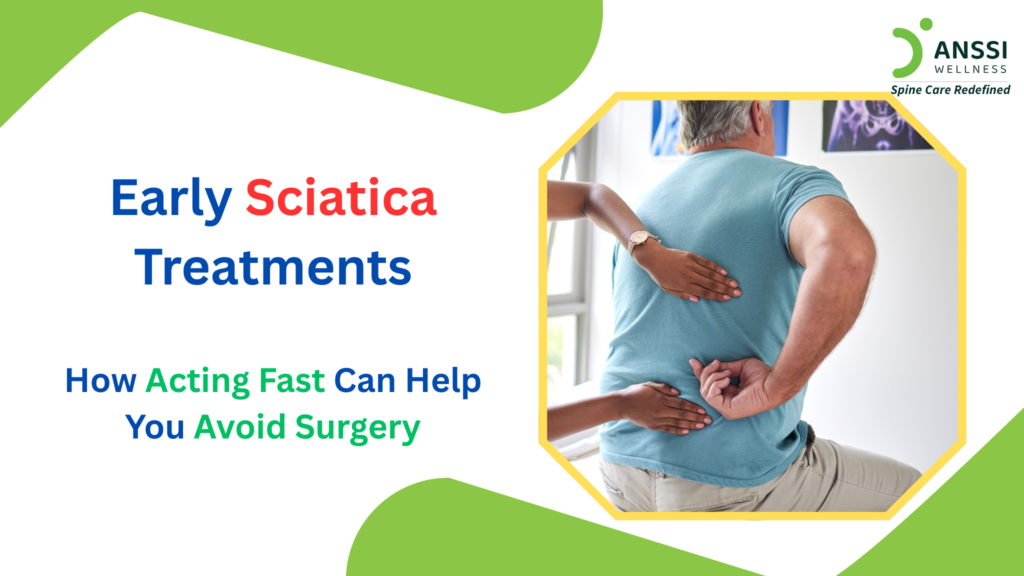
Ignoring sciatica symptoms could lead to permanent nerve damage and inevitable surgery. Discover why early diagnosis, specialist consultation, and Non-Surgical Spinal Decompression Treatment (NSSDT) is the fastest, safest path to lasting sciatica relief in India, without surgery or long-term medication.
It starts as an occasional twinge, a sharp, shooting pain that flares down one leg when you stand up too quickly or sit for too long. You assume it will pass. You take a painkiller, rest for a few days, and carry on. After all, back pain is common. Everyone gets it at some point.
But sciatica is not ordinary back pain. And the habit of waiting for it to resolve on its own, one of the most widespread and damaging responses to this condition, is precisely what transforms a treatable early-stage problem into a chronic, debilitating condition that eventually demands surgical intervention.
Here is the critical reality that every sciatica sufferer needs to understand: the single most powerful factor in avoiding sciatica surgery is not which treatment you choose, but how quickly you seek the right treatment. The window for effective non-surgical intervention is real; it is wide at the beginning, and it narrows significantly with every week of delay.
What is Sciatica and Why Does It Progress?
The sciatic nerve is the longest nerve in the human body, originating from nerve roots in the lumbar spine and travelling through the buttock, down the back of the thigh, and all the way into the foot. When any structure in the lumbar spine, such as a herniated disc, a bone spur, a narrowed spinal canal, or a misaligned vertebra, compresses one of the nerve roots that feeds into the sciatic nerve, the result is sciatica: radiating pain, numbness, tingling, or weakness that follows the nerve’s entire pathway.
Sciatica progresses through recognisable stages.
- In its earliest form, symptoms are intermittent, triggered by specific positions or activities and relieved by rest.
- Without structural treatment, the compression deepens. Symptoms become more frequent, more severe, and less responsive to positional changes.
- Eventually, the nerve sustains inflammatory damage that generates constant, burning pain regardless of position.
- In the most advanced stage, prolonged compression causes permanent structural changes to the nerve itself, irreversible damage that no treatment can fully reverse.
The reason sciatica rarely resolves without proper intervention is straightforward:
- The structural cause of compression, the herniated disc, the bone spur, and the narrowed foramen, does not correct itself.
- Painkillers reduce the brain’s perception of the signal. They do nothing to remove the source of the compression. While the patient experiences temporary relief, the underlying problem silently worsens.
The Serious Life Impact of Untreated Sciatica
The consequences of untreated sciatica extend far beyond physical pain. Chronic sciatic nerve pain systematically dismantles quality of life across every dimension.
- Sleep becomes impossible in many positions.
- The inability to sit comfortably for extended periods threatens careers in desk-based professions.
- Simple activities, such as driving, grocery shopping, and playing with children, become ordeals.
- Progressive leg weakness and the development of foot drop, the inability to lift the front of the foot due to nerve signal failure, can make walking itself hazardous.
The psychological toll is equally severe. Chronic, unresolved pain is one of the leading drivers of anxiety and depression, and sciatica patients who have been suffering for months or years without effective treatment frequently experience significant mental health deterioration alongside their physical decline.
Most critically, there is a neurological point of no return. Prolonged compression of a lumbar nerve root causes axonal damage and structural injury to the nerve fibres themselves, which results in persistent numbness, permanent weakness, and chronic pain that persists even after the compression is eventually relieved.
When a patient reaches this stage, surgery becomes not merely an option but a necessity, and its outcomes are far less predictable than they would have been had intervention occurred earlier.
Why Early Diagnosis Makes All the Difference
The journey toward effective sciatica treatment begins with one non-negotiable step: accurate diagnosis by a specialist, not a general physician managing symptoms empirically.
A specialised spine or orthopaedic doctor brings an entirely different level of diagnostic expertise to the assessment. A thorough neurological examination, testing reflexes, dermatomal sensation patterns, and motor strength in the lower limbs, establishes the clinical picture. The straight leg raise test, along with other specific provocative tests, helps confirm sciatic nerve involvement and identify the affected nerve root level.
The single most important investigation is an MRI of the lumbar spine. Unlike X-rays, which show only bony structures, MRI reveals the soft tissue detail that determines the entire treatment pathway: the size and location of disc herniation, the degree of foraminal narrowing, the condition of the spinal canal, and critically, the extent of nerve root compression and any associated inflammatory changes. This information is not optional; it is the clinical foundation upon which every treatment decision must be built.
Identifying the specific structural cause of sciatic nerve compression, whether it is a disc herniation, lumbar spinal stenosis, spondylolisthesis, or piriformis syndrome, is equally essential because each cause has a different optimal treatment approach. A patient treated for a disc herniation who actually has piriformis syndrome will not improve. A patient whose stenosis is managed as a muscular problem will deteriorate.
The danger of self-diagnosis and prolonged painkiller use without specialist assessment cannot be overstated. Every month spent managing symptoms without identifying and addressing their structural cause is a month in which the underlying compression progresses, nerve damage accumulates, and the chance of avoiding surgery diminishes.
Non-Surgical Treatment Options That Can Help You Avoid Surgery
Once an accurate diagnosis has been established, the question becomes: which treatment most effectively addresses the structural root cause of sciatic nerve compression, without surgery?
Non-Surgical Spinal Decompression Treatment (NSSDT)
It is the most structurally targeted non-surgical treatment available for lumbar nerve root compression of any cause.
- Using a precisely calibrated, computer-controlled decompression table, NSSDT applies a carefully sequenced decompression mechanism to the lumbar spine, creating negative intradiscal pressure within the affected disc.
- This vacuum effect draws herniated disc material back towards its natural position, directly relieving the compression on the sciatic nerve root.
- Simultaneously, the restoration of disc height widens the foraminal canal through which the nerve exits the spinal canal, providing additional decompressive relief.
- The negative pressure also draws oxygen, water, and healing nutrients back into the dehydrated disc, supporting genuine biological recovery rather than simply masking symptoms.
For early-stage sciatica, this mechanism is transformatively effective. The disc has not yet lost significant height. The nerve has not yet sustained axonal damage. The herniated material is still retractable. NSSDT applied at this stage can achieve complete structural correction, resolving the compression, healing the disc, and eliminating the sciatic pain, in a treatment course that requires no hospitalisation, no surgery, no medicines, and no side effects.
Targeted physiotherapy
It plays a valuable complementary role, addressing the postural dysfunction, muscular imbalances, and movement patterns that contributed to the disc herniation or nerve compression in the first place. However, physiotherapy alone cannot retract a herniated disc or widen a narrowed foramen. Its power lies in consolidating and maintaining the structural improvements achieved through NSSDT, not in achieving them independently.
Short-term anti-inflammatory management
It can appropriately reduce the acute inflammatory component of nerve root irritation during the early phase of treatment, making decompression treatment more comfortable and effective. It is a useful adjunct when used judiciously, not a long-term solution, and not a substitute for structural treatment.
Lifestyle and postural modification
Correcting sitting posture, adjusting workstation ergonomics, avoiding stressful movements, and maintaining a healthy body weight reduce the compressive mechanical load on the lumbar spine during recovery and form the foundation of long-term relapse prevention.
References:
- Rahman MM, Ferdous N, Hasan MM, Sarker S, Farhad S. Exploring Rafe’s Sciatica: Investigating the Link Between Spondyloarthropathy and Non-discogenic Sciatica. Cureus. 2025 Sep 15;17(9):e92405. doi: 10.7759/cureus.92405. PMID: 41111649; PMCID: PMC12527974.
- Ramos G., MD, Martin W., MD. Effects of Vertebral Axial Decompression On Intradiscal Pressure. Journal of Neurosurgery 81: 350-353, 1994.
- Naguszewski W., MD, Naguszewski R., MD, Gose E., Ph.D. Dermatosomal Somatosensory Evoked Potential Demonstration of Nerve Root Decompression After VAX-D Therapy. Journal of Neurological Research Vol 23 , No 7, October 2001.
About ANSSI:
ANSSI Wellness focuses on improving the quality of life for patients suffering from spinal issues, aiming to provide relief where other conventional treatments have failed. Through advanced Non-Surgical Spinal Decompression Treatment, ANSSI is committed to helping patients avoid surgery and recover in a safe, effective, and compassionate environment.
Book Consultation:
Call +91 9004726844 | 9920936844
Visit www.anssiwellness.com
Connect with ANSSI Wellness on LinkedIn, Instagram, and Facebook for expert guidance.